As an Amazon Associate, Ordinary Prepper earns from qualifying purchases. Prices last checked October 22, 2026.
Home Readiness — Guide
Beginner Deep Pantry: Your First 30 Days of Food, Priced Out
A real first 30 days of food for one person costs about $60 at a grocery store, or more if you buy it as a kit — and the best-known kit’s price could not be verified on Amazon today — and the kit route needs a warning label the boxes do not carry. Thirty days at a normal 2,000 calories a day is 60,000 calories. Counted that way, the grocery staples below deliver about 93,000 calories for roughly $60 — a month, with half again left over. The best-known “30-day” kit on this page, counted the same way, holds 36,600 calories: eighteen full days, not thirty. Nothing here is dishonest food. The serving counts are just doing marketing work that calories undo in one division. This page prices all four routes the same way — total calories, real days, cost per day of eating — so a beginner can build the cheap base first and add freeze-dried food where it actually helps. The food storage calculator runs the same math for your household size.
How we researched this comparison
We scored 4 routes to 30 days of food — one grocery-staples route and three ready-made kits — judged on the same honest math: 30 days is 60,000 calories for one person at 2,000 a day. The scores rest on the makers’ published serving and calorie figures, on prices checked on October 22, 2026 (two kits had no verifiable price that day, so none is printed), and on verified-owner feedback for the kits, in samples of several thousand reviews named below. The grocery route is priced from a real basket of staples, not from reviews. We never claim hands-on testing, and affiliate commissions are checked only after scores are set — the full method, with the scoring weights, is on our how we research and score page.
The Grocery Staples Route
Rice, beans, oats, peanut butter, pasta, flour and oil: about 93,000 calories, roughly $1.30 per day of eating, in food your house already knows how to cook and will rotate.
Augason Farms Deluxe 30-Day Food Supply
200 servings and 36,600 calories in one pail — the most food in any kit here. But that is 1,220 calories a day stretched over 30 days, and most of it needs real cooking.
Mountain House Classic Bucket
Real meat, the best reputation in freeze-dried food, and a 30-year taste guarantee — in a bucket holding about 3 days of full eating. A taste-first starter, not a month.
ReadyWise 120 Serving Entrée Bucket
Thirteen entrées, just add water, no pot to wash. Also the thinnest calories here per serving, with the salt and low protein owners keep flagging.
If you buy through a link in this section, we may earn a commission from the seller. It never costs you extra, and it never changes a score.
How much does 30 days of food cost, counted honestly?
Counted in calories — the only unit your body spends — the four routes look like this. A “day” in this table is 2,000 calories for one adult. Kit calorie totals are the manufacturers’ own figures; the staples total is built from standard nutrition values for each dry ingredient, and its prices are store-brand grocery prices checked this month, which vary by store and region.
Real days of eating per route (one adult, 2,000 cal/day — total calories divided by 2,000, the makers’ own calorie figures): grocery staples route about 46 days · Augason Farms Deluxe 30-Day about 18 days · ReadyWise 120-serving bucket about 12 days · Mountain House Classic Bucket about 3 days — $134.49.
Cost per day of eating: About $1.30 for staples against about $39.90 for the Mountain House bucket. Two kits had no verifiable price on October 22, 2026, so no cost per day is shown for them.
| Route | Total calories | Real days at 2,000 a day | Cost per day of eating | Price |
|---|---|---|---|---|
| The Grocery Staples Route (no single link — it is a shopping list) | About 93,000 | About 46 | About $1.30 | About $60 in groceries |
| Augason Farms Deluxe 30-Day Food Supply | 36,600 | About 18 | — | Price not verified today |
| ReadyWise 120 Serving Entrée Bucket | About 24,960 | About 12 | — | Price not verified today |
| Mountain House Classic Bucket | 6,740 | About 3 | about $39.90 | $134.49 |
Prices last checked: October 22, 2026.
Read the table the way a beginner should: the staples route is not a little cheaper, it is many times cheaper per day of eating — the premium bucket below runs about $39.90 a day, and it is the only route that reaches 30 days without buying multiples. The kits earn their money somewhere else — shelf life measured in decades, no cooking skill required, a bucket you can hand to a house-sitter or a college kid. The sensible first pantry is both, in that order: staples for the base, one kit for the days nobody can face a pot of beans. Week two of the first-month guide sequences it exactly that way.
Augason Farms Deluxe 30-Day Food Supply
Why this one: The most food in any kit here: 200 servings and 36,600 calories in one pail. Counted honestly that is 1,220 calories a day stretched over 30 days — eaten at a full 2,000 a day, the pail is about 18 days of food, and still the best kit value on the page.
What does 30 days of food actually cost if you build it from grocery staples?
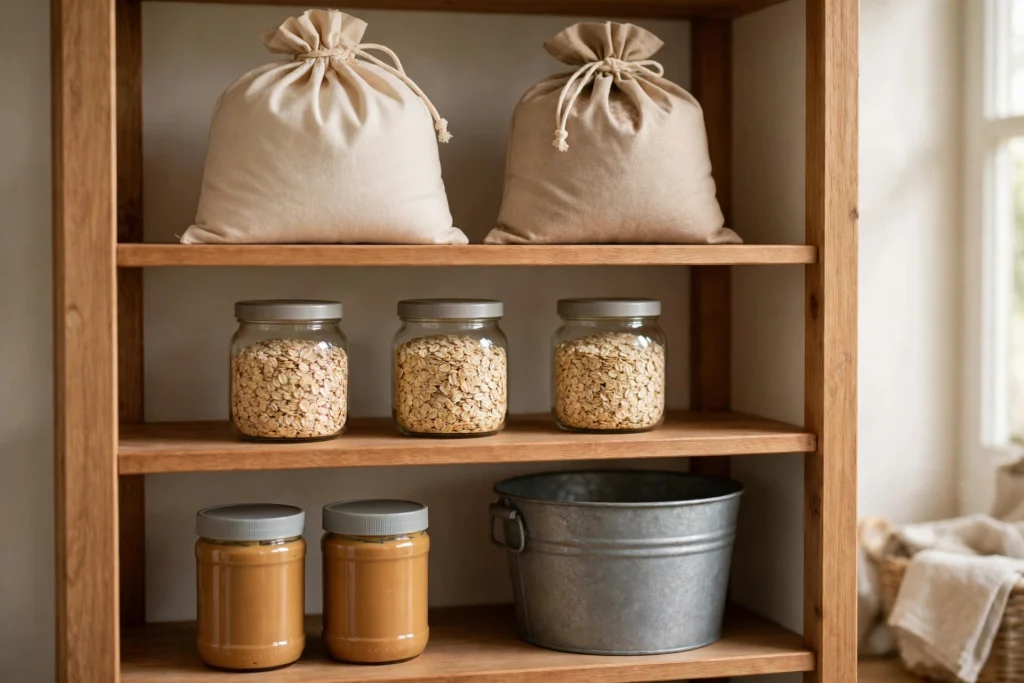
About $60, for more than 30 days. The basket we priced this month: 20 pounds of long-grain rice, 12 pounds of dry pinto beans, 10 pounds of oats, 5 pounds of peanut butter, 6 pounds of pasta, plus flour, cooking oil, sugar, salt and bouillon to make it all cookable and worth eating. At store-brand prices those lines came to about $60.51 — rice at $3.37 for 5 pounds, peanut butter at about $4.18 for 40 ounces, oats at about $4.18 for 42 ounces. Count just the five main lines and the calories come to roughly 93,000 — rice and beans doing the heavy lifting, peanut butter carrying the calorie density — before the flour, oil and sugar add thousands more that we did not count, to keep the number honest. That is about $1.30 per 2,000-calorie day, and it is food with a second job: all of it rotates into normal meals, so the pantry renews itself instead of expiring in a closet. Buy it if you are starting from zero — almost every beginner should. The honest costs are effort and shelf life: dry staples keep 6 to 24 months in their bags, years only if you repackage them into buckets or mylar with oxygen absorbers, and every meal needs water and a way to boil it. There is no buy button on this card, on purpose: a shopping list is not a product, and the grocery store beats any link we could give you.
The 30-day basket, in pounds
The five main lines of the grocery basket — together roughly 93,000 calories, before the flour, oil and sugar add thousands more.
Is the Augason Farms 30-day kit really 30 days?
Only if a day means 1,220 calories. The Deluxe 30-Day supply (item 5-20091) holds 200 servings and 36,600 calories across 11 varieties — oatmeal, pancakes, creamy wheat, rice dishes, soups and a whey milk drink — in 24 pouches in a pail, with a shelf life of up to 25 years and a meal planner that rations it across the month. Rationing is the right word: an active adult on 1,220 calories a day is hungry by day three and losing weight by week two. Eaten at a full 2,000 a day, the pail is about 18 days of food — still the most complete kit here, and the best kit value on the page — but its Amazon price could not be verified at this check, so no cost per day is printed for it; run the calorie division on whatever price the listing shows you before judging it. On Amazon the pail holds 4.5 stars across 3,115 reviews. Two more things owners and testers agree on: most of these meals are not “just add water” in the Mountain House sense — they simmer, some for 20 minutes or more, which means a stove, a pot, and fuel for a month of cooking; and the prepared entrées get mixed taste reviews, while Augason’s single-ingredient staples (the rice, the milk, the fruit) get genuinely good ones. One trap to check before buying: Augason sells other “30-day” kits with different contents rated near 1,850 calories a day. Same brand, same claim, different box — read the total calories on the exact item, not the day count on the front. Buy it if you want one purchase that covers most of a month’s base and you can cook. Skip it as a literal 30-day plan unless a staples basket is going underneath it — which, priced out, is exactly what we recommend.
The Augason pail — 30 days only at a ration: 200 servings, 36,600 calories in total — about 18 days eaten fully. Spread over 30 days it is 1,220 cal a day against a full day’s 2,000 cal.
What that feels like: An active adult on 1,220 calories a day is hungry by day three. Check other Augason “30-day” kits individually — some are rated near 1,850 calories a day.
Which bucket tastes best if you only need a few days?
The Mountain House Classic Bucket, and owners have said so for years. It is 12 pouches — beef stew, beef stroganoff, chicken fried rice, spaghetti with meat sauce, granola with milk and blueberries — made with real meat, no artificial flavors or colors, ready in under 10 minutes with water added straight to the pouch, and covered by Mountain House’s 30-year taste guarantee, the longest in the business. On Amazon the bucket holds 4.8 stars across 4,448 reviews. Now the arithmetic that keeps it honest: the bucket holds 6,740 calories by its spec sheet. That is about 3 days at 2,000 calories — a long weekend. At this check it was $134.49 at Amazon — about $39.90 for each of its roughly three full days of eating, the most expensive day of eating on this page, which is part of the point of including it. Nobody should buy it as a month of food, and Mountain House’s own 30-day kit is a different, much larger product. Buy the Classic Bucket as the taste test and the three-day layer: the food a nervous household will actually eat during a bad week, and the benchmark that tells you whether freeze-dried meals work for your family at all before real money follows. Skip it as a deep pantry — at this cost per calorie, a month of Mountain House for a family is a four-figure sentence.
From the bucket to the meal, in the pouch: The bucket (12 pouches · 5 dishes) → in the pouch (add water straight in) → ready (under 10 minutes). Eat from the pouch — no pot, no simmering.
The bucket’s math: 6,740 calories in the bucket ≈ 3 full days at 2,000 a day. Covered by Mountain House’s 30-year taste guarantee.
Relevant pickMountain House Classic Bucket
Real meat, the best reputation in freeze-dried food, and a 30-year taste guarantee — in a bucket holding about 3 days of full eating. A taste-first starter and the benchmark for whether freeze-dried works for your family, not a month of food.
6,740 calories · About 3 full days · 30-year taste guarantee
How long does a ReadyWise 120-serving bucket really last?
About 12 days for one person eating fully — the clearest servings-versus-calories lesson on the page. The bucket holds 120 servings of 13 entrées (cheesy lasagna, pasta alfredo, stroganoff, teriyaki rice, southwest rice and beans, and their relatives) in a stackable grab-and-go pail with a 25-year shelf life, and it is genuinely the easiest food here: add water, wait, eat, no simmering and no pot. But the servings average roughly 208 calories each, so the bucket totals about 24,960 calories. We could not verify a current Amazon price for it today — its price history swings hard enough that a stale number would mislead — so this page prints none; run the calorie division on whatever price the listing shows you before judging it. The pattern in owner feedback is consistent enough to print: the convenience praised, the nutrition questioned — meals are carbohydrate-heavy, the meat is mostly “chicken-flavored” rather than chicken, protein runs low, sodium runs high, and more than one owner reports being hungry again within a couple of hours. On Amazon the bucket holds 4.5 stars across 10,536 reviews. Buy it if the priority is food a tired person can make with a kettle on the worst day of the year, priced as a two-week layer. Skip it as a standalone month, and skip it for anyone watching sodium.
Calories: one serving against one full day
120 servings totalling about 24,960 calories is about 12 days of full eating for one person — the servings-versus-calories lesson in one picture.
Servings or calories: which number should you trust?
Calories, every time. A serving is whatever a manufacturer says it is — 208 calories at ReadyWise, about 183 per serving in the Augason pail, about 280 in a Mountain House pouch — so serving counts cannot be compared across brands, and “days” claims built on them inherit the fudge. The conversion that cuts through all of it fits on an envelope: total calories, divided by 2,000, equals real days for one adult. Run it on any kit before you buy, including the ones on this page. It is also why the food storage calculator asks for people and days and answers in pounds and calories, not servings.
What are the honest caveats?
Five. First, every route on this page needs water and heat: the kits need roughly a cup of water per serving and the staples need far more — dry beans are not food until they have soaked and boiled, so this pantry pairs with the water storage we compared and a way to cook without the grid, not with a bare shelf. Second, kit calorie totals come from the manufacturers, and listings disagree with each other more than they should — Mountain House’s own bucket appears at 6,120 calories in one preparedness source and 6,740 in its spec table; we used the spec table and flagged the gap rather than split it. Third, grocery prices move: the $60 basket was priced from store-brand listings this month and will run $55 in one town and $75 in another — the ratio against the kits survives any of those numbers. Fourth, sodium: freeze-dried entrées across brands run high, which matters for blood pressure and for the water budget, since salty food makes thirsty people. Fifth, shelf-life claims (“up to 25 years”) assume cool, dark storage around 55–70 degrees; a hot garage takes years off every figure on this page, kits and staples alike.
Three more worth a look
Not reviewed or scored — listed because readers cross-shop them, with the same disclosure as everything here.
Peak Refuel Basecamp Bucket 3.0
The premium freeze-dried bucket — real meat and roughly double the protein of standard kits, at a premium price to match.
ReadyWise 120 Serving Breakfast Bucket
The breakfast half of the ReadyWise system — oatmeal, granola and eggs — for households whose entrée bucket needs a morning.
Augason Farms 72-Hour 1-Person Kit
The small Augason pail — about 2,600 calories a day for 3 days by the maker’s count — as a car or office kit, or a first taste of the brand.
As an Amazon Associate, Ordinary Prepper earns from qualifying purchases. The three products above have not been reviewed or scored.
Frequently asked questions
How much food do I need for 30 days?
About 60,000 calories per adult — 2,000 calories a day for 30 days. In staples that is roughly 35 to 40 pounds of dry food per person: rice, beans, oats and the calorie-dense extras like peanut butter and oil. Children and smaller adults need less; plan teenagers like adults.
How much does a 30-day emergency food supply cost?
Built from grocery staples, about $60 per person buys roughly 93,000 calories — more than the month. Bought as kits, the same full month means an Augason pail bought nearly twice over, and far more in premium freeze-dried brands. Cost per day of eating is the number to compare: about $1.30 for staples against about $39.90 for the Mountain House bucket — and two of the three kits on this page had no verifiable Amazon price today, which is worth knowing before anyone shops on serving counts alone.
What foods should a beginner buy first?
The ones your house already eats: rice, dry beans or lentils, oats, pasta, peanut butter, flour, oil, salt and bouillon. Add them a bag or two per grocery trip, store them dry and cool, and rotate them into normal meals. Freeze-dried kits come second, as the no-cooking layer.
How long does emergency food last?
Freeze-dried kits claim up to 25 years (30 for Mountain House’s taste guarantee) in cool, dark storage. Dry staples last 6 to 24 months in their original bags and years repacked in mylar or buckets with oxygen absorbers. Canned food runs 1 to 5 years. Heat shortens every one of those numbers.
How long each layer keeps (cool, dark storage): staples in their bags 6–24 months · canned food 1–5 years · freeze-dried kits up to 25 years · Mountain House taste guarantee 30 years.
The storage caveat: Shelf-life claims assume storage around 55–70°F — a hot garage takes years off every figure.
Is freeze-dried food worth the money?
For a few days of no-cooking insurance, yes — it is light, lasts decades, and needs only water. As a whole month of eating, it costs many times the staples route per day — about thirty times for the premium bucket on this page. Most households land in the middle: staples for the base, a few days of freeze-dried on top.
Do I need special storage containers?
Not to start. The original bags in a cool, dark cupboard cover the first months. When the pantry outgrows the cupboard, food-grade buckets with gamma lids, or mylar bags with oxygen absorbers inside those buckets, are the standard step up — storage is what turns months of shelf life into years.
Which route should you choose?
Choose the staples basket if you are starting from zero — it is the only route that reaches a true 30 days on a beginner’s budget, and it should go in first whatever else follows. Add the Augason pail if you want a sealed, decades-long layer that covers most of a month’s base in one purchase and your house can simmer food. Choose the Mountain House Classic Bucket as your three-day, best-taste layer — or as the taste test before committing to any brand. Choose the ReadyWise entrée bucket if the worst-day scenario is a kettle and no patience, and count it as twelve days, not a month. Then size the whole shelf with the food storage calculator, store the water to cook it with from the Water hub, and see the rest of this shelf on the Food hub.
Talk it over with other homeowners. If your first deep pantry is going in this month, bring your list — what your family will actually eat for thirty days is the part of this decision no price table can settle for you. The Ordinary Prepper Community on Facebook is where readers compare outage plans, show their setups, and help decide what we research next. Join the group →