As an Amazon Associate, Ordinary Prepper earns from qualifying purchases.
Home Readiness — Guide
What Radio Station or Channel Do You Listen to in a Blackout?
Short answer: There is no single blackout channel, and that is the part nobody tells you. Weather and official warnings live on NOAA Weather Radio — seven channels from 162.400 to 162.550 MHz, one of which is your local transmitter. Local news, road closures, and shelter information live on your regular AM and FM stations, which carry Emergency Alert System messages. Neighbours and family nearby talk on FRS channels 1–22, which need no licence. This page is the chart to tape inside a kitchen cupboard: what to tune to, in what order, and what each one can actually tell you.
First, the listening chart
| What you want | Tune to | Licence? | What you get |
|---|---|---|---|
| Weather warnings | NOAA Weather Radio, 162.400–162.550 MHz | None to listen | Watches, warnings, forecasts |
| Local emergency news | Your local AM/FM news stations | None to listen | EAS alerts, closures, shelters |
| Family nearby | FRS channels 1–22 | None | Talk within a mile or two |
| Family, more range | GMRS, same 22 channels | FCC licence, $35 | More power, repeaters |
| Ham traffic | 146.52 MHz and local repeaters | None to listen | Local nets, damage reports |
Read the chart in order. In a storm blackout, NOAA comes first because weather is usually the thing still trying to hurt you. Local AM/FM comes second because it answers the questions weather radio does not: which roads are closed, where the warming shelter opened, when the water is safe. The two-way channels come last, because they are for talking, not for information — and in the first hours, information is worth more.
Three separate bands on the dial — a normal AM/FM set cannot reach the NOAA band at all
AM broadcast — local news; travels much farther at night
FM broadcast — local news and EAS messages
NOAA Weather Radio — 162.400–162.550 MHz; needs a weather-band receiver
Midland WR120B Weather Radio
Why this one: The set our outage pillar already points readers to, for the reasons this chart gives: it only sounds for your county, carries a loud alert alarm, and runs on wall power with AA batteries behind it for the outage itself. A listener, not a talker — pair it with FRS handsets for the family channels.
NOAA Weather Radio: the seven channels
NOAA Weather Radio All Hazards is a network of more than 1,000 transmitters run by the National Weather Service, broadcasting around the clock. It does not come in on a normal radio. An ordinary AM/FM set cannot reach these frequencies at all — you need a receiver with the weather band, which is the first thing to check on any radio you already own.
NOAA Weather Radio: the seven channels — step through all seven; the clearest voice, naming your county, is yours
WX1 162.400 · WX2 162.425 · WX3 162.450 · WX4 162.475 · WX5 162.500 · WX6 162.525 · WX7 162.550 MHz
Broadcast from 1,000+ transmitters; range roughly 40 miles on flat ground
Write your channel on the radio.
| Channel | Frequency | Notes |
|---|---|---|
| WX1 | 162.400 MHz | One of seven — yours is one of these |
| WX2 | 162.425 MHz | Step through all seven |
| WX3 | 162.450 MHz | The clearest voice wins |
| WX4 | 162.475 MHz | Usually one strong local signal |
| WX5 | 162.500 MHz | Others will be weak or silent |
| WX6 | 162.525 MHz | Range is roughly 40 miles, flat ground |
| WX7 | 162.550 MHz | Write your channel on the radio |
You do not memorise the list. On a calm day, you step through the seven, find the one that comes in clear and names your county in its forecast, and that is your channel — the National Weather Service publishes each county’s transmitter and frequency at weather.gov, under NOAA Weather Radio coverage. Write it on a sticker on the radio itself. At 2 a.m. in a blackout, nobody should be hunting a website that will not load.
The feature that makes a weather radio worth owning instead of merely nice is SAME — Specific Area Message Encoding. Every county has a six-digit SAME code. Program yours in, and the radio stays quiet through warnings for counties two hours away, then sounds its alarm only when a warning covers you. Without SAME, a radio in storm country cries wolf all night, and owners do the predictable thing: they unplug it. Program the code once, on the calm day, and test it during the Wednesday test broadcast most offices run late morning.
Local AM and FM: where the local answers live
The Emergency Alert System is the chain that lets federal, state, and local authorities interrupt broadcast radio and TV. In a blackout, your local news and talk stations are the ones carrying it — plus the running local detail no national feed has: the boil-water notice, the road that flooded, the school gym that opened as a shelter. AM deserves a special word here. AM signals travel much farther at night, and big AM news stations can be heard across several states after dark. If your local stations are down with the same outage, a distant AM station in a city that still has power may be the first voice you find.
The Emergency Alert System chain — how an official warning reaches a household radio
Authorities (federal · state · local) → broadcast stations (your local AM / FM) → household radio (battery or hand-crank)
AM at night: big news stations can be heard across several states.
The catch is that “your local station” has to be decided before the outage. Most households cannot name the station they would turn to, and a car radio preset list is not a plan if the car is in a closed garage. Pick two — one FM, one AM — write their frequencies on the same cupboard chart, and make sure your battery radio can sit somewhere in the house where they actually come in. Basements are where radios go to be useless; a kitchen windowsill usually beats them.
FRS and GMRS: the talking channels
Listening gets you information. Talking to the people two streets away is a different job, and it belongs to the little handheld radios sold in blister packs everywhere. The Federal Communications Commission runs two services on the same 22 channels, in the 462 and 467 MHz bands, and the radios talk to each other fine. The difference is the rules, not the dial.
Power limits, by service and channel
Watts. FRS and GMRS share the same 22 channels — the rules and the power are the difference, not the dial. FRS channels 8–14 are the half-watt channels (0.5 W).
| Service | Channels | Licence | Limits |
|---|---|---|---|
| FRS | 1–22 | None | 2 watts max, fixed antenna |
| GMRS | 1–22, plus repeaters | $35, 10 years, no test | Up to 5 watts handheld |
FRS — the Family Radio Service — is licence-free, which is why it is the right default for a family set: hand one to anybody, including the teenager and the neighbour, and it is legal the moment it is switched on. Channels 8–14 are the low-power half-watt channels; channels 1–7 and 15–22 carry the full FRS power. GMRS uses the same channels at higher power, with removable antennas and repeater access — a repeater on a hilltop re-sends your signal across a county. That step up costs one FCC licence: $35, ten years, no exam of any kind, and one licence covers your immediate family. Be plain about it, because the shop shelf will not be: if the radio is a GMRS radio used at GMRS power, somebody in the family needs that licence. The full plan for using these radios as a family — who carries which, on what channel, checking in when — is its own page: how a family reaches each other when cell service is down.
One honest range note, because the boxes lie by omission: the mileage printed on handheld-radio packaging is measured hilltop to hilltop over open water. In a suburb, house to house, expect a mile or two. Hills, brick, and wet trees all take their cut. A mile or two is still genuinely useful — it covers the neighbourhood, the school run, and the family member who walked to check on someone — as long as nobody planned around the number on the box.
Ham radio: listening is free
You need no licence of any kind to listen to amateur radio. A receiver or scanner that covers the ham bands will hear local operators running exactly the traffic a blackout produces: which areas are dark, which roads are passable, where help is already organised. The frequency worth writing down is 146.52 MHz — the national calling frequency on the 2-metre band, where operators make contact before moving off to talk. Local repeaters carry the rest; the ARRL, the national association for amateur radio, maintains a repeater directory, and your county’s repeaters are findable there on a calm day, which is when this list should be built. Transmitting is the licensed part, and it is a real commitment of study and testing — worth it for some households, but nobody should buy a ham radio expecting to talk on it legally the day it arrives. As a listening tool in an emergency, though, it is open to everyone, tonight, for the price of a receiver.
Ham traffic: listening is free — 146.52 MHz, the national calling frequency on the 2-metre band
Local operators (road + damage news) → the hilltop repeater → your receiver — listening, no licence needed
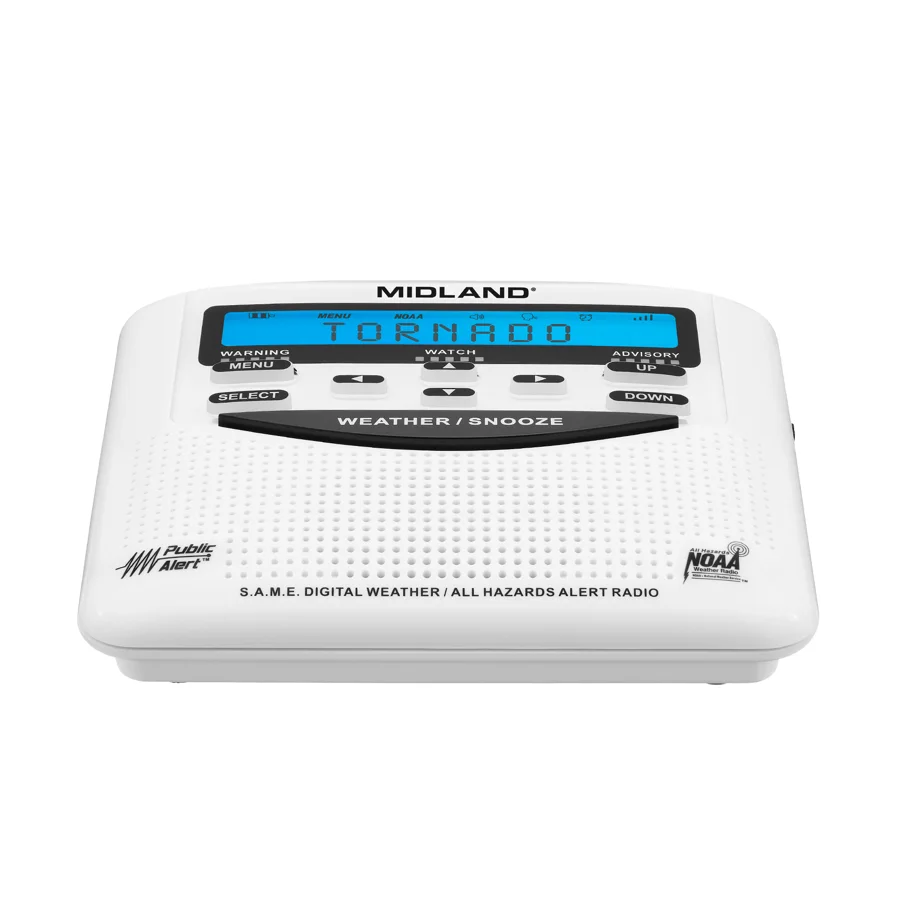
Photo: Midland
Midland WR120B Weather Radio
The set our outage pillar already points readers to, for the reasons this chart gives: it receives all seven NOAA channels, takes a SAME county code so it only sounds for your county, carries a loud alert alarm, and runs on wall power with AA batteries behind it for the outage itself. It is a listener, not a talker — pair it with FRS handsets for the family channels below it on the chart.
Prices last checked: October 29, 2026. No price is printed for this pick in this run — the listing price could not be verified cleanly today, and an unverified price does not go on the page.
What a hand-crank or battery radio must actually receive
The crank radios are sold on their charging tricks — the handle, the little solar panel, the phone-charging socket. Those are the least important things about them. A crank buys you minutes of listening per session of cranking, which is fine for checking a forecast and poor for following a long night of news. What matters is the receive list, in this order: AM, because distance and news live there; FM, for your local stations; and the NOAA weather band, all seven channels, because without it the radio cannot hear the one service that broadcasts warnings around the clock. Alert function beats crank: a radio that wakes itself up for a SAME warning while you sleep is worth more than a handle. Batteries you can replace — plain AAs, stocked in the same drawer — beat a sealed internal cell that will be three years old on the night you need it. If a radio you are looking at does not list AM, FM, and the weather band on its own spec sheet, it is a torch with a speaker, and it should be priced in your head that way.
What a blackout radio must receive — the receive list matters more than the charging tricks
AM — distance + news
FM — local stations
NOAA weather band — all 7 channels, with S.A.M.E. alert
Power — replaceable AA batteries, and a hand crank
Follow-up questions
Can my phone replace all of this?
Partly, while it lasts. Wireless Emergency Alerts reach a charged phone on a working network, and the FEMA app carries alerts for up to five locations. A blackout attacks both halves of that — the battery and the network — which is why every official kit list still starts with a battery or hand-crank radio. The phone is the second receiver in the house, not the first.
What if I hear nothing on any NOAA channel?
Move before you conclude anything. Weather-band signals are line-of-sight-ish: a window, an upstairs room, or a few steps outside often turns static into a voice. Raise the telescopic antenna fully, and try all seven channels again — in some counties the second transmitter over is the one your house can hear.
Is a police scanner the same thing?
No, and it matters less than it used to. Many police and fire services have moved to digital or encrypted systems a household scanner cannot follow. The listening that still pays in a blackout is the official broadcast side — NOAA, local AM/FM, and ham nets — which is exactly what this chart is built from.
Frequently asked questions
What radio station do I listen to in a blackout?
Two answers, written down in advance: your county’s NOAA Weather Radio frequency (one of 162.400–162.550 MHz, found on weather.gov’s coverage pages) for warnings, and your local AM/FM news station for local emergency information carried through the Emergency Alert System.
Do I need a licence to listen to any of this?
No. Listening never needs a licence — not to NOAA, not to broadcast radio, not to ham bands. Licences only enter when you transmit: none for FRS, a $35 no-test FCC licence for GMRS, and a tested licence for ham.
When the talking has to go further than a mile or two?
That is the job satellite communicators were built for — two-way texting that ignores the local network entirely, at the price of a subscription. We work through that choice, and what it really costs per month, here: satellite communicators for home emergencies, compared.
The verdict
The blackout question sounds like it wants one number. It actually wants four, decided on a calm day: your NOAA channel, your two local stations, and your family’s FRS channel — written on paper, taped inside a cupboard, with a radio in the drawer underneath that receives AM, FM, and the weather band and has fresh AAs beside it. Do that once and the 2 a.m. version of the question answers itself.
The full set is at What People Are Asking About Outage Living, and the wider outage plan is the six problems every house has to solve when the power goes out.
Talk it over with other homeowners
The Ordinary Prepper Community on Facebook is where readers compare outage plans, show their setups, and help decide what we test next.