
As an Amazon Associate, Ordinary Prepper earns from qualifying purchases. Prices last checked October 28, 2026.
Home Readiness — Guide
Bluetti vs EcoFlow for Home Backup: Which Brand's Batteries Hold Up?
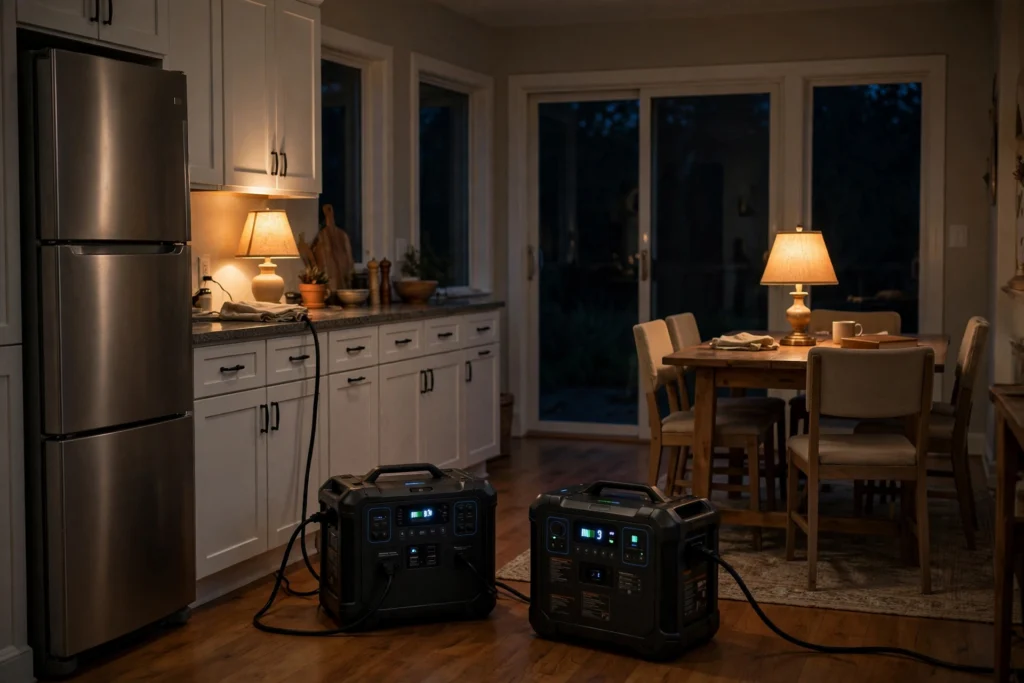
Bluetti vs EcoFlow for home backup comes down to one number most buyers skim past. Both brands sell a 2,048–2,074 watt-hour box that runs a fridge for about a day and a half. The difference is how long the battery inside is rated to keep doing it: Bluetti rates the Elite 200 V2 for 6,000+ charge cycles before it fades to 80% of its original capacity, and EcoFlow rates the DELTA 2 Max for 3,000. That is twice the rated working life from the Bluetti — and, as the sections below show, it matters a lot for some houses and barely at all for others. These are the same two machines from our solar generators for home backup comparison, judged here as brands, on the record each one has built.
How we researched this comparison
We scored 2 products for this comparison — the same two machines as our main solar-generator comparison, judged here as brands: which one’s battery is built to hold up longer. The scores rest on the manufacturers’ published specifications (cycle ratings, capacity, warranty terms), on prices checked on October 28, 2026, and on the verified-owner record for each machine — 947 Amazon reviews for the Bluetti and 1,357 for the EcoFlow at the last count, with the patterns worked through in the sections below. We never claim hands-on testing, and affiliate commissions are checked only after scores are set — the full method, with the scoring weights, is on our how we research and score page.
Bluetti Elite 200 V2
6,000+ rated cycles — about 12,442 kWh of lifetime energy, double the EcoFlow’s rated total — and the stronger 2,600 W inverter. Fixed size: it cannot grow.
EcoFlow DELTA 2 Max
3,000 rated cycles at $1,029 — and the only one of the two that takes extra batteries later, up to 6,144 Wh.
If you buy through a link in this section, we may earn a commission from the seller. It never costs you extra, and it never changes a score.
How we grade: scores use the rubric on our How We Rate page (Evidence 30 / Cost 25 / Owner experience 25 / Fit for an ordinary home 20). The owner record below rests on 947 Amazon reviews averaging 4.7 stars for the Elite 200 V2 and 1,357 Amazon reviews averaging 4.7 stars for the DELTA 2 Max — the same samples behind our first comparison of these machines, rechecked against the listings for this post. Prices are Amazon prices, checked October 28, 2026; neither brand’s own store price is printed here.
How do the two brands’ home-backup boxes compare on paper?
The Bluetti Elite 200 V2 and the EcoFlow DELTA 2 Max are near-twins in size and output, and far apart in rated battery life and expansion. Both use LiFePO4 batteries — the chemistry that replaced older lithium in this class because it tolerates far more charge cycles — and both carry a 5-year warranty.
Rated cycles to 80% capacity
Both boxes are LiFePO4 with a 5-year warranty — the cycle rating is where the two part company.
| Product | Capacity | Output | Rated cycles to 80% | Fridge runtime | Price |
|---|---|---|---|---|---|
| Bluetti Elite 200 V2 | 2,074 Wh | 2,600 W | 6,000+ | About 1.5 days | $899 |
| EcoFlow DELTA 2 Max | 2,048 Wh | 2,400 W | 3,000 | About 1.4 days | $1,029 |
Prices last checked: October 28, 2026
Fridge runtime uses the same math as our home power sizer: a typical refrigerator uses about 1,200 watt-hours a day, and no station hands over its full rated capacity — inverter losses take roughly 15%, so runtimes use 85% of rated watt-hours.
Bluetti Elite 200 V2
Why this one: 6,000+ rated cycles — about 12,442 kWh of lifetime energy, double the EcoFlow’s rated total — and the stronger 2,600W inverter. The trade is fixed size: it cannot grow.
Why does the Bluetti Elite 200 V2 hold up longest on paper?
The Bluetti Elite 200 V2 wins the longevity question outright: 6,000+ rated cycles to 80% capacity, against 3,000 for the EcoFlow. Multiply the rating by the capacity and the gap turns into energy a household actually gets over the machine’s life — about 12,442 kWh through the Bluetti’s battery, against about 6,144 kWh through the EcoFlow’s. At today’s prices the Bluetti wins both halves of the value story: it is cheaper per watt-hour you buy today ($899 for 2,074 Wh, about 43 cents a watt-hour, against about 50 cents for the EcoFlow), and cheaper per lifetime kilowatt-hour — roughly 7 cents against 17 cents — because its battery is rated to deliver twice the total energy.
Lifetime energy through the battery
Rated cycles multiplied by capacity — the energy a household actually gets over the machine’s life.
What it runs: a fridge for about 1.5 days on one charge; a CPAP (about 40 W average, 8 hours a night) for roughly 5 nights if the CPAP is the only load; a fridge plus lights and the router for a long evening with capacity to spare. Its 2,600 W inverter is the stronger of the two, which is the headroom that starts a fridge compressor without drama.
Owners back most of the spec sheet. Across 947 Amazon reviews averaging 4.7 stars, the praise that repeats is how much power fits in a box this compact, the fast charging, and a fridge and freezer run without fuss. The complaints repeat just as reliably: at 53.4 pounds it is a place-it-once machine, the phone app drops its connection often enough to annoy, and there is no way to add a battery later — buyers who assumed they could expand learned otherwise after purchase. A smaller number of owners in Bluetti’s own forum report solar input faults that needed a firmware update or service.
Pros: double the rated cycle life of the EcoFlow; strongest inverter in this pairing; compact for its capacity; quiet under light loads.
Cons: no expansion path at all; app connection drops are a standing owner complaint; 53.4 lb.
Buy it if the machine will cycle often — daily solar use, regular outage duty, a fridge that lives on it — and you want the battery rated to still be working years from now. Skip it if you already know 2 kWh will not stay the whole plan, because this box cannot grow.
The Bluetti Elite 200 V2 is $899 on Amazon as of October 28, 2026: See it on Amazon.
When is the EcoFlow DELTA 2 Max the smarter buy anyway?
The EcoFlow DELTA 2 Max is the smarter buy when the plan might grow. It costs $1,029 today — $130 more than the Bluetti — for effectively the same fridge runtime, and it is the only one of the two that accepts extra batteries: add one or two DELTA 2 Max smart extra batteries and the system reaches 6,144 Wh, about 4.3 days of fridge runtime at the same 85% math. It also gives you six AC outlets against the Bluetti’s four, and two separate solar inputs of 500 W each, which makes odd panel arrangements easier to wire.
Capacity: the base box, and where it can grow
The EcoFlow is the only one of the two that takes extra batteries later; the Bluetti’s size is fixed the day you buy it.
What it runs: a fridge for about 1.4 days on the base unit; a CPAP for roughly 5 nights as the only load; a fridge, lights, and phones through a long outage evening. Expanded to 6,144 Wh, the fridge figure stretches past four days — the territory where the conversation stops being about one box and starts being about the whole-house systems the Power hub covers.
Owners rate the DELTA 2 Max 4.7 stars across 1,357 Amazon reviews — the larger sample of the two, and just as warm. The praise lines up with the pitch: fast charging from wall and sun, an app people actually like, and a fridge and freezer handled without drama. The complaints that keep coming up are fan noise when it works hard, what the extra batteries cost when the day comes to expand, and a smaller set of reports of trouble right after a software update, with a few owners needing service afterward.
Pros: expands to 6,144 Wh; six AC outlets; dual solar inputs; the better-liked app of the two.
Cons: half the Bluetti’s rated cycle life; fan noise under load; extra batteries are a significant second purchase; post-update trouble is a recurring owner report.
Buy it if you are starting at 2 kWh with honest doubts it will stay enough, or if the better-liked app decides it. Skip it if the machine will be cycled daily for years — that is exactly the use the 3,000-cycle rating punishes first.
The EcoFlow DELTA 2 Max is $1,029 on Amazon as of October 28, 2026: See it on Amazon.
Relevant pickEcoFlow DELTA 2 Max
3,000 rated cycles — and the only one of the two that takes extra batteries later, up to 6,144 Wh. The smarter buy when 2 kWh might stop being enough.
2,048 Wh · Expands to 6,144 Wh
Which battery is rated to last longer, Bluetti or EcoFlow?
Bluetti, and it is not close. The Elite 200 V2’s 6,000+ cycles to 80% capacity is double the DELTA 2 Max’s 3,000, and both figures are for the same LiFePO4 chemistry measured the same way — full charges and discharges until the battery holds 80% of what it held new. Cycled once a day, every day, that is roughly 16 years of rated life for the Bluetti against roughly 8 for the EcoFlow. No other number in this comparison separates the brands by two to one.
If the power station only runs during outages, does the cycle rating even matter?
For most houses, much less than the headline suggests. A home-backup box that sees ten full cycles a year — a heavy outage year — would need 300 years to wear out the EcoFlow’s 3,000-cycle rating and 600 to wear out the Bluetti’s. Long before cycle wear matters, calendar aging and the 5-year warranty both brands carry become the real limits. The cycle gap decides the question only for houses that cycle the battery often: daily solar self-use, off-grid cabins, or a fridge that runs off the station every day. For a closet-kept outage box, buy on runtime, price, and expansion — the rating is a tie that marketing breaks.
Which one runs a fridge longer on a single charge?
The Bluetti Elite 200 V2, by a nose. Its 2,074 Wh at the honest 85% factor is about 1,762 usable watt-hours, roughly 1.5 days of a typical fridge’s 1,200 Wh daily appetite. The EcoFlow DELTA 2 Max’s 2,048 Wh works out to about 1,741 usable watt-hours and 1.4 days. The real-world gap is a couple of hours, not a category — and it reverses the moment the EcoFlow adds one extra battery, which the Bluetti cannot do. Cycle the fridge door discipline the way our first comparison described — a shut fridge holds safe temperatures about 4 hours — and both stretch well past these figures.
Which one refills faster when the power comes back for an hour?
The EcoFlow DELTA 2 Max, on the combined-charge figure that matters in a rolling outage. EcoFlow rates it at 0–80% in about 43 minutes when wall and solar feed it together (2,400 W combined), and about 80 minutes for a full charge from the wall alone. The Bluetti Elite 200 V2 reaches 80% in about 50 minutes combining its AC and DC inputs, with a full wall charge in roughly an hour and a half. Both are fast enough to matter in a one-hour power window; the EcoFlow simply banks more of that window. Solar input is a dead tie — 1,000 W maximum each — though the EcoFlow splits it across two inputs and the Bluetti takes it through one.
Which one can grow when 2 kWh stops being enough?
Only the EcoFlow. The DELTA 2 Max takes up to two smart extra batteries and grows from 2,048 Wh to 6,144 Wh without replacing the main unit. The Elite 200 V2 has no expansion port and no add-on battery in Bluetti’s line — 2,074 Wh is the whole machine, forever. One honest warning that owners repeat: EcoFlow’s extra batteries cost enough that expanding later is not the bargain it sounds like at purchase time. Price the full expanded system before treating expansion as free headroom.
Which app and controls are easier to live with?
EcoFlow, by the owners’ own account. Across 1,357 Amazon reviews, the EcoFlow app is praised by name — monitoring, charge scheduling, and updates that mostly behave. Across the Bluetti’s 947 reviews, the app is the complaint that recurs: connections that drop and need re-pairing, on a machine whose battery underneath keeps working fine. Neither app is required to run a fridge in an outage — both boxes work from their front panels — so this is a quality-of-life difference, not a capability one. It matters most to households that plan to check the battery from another room, or another town.
Who backs their machine if something goes wrong?
On paper, it is a tie: both the Bluetti Elite 200 V2 and the EcoFlow DELTA 2 Max carry a 5-year warranty. The owner records differ at the edges. EcoFlow’s recurring story is software — a few owners report trouble arriving with an update and being resolved through service, and the standing owner advice is to set the machine up, confirm it works, and not update it mid-storm-season. Bluetti’s recurring story is responsiveness — owners praise the hardware and describe slower support replies, with the helpful Bluetti user community filling some of the gap. One more Bluetti caveat worth stating plainly: its Better Business Bureau profile has drawn complaints that cluster on shipping and returns rather than product failure, which is an argument for buying through a retailer whose return window you trust — as the Amazon links here do — rather than an argument against the machine.
What are the honest caveats?
Three, and they apply to both brands. First, a cycle rating is a lab figure: it assumes full cycles at moderate temperatures, and a battery kept in a hot garage ages by the calendar no matter whose logo is on the box — store either machine charged to about 80% and top it up every few months, as both manuals advise. Second, neither machine is a whole-house answer: at 2,400–2,600 W they run essentials — fridge, freezer, lights, router, a CPAP — not central air, an electric range, or a well pump on the same circuit of your attention. Third, the switchover when the grid drops is fast on both (15 milliseconds or less for the Bluetti; EcoFlow rates the DELTA 2 Max’s EPS at 20–30 milliseconds) — fine for a fridge or router, but neither is sold as a medical-device UPS, and a CPAP that must never blink deserves its own small dedicated backup as well.
Three more worth a look
Not reviewed or scored — listed because readers cross-shopping these two brands run into them, with the same disclosure as everything here.
Jackery Explorer 2000 v2
The lightest 2 kWh carry of the class at about 39 pounds, from the brand with the longest track record in portable power.
Anker SOLIX C1000
The 1 kWh-class alternative for smaller loads and smaller budgets.
Goal Zero Yeti 1500X
The older name in portable power; heavier and slower-charging than this class, still widely owned and supported.
As an Amazon Associate, Ordinary Prepper earns from qualifying purchases. The three products above have not been reviewed or scored.
Frequently asked questions
Which lasts longer, EcoFlow or Bluetti?
On the rating that measures battery wear, Bluetti: the Elite 200 V2 is rated for 6,000+ cycles to 80% capacity, double the DELTA 2 Max’s 3,000. For a box used only in outages, calendar aging and the shared 5-year warranty matter more than either figure.
Is EcoFlow better than Bluetti overall?
Neither wins everything. EcoFlow’s DELTA 2 Max expands to 6,144 Wh and has the better-liked app. Bluetti’s Elite 200 V2 is $130 cheaper today, with the stronger inverter and double the rated battery life. Which list matters more depends on how your house will actually use the machine.
Can a Bluetti Elite 200 V2 or EcoFlow DELTA 2 Max run a whole house?
No. Both are 2 kWh-class machines with 2,400–2,600 W inverters, built for essentials: a fridge, a freezer, lights, phones, the router, a CPAP. Central air, an electric range, and a water heater need more than either box can give. They keep the important things cold and lit.
How long will each one run a refrigerator and a CPAP?
At the honest 85% factor, the Bluetti runs a typical fridge about 1.5 days and the EcoFlow about 1.4 days. A CPAP drawing about 40 W runs roughly 5 nights on either as the only load. Run fridge and CPAP together and expect about a day of cover.
Can you add more battery to these later?
The EcoFlow, yes: the DELTA 2 Max accepts up to two smart extra batteries, reaching 6,144 Wh. The Bluetti Elite 200 V2, no — it has no expansion option, so 2,074 Wh is its permanent ceiling. Price EcoFlow’s extra batteries first; owners call them a significant second purchase.
Do Bluetti and EcoFlow carry the same warranty?
Yes — both machines carry a 5-year warranty, which covers most of the realistic service life of an outage-only box. The differences owners report are about the experience around the warranty: EcoFlow’s post-update service stories on one side, Bluetti’s slower support replies on the other.
Which one should you choose?
Choose the Bluetti Elite 200 V2 if the battery will work for a living — daily cycling, solar self-use, a fridge that rides on it through a long outage season — and you want the machine rated to still hold 80% after 6,000 cycles. Choose the EcoFlow DELTA 2 Max if it will mostly wait in a closet for outage duty, or if there is any real chance the system needs to grow past 2 kWh, because it is the only one that can. Either way, run your own numbers through the home power sizer before buying — the fridge, freezer, and medical loads in your house, not a review page, set the size you need — and browse the Power hub for the rest of our home-backup coverage.
Talk it over with other homeowners
The Ordinary Prepper Community on Facebook is where readers compare outage plans, show their setups, and help decide what we test next.