
As an Amazon Associate, Ordinary Prepper earns from qualifying purchases. Prices last checked October 28, 2026.
Home Readiness — Guide
Generator Fuel: Burn Per Day, How Much to Store, and Keeping It From Going Stale
Short answer: Fuel burn is a load question, not a generator question: a mid-size portable burns roughly 0.1–0.2 gallons per hour loafing at quarter load, 0.3–0.5 at half load, and 0.6–1.0 at full tilt — so the same machine costs one household 3 gallons a day and another 12, depending on how it is run. Running in blocks (a few hours on, everything charged and cooled, then off) cuts most houses to 3–5 gallons a day. Store 10–20 gallons of gasoline in approved cans in a detached shed or garage, never in the house; with stabilizer, gasoline keeps about 12 months, without it, count on 3–6. Propane changes the whole problem: it keeps indefinitely, which is why dual-fuel owners store propane deep and gasoline shallow.
Burn per day: the table
| How you run it | Typical burn | Gallons per 24h | What 10 gallons buys |
|---|---|---|---|
| Quarter load, mostly idle loads | ~0.15 gal/hr | ~3.5 gal | ~3 days |
| Half load, steady house loads | ~0.4 gal/hr | ~9.5 gal | ~1 day |
| Full load, everything at once | ~0.8 gal/hr | ~19 gal | ~Half a day |
| Block running, 6 hrs/day at working load | ~0.4 gal/hr while on | ~2.5 gal | ~4 days |
Figures are for the common 4,500–7,500W portable class and are deliberately ranges — your manual prints your machine’s rated consumption at half load, and an hour with a measured gallon and a watch beats any table. Two patterns matter more than the decimals. First, burn does not scale with load the way people hope: a generator at quarter load still burns half or more of its half-load fuel, because most of the gasoline is spent being a spinning engine. Second, that inefficiency is exactly why block running wins: concentrate the loads into hours where the generator works hard, charge every battery in the house while it runs, then shut it down and live off storage in silence.
Gallons burned per 24 hours, by how you run it (common 4,500–7,500 W portable class; deliberately ranges): quarter load, mostly idle ~3.5 gal — 10 gal buys ~3 days · half load, steady house loads ~9.5 gal — 10 gal buys ~1 day · full load, everything at once ~19 gal — 10 gal buys ~half a day · block running, 6 hrs/day ~2.5 gal — 10 gal buys ~4 days.
Your own number: Your manual prints your machine’s rated consumption at half load — an hour with a measured gallon and a watch beats any table.
Champion 4,500W Dual Fuel Inverter
Why this one: Most of this page’s pain — stabilizer, rotation, the 12-month clock — is a gasoline problem. Propane does not go stale, so a dual-fuel machine run mostly on propane, with gasoline kept shallow as the backup fuel, is the simplest storage plan on this site.
How much to store
Work backwards from your plan, not forwards from a can collection. A block-running house at 2.5–4 gallons a day needs about 12.5–20 gallons for a five-day outage; a run-it-continuously house needs two to three times that and should instead change its running plan. Ten to twenty gallons — two to four 5-gallon cans — is the band most households land in, and it is also roughly the band that storage safety and local fire codes are comfortable with in a detached structure. Beyond twenty gallons, the storage problem (space, rotation, code, sheer weight at 6 pounds a gallon) starts arguing for propane, which stores forever and in bigger vessels.
Keeping it from going stale
Gasoline ages by oxidation and by losing its lightest fractions; ethanol-blended fuel adds water absorption to the charge sheet. The honest shelf lives: untreated pump gasoline, about 3–6 months before it starts costing you easy starts; with a quality stabilizer added when the fuel is fresh, about 12 months (some stabilizers claim 24 — plan on 12 and be pleasantly surprised). Ethanol-free gasoline, where you can buy it, is the premium option for storage and small engines alike.
The rotation that makes all of this painless: date every can with tape and a marker, and every few months pour the oldest can into the car and refill it fresh. Stored fuel then never ages past a season, the generator always meets young gasoline, and the “rotation system” is a habit rather than an event. Stabilizer goes in at the pump or at the can, while the fuel is fresh — it preserves, it does not resurrect.
Gasoline, untreated: About 3–6 months before it starts costing you easy starts.
Gasoline, stabilised: About 12 months with a quality stabilizer added while the fuel is fresh. Some stabilizers claim 24 — plan on 12 and be pleasantly surprised.
Ethanol-free gasoline: The premium storage option where you can buy it: ethanol content, not octane, is the variable that matters.
Diesel: About 6–12 months untreated, longer with care — but the machines cost more and weigh more.
Propane: Does not go stale in its tank — effectively indefinite storage.
Storage safety, the non-negotiables
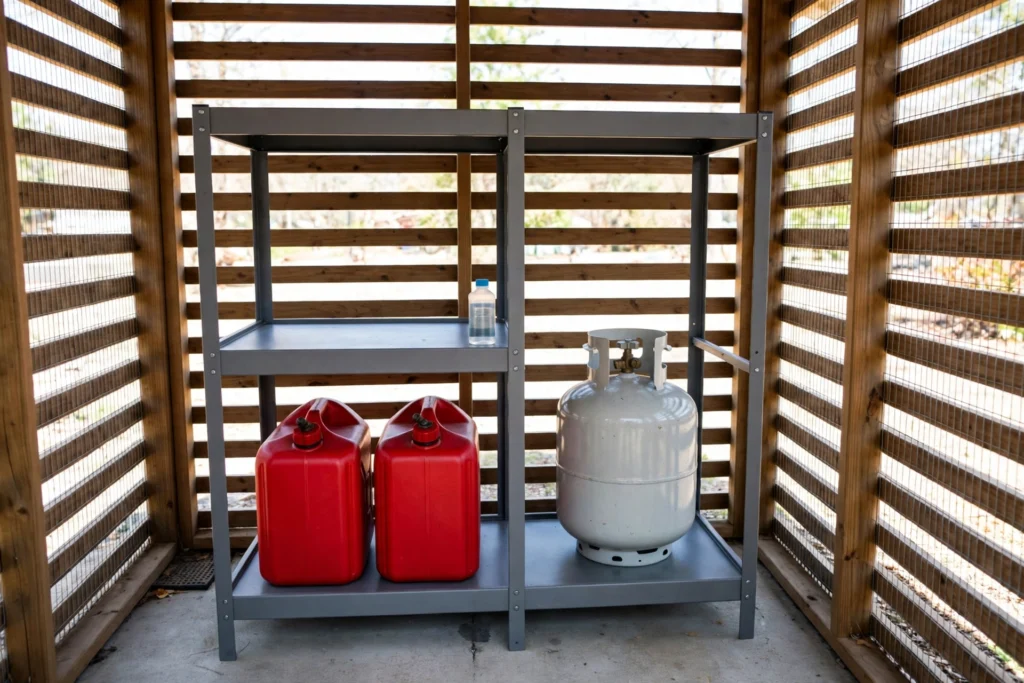
Approved cans, closed, upright, in a detached shed or a garage’s far corner — never in living space, never near the water heater or any ignition source, never in a hot car trunk for the season. Fill cans on the ground, not in a truck bed (static). Let the generator cool before refuelling — the storm-season burn units are stocked with people who did not. And the generator itself lives outdoors in use, 20-plus feet out: the fuel plan and the carbon-monoxide plan are the same plan viewed from two sides.
The storage problem has a dual-fuel shortcut
Most of this page’s pain — stabilizer, rotation, the 12-month clock — is a gasoline problem. Propane does not go stale, which is why the simplest storage plan on this site is a dual-fuel generator run mostly on propane, with gasoline kept shallow as the backup fuel. The dual-fuel machines we have already scored for house duty are the Champion 4,500W Dual Fuel Inverter and its smaller sibling, the Champion 2500W Dual Fuel Inverter for lighter load lists. No prices are printed here because they move; the links show today’s figure.
Relevant pickChampion 2500W Dual Fuel Inverter
The smaller sibling of the 4,500W machine above — the same dual-fuel answer, scored for lighter load lists.
Dual fuel · For lighter load lists
Your next step: if you are still choosing the machine itself, start with our generator sizing page — the right size burns less of whatever fuel you store.
Follow-up questions
Is propane really unlimited storage?
Effectively, yes: propane does not degrade in its tank, and a 20-pound cylinder holds about 4.6 gallons — roughly a day of block running for a dual-fuel machine at working load, less at full tilt since propane derates most generators by about 10%. A pair of cylinders is a week of evenings; a 100-pound or 250-gallon stationary tank is a different league entirely.
What does a standby generator burn?
Standbys sip from a bigger straw: a 20 kW-class unit at half load burns roughly 2–2.5 gallons of propane or about 200 cubic feet of natural gas per hour — which is why the planned-outage page in this series exists, and why natural gas (no stored quantity to exhaust) suits standbys whose owners fear week-long events.
Can I use last year’s gas in the car instead?
Yes — the car is the forgiving engine and the standard rotation route: older stored gasoline, diluted into a mostly-full car tank, is how most stored fuel gets honourably discharged. The generator, with its small carburettor jets, is the picky one, and gets the fresh can.
Frequently asked questions
Does premium gasoline store better?
Octane is not the variable that matters for storage; ethanol content is. Ethanol-free fuel of any grade outlasts E10 of any grade in a can, and stabilizer matters more than either.
How do I know stored gas has gone bad?
Dark colour, a sour or varnish smell, and a generator that suddenly will not start on fuel it ran on last season. Do not pour suspect fuel into the generator to “test” it — the test contaminates the carburettor you were protecting.
Is diesel a better storage fuel?
Diesel stores longer than gasoline (about 6–12 months untreated, longer with care) and diesel generators sip less per watt — but the machines cost more, weigh more, and suit farms and workshops better than suburbs. For most houses the dual-fuel propane route reaches the same goal more cheaply.
The bottom line
Decide your running pattern first — blocks, always, for a house — then store the gallons that pattern actually drinks: usually 10–20, stabilized, dated, rotated through the car. Store propane for the deep reserve. Fuel anxiety is a planning failure, and it is entirely curable in an afternoon.
The full set is at What People Are Asking About Home Generators, and the sizer that starts the whole plan is in our Power hub.
Talk it over with other homeowners
The Ordinary Prepper Community on Facebook is where readers compare outage plans, show their setups, and help decide what we test next.