
As an Amazon Associate, Ordinary Prepper earns from qualifying purchases. Prices last checked October 27, 2026.
Home Readiness — Guide
Your Grid-Tied Solar Shuts Off in a Blackout — Here's How to Use It.
Short answer: your panels are fine — the inverter is doing exactly what it is built to do. A grid-tied system is required to shut down when the grid fails. Using your solar in an outage takes one of four additions: Sunlight Backup controller hardware on a compatible Enphase system, a home battery, a meter-socket inlet like GenerLink paired with a portable generator, or a separate power station that ignores the roof entirely. They run from about $800 to well over $10,000 installed.
Why your panels go dark in a blackout
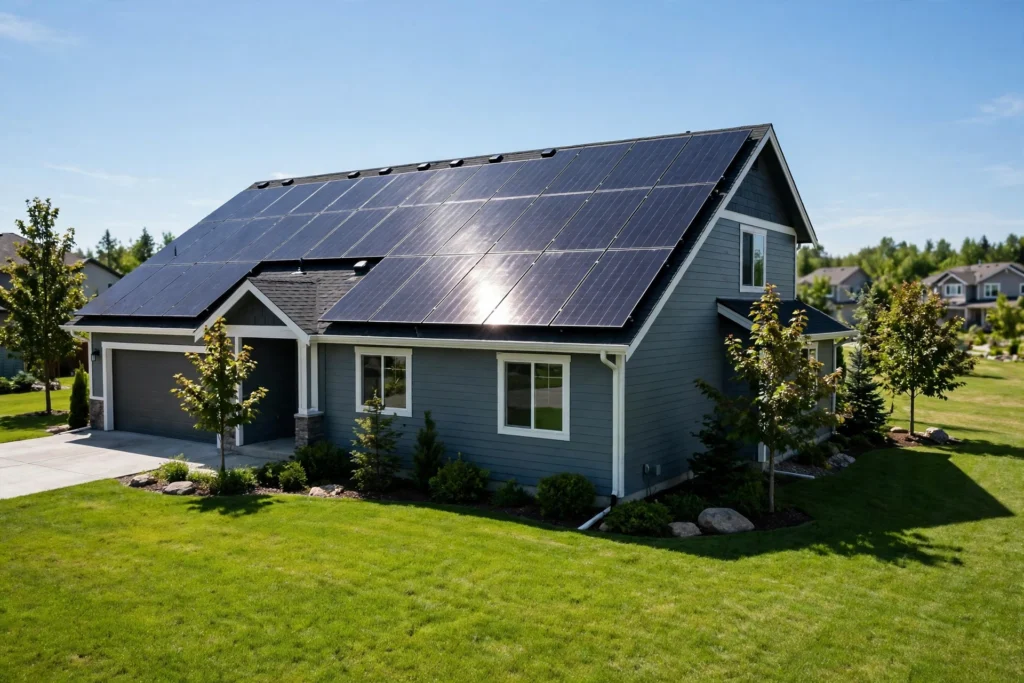
The panels do not quit — on a sunny afternoon they are still making electricity. What stops is the inverter, the box that turns their power into the kind your house runs on.
The problem it solves is simple. When a storm drops a line, the crew fixing it works on that line expecting it to be dead. If rooftops kept feeding power backward onto it, somebody could be killed. So grid-tied inverters carry anti-islanding protection: they watch the grid constantly, and the instant it disappears, they shut down until it returns. In the U.S., that behavior is baked into the UL 1741 certification every grid-tied inverter must carry, alongside the IEEE 1547 grid rules.
That is a safety feature, not a defect, and there is no setting to switch it off. Every route that works separates your house from the grid first, cleanly and mechanically, and only then runs your circuits.
The panels: Still making electricity on a sunny afternoon — they do not quit.
The inverter: Turns panel power into house power, and watches the grid constantly.
Anti-islanding: The instant the grid disappears, the inverter shuts down until it returns — UL 1741 and IEEE 1547.
The rule: Every route that works separates your house from the grid first, cleanly and mechanically.
Bluetti Elite 200 V2
Why this one: The top pick of the route that leaves the roof alone: about 1,760 usable watt-hours — fridge, lights, phones, and router through the night and into the next day — from a box that never touches your house wiring, meter, or solar warranty.
Route 1: Sunlight Backup — power straight off the roof, while the sun shines
If your system uses Enphase IQ8-class microinverters, Enphase sells a configuration called Sunlight Backup. Add an IQ System Controller, an IQ Combiner, load controllers, and a small panel of essential circuits, and the microinverters may form their own little grid when the main one fails — feeding the circuits you picked: fridge, lights, internet, a few outlets.
At noon: the best version of itself — a decent array in full sun can carry the fridge, lights, phones, router, and television. At 9 p.m.: nothing. There is no battery, so nothing is stored. Sunset ends the backup, and so does a heavy cloud bank: the system sheds circuits as output drops. Big loads are out — no central air, no electric range.
Cost: as a typical installed range, guides and installer write-ups put Sunlight Backup at about $4,000 to $7,000 added to a compatible system, with $5,000 to $6,000 a common quoted band; adding it during a new install can cost far less. Who it’s for: the IQ8 owner whose outages are mostly daytime inconveniences. Everyone else should read the next three routes before paying for this one.
Route 2: Add a home battery — the full answer, at the full price
A battery changes the deal completely, because now power has somewhere to sit. In an AC-coupled setup — an Enphase IQ Battery on an Enphase system, or a Tesla Powerwall-class battery alongside whatever solar you have — its controller disconnects your house, forms the island, and lets your panels keep producing into it. A hybrid-inverter swap does the same job on string-inverter systems.
At noon: the house runs on solar, and the surplus charges the battery. At 9 p.m.: the house runs on the battery — fridge, lights, internet, television, and on a larger setup, more. A single 10 to 13.5 kWh battery, used on essentials, is an overnight-to-a-day answer; the panels refill it next morning.
Cost: 2026 pricing guides put a single-battery essentials setup at about $9,000 to $16,000 installed — roughly $7,000 to $11,000 for a smaller 5 to 8 kWh Enphase setup, $12,000 to $16,000 for a Powerwall-class unit — before incentives; whole-home multi-battery systems run well past $20,000. Who it’s for: long or frequent outages, a medical device, a well pump that cannot wait — real independence, at real money.
Route 1 — Sunlight Backup. At noon: fridge, lights, phones, router and television in full sun on a decent array. At 9 p.m.: nothing — there is no battery, so nothing is stored. The catch: sunset ends it, and a heavy cloud bank sheds circuits.
Route 2 — Home battery. At noon: the house runs on solar, and the surplus charges the battery. At 9 p.m.: fridge, lights, internet and television on stored power. The span: one 10 to 13.5 kWh battery on essentials — overnight to a day.
Route 3: A GenerLink-style meter inlet and a portable generator
This route uses no solar at all, and it is the one many solar owners quietly end up taking. A GenerLink is a collar behind your electric meter. Plug a portable generator in, start it, and the device connects it to your whole breaker panel while keeping it separated from the street — the same anti-backfeed job, done at the meter. No rewiring or transfer-switch panel. Your utility or an approved electrician installs it, the utility must okay it, and it fits services up to 200 amps.
At noon: anything the generator can handle — fridge, lights, furnace blower, window air conditioner, a well pump on a bigger machine. At 9 p.m.: exactly the same, for as long as you have fuel. A generator does not care about clouds or sunset. The costs: noise, exhaust kept well away from windows, fuel storage, an engine to maintain.
Cost: through a participating utility, typically about $800 to $1,400 installed — published utility prices cluster between roughly $775 and $1,200 including installation — plus the generator itself if you do not own one. Outside a utility program the total can reach $2,000 to $2,500; some utilities lease monthly instead. Who it’s for: the practical house — the cheapest route to real, all-night, whole-panel power when outages last days.
Route 4: Skip the roof — a power station and folding panels
The fourth route leaves the rooftop system alone and builds a small, separate one indoors. A portable power station — battery and inverter in one box — sits by the fridge, charged from the wall while the grid is up. Folding panels in the yard recharge it by day — no contact with your house wiring, meter, or solar warranty. No permits, no electrician — running in your kitchen this weekend.
The limits: it powers what you plug into it, with cords — not house circuits, not the furnace blower, not the well pump. The math we use across this site: a fridge uses about 1,200 watt-hours a day, and a station delivers about 85% of its rated capacity, so a roughly 2,050 watt-hour station gives about 1,740 usable watt-hours — the fridge for a day and a half. A 400-watt folding panel harvests about 300 real watts in decent sun — roughly 75% of the number on the box.
At noon: fridge and small loads running, station topping up from the panels. At 9 p.m.: fridge, lights, phones, and internet on stored power — no fuel, no noise. Who it’s for: renters, anyone whose solar is leased or under a contract they do not want to touch, and anyone who wants a working answer now while saving toward Route 2.
Bluetti Elite 200 V2
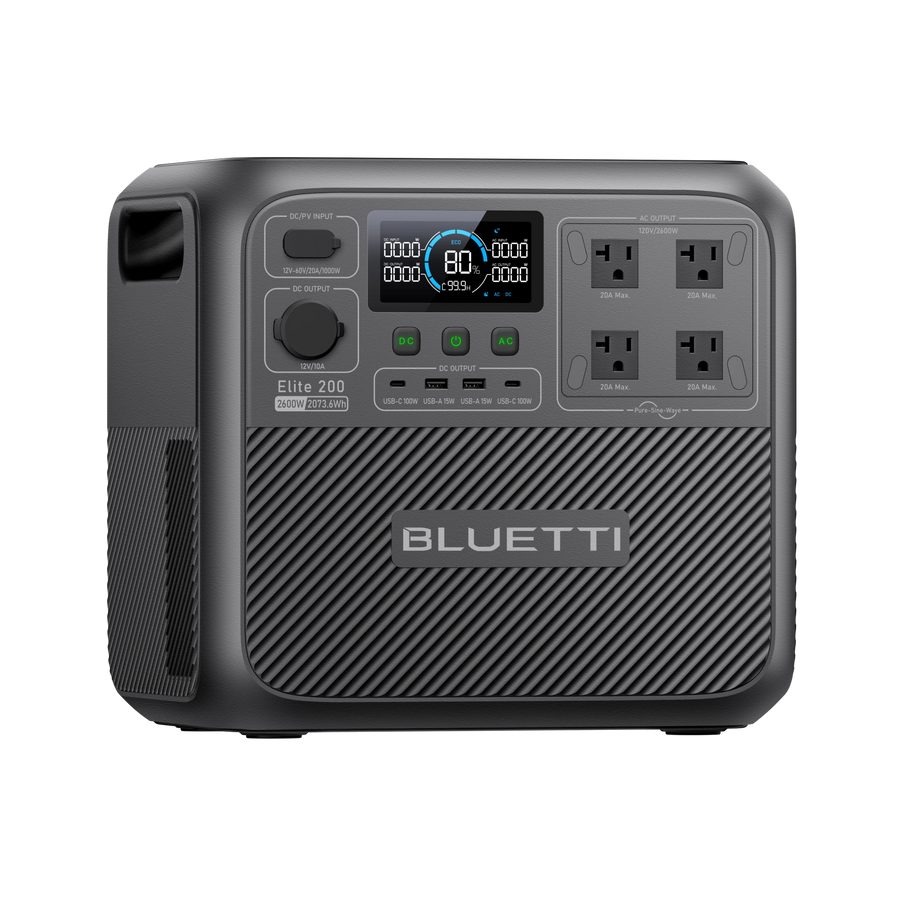
Photo: Bluetti
2,074 watt-hours and the stronger 2,600W inverter, rated for 6,000+ cycles and about 1,760 usable watt-hours — fridge, lights, phones, and router through the night and into the next day.
EcoFlow DELTA 2 Max
2,048 watt-hours, fast wall charging, and room to add extra batteries later up to 6,144 watt-hours — the fridge-through-the-night box that can grow later.
A fridge: About 1,200 watt-hours a day.
Usable power: A station delivers about 85% of its rated watt-hours.
The worked example: A roughly 2,050 Wh station gives about 1,740 usable Wh — the fridge for about a day and a half.
The panels: A 400 W folding panel harvests about 300 real watts in decent sun — about 75% of the number on the box.
Relevant pickEcoFlow DELTA 2 Max
The grow-with-you option from the same route: 2,048 watt-hours, fast wall charging, and room to add extra batteries later up to 6,144 watt-hours — the fridge-through-the-night box that can grow later.
2,048 Wh · Expands to 6,144 Wh with extra batteries
The four routes, side by side
| Route | Typical cost | Power at night | One-line catch |
|---|---|---|---|
| Sunlight Backup | $4,000–$7,000 | None | Ends at sunset — and at clouds |
| Home battery | $9,000–$16,000 | Yes — hours to all night | Full answer, full price |
| GenerLink + generator | $800–$1,400 | Yes — while fuel lasts | Needs a generator, fuel, and utility approval |
| Separate station | $899–$1,029 | Yes — one night of essentials | Runs cords, not house circuits |
Prices last checked October 27, 2026.
Read the table by the night column: two routes store power, one burns fuel, and one stops when the sun does.
Three more worth a look
To feed a station from the yard, the EcoFlow 400W Portable Solar Panel is the big folding option. The Renogy 200W N-Type Solar Panel is the smaller, lighter panel option. And the Jackery Explorer 2000 v2 is the other roughly 2,000 watt-hour station we track — the lightest carry in its class.
The questions that come next
Will Sunlight Backup run my air conditioner?
No — not central air, and plan on no for a big window unit too. Sunlight Backup can only hand out what the roof is making that minute, and a central AC’s starting surge alone can exceed an array’s midday output. Ask for more than the sun gives and the system sheds circuits, AC first. A battery with enough output can start one; sunshine cannot be counted on to.
Can I just unplug the inverter’s grid sensor, or trick it into staying on?
No. Do not try, and do not hire anyone who offers to. That sensor is the anti-islanding protection standing between a repair crew and your roof feeding a line they believe is dead. Defeating it can kill someone, breaks the electrical code and your system’s certification, voids warranties, and can leave you liable. No shortcut version is safe.
Does adding a battery void my solar warranty?
It depends on how it is done — a boring answer, and the true one. An AC-coupled battery installed downstream, without modifying your panels or microinverters, generally leaves the solar maker’s warranty intact; the battery carries its own. Get your solar installer’s answer in writing before signing.
How much battery do I need for one night of fridge and lights?
About 2 kWh of rated capacity covers it, with margin. The fridge uses roughly 1,200 watt-hours a day, so overnight is about 500 to 600. Add lights, phones, and router for an evening: 200 to 300 more — roughly 800 to 900 watt-hours of real need. Divide by 0.85, since a station delivers about 85% of its box number, and the bare minimum is near 1,050 watt-hours.
Air conditioning? No on Sunlight Backup — a central AC’s starting surge alone can exceed an array’s midday output.
Trick the sensor? Never. That protection stands between a repair crew and a line they believe is dead.
Battery and warranty? An AC-coupled battery installed downstream generally leaves the solar warranty intact — get the installer’s answer in writing.
One night’s battery: About 2 kWh of rated capacity covers fridge and lights for a night, with margin.
Frequently asked questions
Are my panels damaged when they sit in the sun during an outage?
No. The shutdown does not harm them; they simply have nowhere to send power. When the grid returns, the system watches it a few minutes to be sure it is stable, then reconnects on its own.
Can a portable power station run my whole house?
Not the two on this page. They run what plugs into them — fridge, lights, phones, internet, television, a CPAP — the loads that matter in most outages. Whole-house backup is Route 2 money, or Route 3 with a large generator.
Which route works if my solar is leased?
Usually Routes 3 and 4 — neither touches the leased system. Routes 1 and 2 modify it, which most leases restrict. Check the lease before getting quotes.
Which route fits your house?
Short, mostly-daylight outages and an Enphase IQ8 system already on the roof? Sunlight Backup earns a quote — a daytime-only answer at a battery-adjacent price. Long outages and the budget for it? The home battery is the complete fix, the only route that makes the roof useful around the clock. Days-long outages without that budget? A GenerLink and a generator carry the whole panel for a tenth of the battery money, at the price of noise and fuel. And if you want something working this weekend — or you rent, or your solar contract is not yours to modify — buy the station and charge it tonight.
For the rest, see What People Are Asking About Solar in an Outage.
Talk it over with other homeowners
The Ordinary Prepper Community on Facebook is where readers compare outage plans, show their setups, and help decide what we test next.