As an Amazon Associate, Ordinary Prepper earns from qualifying purchases.
Home Readiness — Guide
What Denominations Should Emergency Cash Be In?
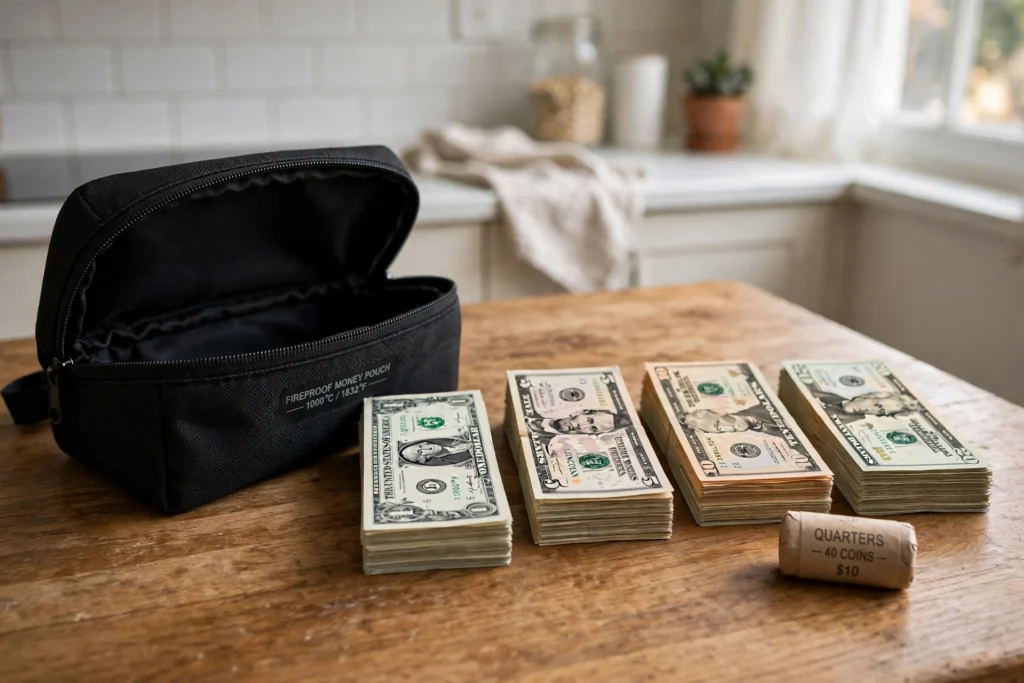
Short answer: Small bills, weighted toward fives, and nothing larger than a twenty. For a $300 home stash: twenty $1s, twenty-two $5s, eight $10s, four $20s, and one $10 roll of quarters — 54 bills plus the roll. The principle underneath the mix: you are stocking a cash register, not a savings account. When the card readers are down, the seller’s change supply is whatever is in the till, and a $100 bill spends like a rumor. The household that can pay close to the exact amount keeps the line moving, gets served, and stays welcome back tomorrow. If you have not settled the total yet, start there: how much cash to keep at home works the amount out from what European governments advise and what a cash-only day actually costs.
SentrySafe SFW123GDC
UL Classified for one hour at 1,700°F and ETL Verified against 24 hours of water — the bulk of the stash lives here, and the interior drawer keeps the working bills (ones and fives) separate from the reserve twenties at the back.
SentrySafe 1200 Fire Chest
UL Classified for 30 minutes at 1,550°F and exactly bill-sized inside: a strap of fives lies flat with the documents underneath. Its 4.7-star average runs across more than 15,000 ratings. Not waterproof — the starter layer, not the whole plan.
ROLOWAY Fireproof Document Bag with Lock
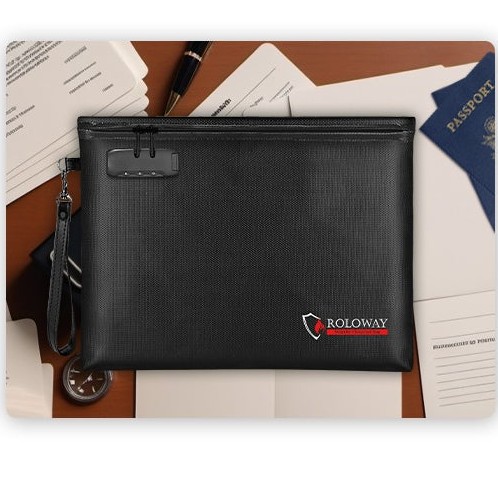
Photo: ROLOWAY.
For denominations, its divided pockets are the point: ones and fives in one slot, tens and twenties in another, so you are never unfolding the whole stash at a register. Its 5,200°F figure is a maker material rating, not a UL certification — a layer, best used inside a safe or chest.
Why the mix matters: the change problem
Picture the second day of a payment outage. The grocery store is open, cash only, and the register float is what the manager brought from home. You hand over a $100 bill for $14 of groceries and you have just spent most of the till’s ability to make change — if they take it at all. Multiply you by forty customers and the store stops breaking big bills by mid-morning. This is not theory: it is how the cash-only days played out after the April 2025 Iberian blackout, and it is why the official advice specifies denominations at all. The European Central Bank’s €70–€100 (about $78–$111) per person comes with “small denominations” attached; Sweden’s brochure says cash “in different denominations”; Ready.gov says “small bills” and stops there, without defining them. The table below is the definition.
| Stash total | $1 bills | $5 bills | $10s / $20s |
|---|---|---|---|
| $150 | 10 | 12 | 3 / 2 |
| $300 | 20 | 22 | 8 / 4 |
| $500 | 20 | 30 | 12 / 10 |
Every row also carries one $10 roll of quarters, included in the total — so the $300 mix is $290 in bills plus the roll. Read the proportions, not just the counts: at $300, ones and fives are 42 of the 54 bills, more than three-quarters of the stack, yet they hold under half the value. The twenties are the reserve for the two or three genuinely large purchases (a tank of fuel, a big grocery run); everything daily — bread, ice, batteries, the pharmacy — is priced in fives and ones. Note what is absent: no $50s, no $100s, at any size. A bigger stash scales the same proportions up rather than graduating to bigger bills, because the change problem does not shrink as your stack grows.
The $300 mix, in dollars: 20 × $1 = $20 · 22 × $5 = $110 · 8 × $10 = $80 · 4 × $20 = $80 — 54 bills = $290, plus one $10 roll of quarters = $300.
No $50s and no $100s, at any stash size. The other rows: $150 = 10 / 12 / 3 / 2 plus the roll; $500 = 20 / 30 / 12 / 10 plus the roll.
Relevant pickROLOWAY Fireproof Document Bag
For denominations, its divided pockets are the point: ones and fives in one slot, tens and twenties in another, so you are never unfolding the whole stash at a register.
Divided pockets · Locking zipper
SentrySafe SFW123GDC
Why this one: The home base for the whole stash — UL Classified for one hour at 1,700°F and ETL Verified against 24 hours of water. The bulk of the stash lives here, and the interior drawer keeps the working bills (ones and fives) separate from the reserve twenties at the back.
How to build the mix without a special errand
Three habits assemble this in about a month. First, the teller swap: any bank branch will trade twenties for a strap of fives and a handful of ones free, in about two minutes — it is the fastest single step and the one most people never think to ask for. Second, ATM discipline: machines mostly issue twenties, so break one twenty a week with a small cash purchase and bank the small bills from the change into the stash instead of spending them. Third, treat the mix as the target when you add money: however the total in the companion page gets built — $20–40 a week is the pace we suggest — add it in fives and ones first, and let the twenties be the last denomination you top up.
Follow-up questions
Should I keep any $50s or $100s at all?
Not in the spending stash. Big bills fail at exactly the moment the stash exists for — nobody in a cash-only line can break them. If you want a deeper reserve than $500, that is bank money, earning interest and insured; the stash’s job is making change-sized purchases for a few days, and it should be built like it.
Do coins beyond quarters earn their weight?
No. A roll of quarters covers the coin-only moments — vending, laundry, exact fares, air pumps. Dimes and nickels solve no problem a quarter doesn’t, and a jar of mixed change is heavy, slow to count, and mostly pennies. One roll is the whole coin plan.
What denominations for a car kit or a go-bag?
The same logic at a smaller scale — even more weight in ones and fives, since a bag’s purchases are snacks, fuel top-ups, and tolls. Our sister desk at Shelter Tactics worked the bag version of this question in full: how much cash should be in the bag, and in what denominations.
Quarters: One $10 roll is the whole coin plan — it covers vending, laundry, exact fares and air pumps.
Dimes and nickels: They solve no problem a quarter does not, and a jar of mixed change is heavy, slow to count, and mostly pennies.
Car kit or go-bag: The same logic at a smaller scale — even more weight in ones and fives, because a bag’s purchases are snacks, fuel top-ups and tolls.
Frequently asked questions
Will an ATM give me small bills?
Usually not — twenties are the default, though a growing number of machines let you choose denominations. When yours doesn’t, the teller swap inside the branch is free and instant.
Does the mix change for a bigger stash?
Only by scaling. The $500 row is the $300 row grown, and a $1,000 stash would be the $500 row doubled — same proportions, still nothing over a twenty.
How do I keep the denominations organized at home?
Separate envelopes, or the divided pockets of a document bag, with the reserve twenties at the back and the working ones and fives in front. The test: in the dark, in a hurry, you can pull out a five without unfolding the whole stash. Where the organized stash should live is the companion page’s subject.
The verdict
“Small bills” is the whole instruction American guidance gives you, and it is not wrong — it is just unfinished. Finished, it looks like this: roughly three-quarters of your bills in ones and fives, tens for mid-size purchases, a thin spine of twenties as the reserve, one roll of quarters, and nothing larger anywhere in the stack. Build it with one teller swap and a month of ATM change, and your stash stops being a wad of money and starts being a working cash register for the week the real ones go dark.
The full set is at What People Are Asking About Outage Living, and the companion page settles the amount: how much cash to keep at home for emergencies.
Talk it over with other homeowners
The Ordinary Prepper Community on Facebook is where readers compare outage plans, show their setups, and help decide what we test next.