As an Amazon Associate, Ordinary Prepper earns from qualifying purchases. Prices last checked October 23, 2026.
Home Readiness — Guide
Best Backup Cooking Options When the Power Is Out, Compared
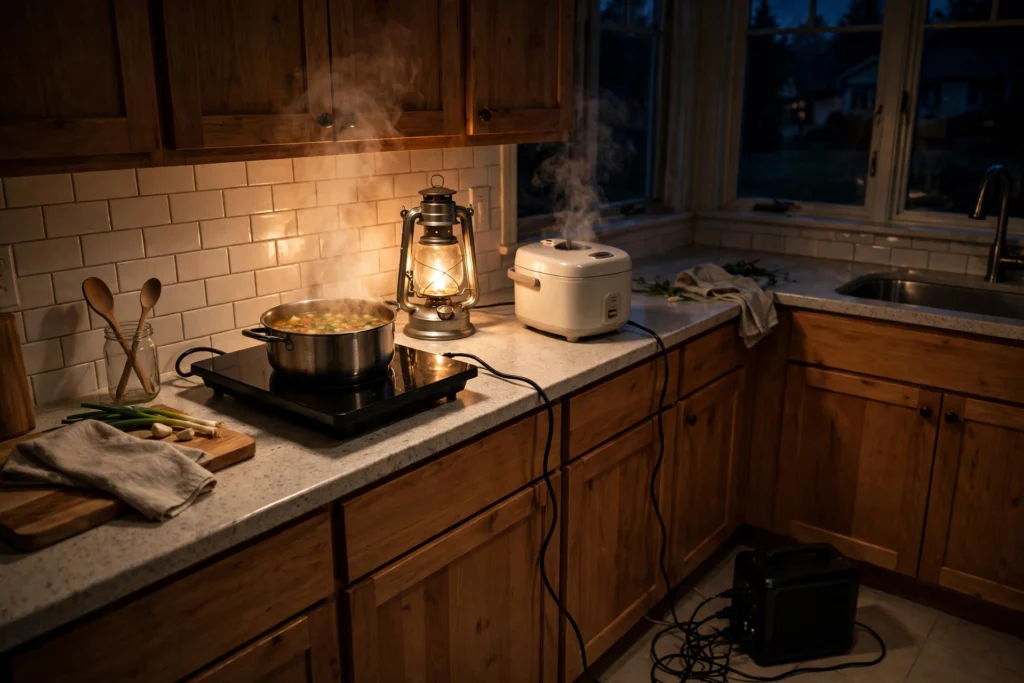
The best backup cooking option for most houses is electric, indoors, and smaller than you think. When the power goes out, the cooking gear that is safe to use inside your kitchen is an induction burner or a small electric cooker running off the same battery station that is keeping your fridge cold — and the meal is affordable only if the cooker sips instead of gulps. A full-size burner meal costs roughly 420 watt-hours of that battery. A little 200-watt rice cooker does a real dinner for about 67. This page compares four indoor-safe routes — the Duxtop induction cooktop, the Dash mini rice cooker, the 45-watt HOTLOGIC Mini, and Sterno canned heat for the day the battery is empty — priced in the only currency an outage respects: what each hot meal costs your backup power. Every figure below uses the same 85%-of-rated-capacity math as our home power sizer and our solar generator comparison, so the numbers cannot drift apart.
How we researched this comparison
We scored 4 products for this comparison — indoor-safe cooking only: an induction cooktop, a mini rice cooker, a low-watt heated oven, and canned heat. Propane is covered separately on the page as outdoor-only and was not scored as an indoor pick. The scores rest on the manufacturers’ specifications — watts above all, because the watt figures drive the battery math — on prices checked on October 23, 2026, and on patterns in verified-owner feedback, in samples from roughly 1,700 to nearly 48,000 reviews, named per product below. We never claim hands-on testing, and affiliate commissions are checked only after scores are set — the full method, with the scoring weights, is on our how we research and score page.
Duxtop Portable Induction Cooktop (9100MC)
The only pick that cooks like your stove — boils, fries, simmers — with no flame and no fumes indoors. The catch is appetite: at full power it eats a home battery faster than anything else on this page.
Dash Mini Rice Cooker
A 200-watt pot that cooks real food from raw — rice, oatmeal, soup, stew for one or two — for about 67 watt-hours a batch. The cheapest hot dinner your battery will ever serve.
HOTLOGIC Mini Portable Oven
A 45-watt heated bag that turns leftovers and frozen meals hot over an hour or two and holds them there — about 90 watt-hours a meal, less than the lights over the table. Slow is the whole trade.
Sterno Canned Heat (2.25-Hour Cans)
The caterer’s fuel: gel cans that store for years, light in seconds, and warm or gently simmer a small pot when there is no battery left to spend. It warms far better than it cooks — read its section before counting on it for dinner.
If you buy through a link in this section, we may earn a commission from the seller. It never costs you extra, and it never changes a score.
How do the four compare on power, fuel, and price?
Counted the way an outage counts them. The battery figures assume the 2 kWh-class station from our power comparison (2,048 watt-hours rated, about 1,740 usable after the honest 15% loss) — and remember that the same battery owes the fridge roughly 1,200 watt-hours a day before anyone cooks.
What one hot meal costs the battery
Watt-hours per meal, from the table above. The same battery owes the fridge about 1,200 watt-hours a day before anyone cooks.
| Product | Power or fuel | Cost per hot meal | Price |
|---|---|---|---|
| Duxtop Portable Induction Cooktop (9100MC) | Up to 1,800 W | About 420 Wh | $84.99 |
| Dash Mini Rice Cooker | 200 W | About 67 Wh | $36.02 |
| HOTLOGIC Mini Portable Oven | 45 W | About 90 Wh | $39.95 |
| Sterno Canned Heat (2.25-Hour Cans) | Gel can, 2.25 h each | About half a can | $22.99 |
In plain terms: the Duxtop cooks anything a stove burner does, for a family; the Dash cooks grains, soups and stews for one or two; the HOTLOGIC reheats leftovers and frozen meals; the canned heat warms and simmers.
Prices last checked: October 23, 2026.
Duxtop Portable Induction Cooktop (9100MC)
Why this one: The only pick that cooks like your stove — boils, fries, simmers — with no flame and no fumes indoors. The catch is appetite: at full power it eats a home battery faster than anything else on this page.
Which of these can you actually use indoors?
All four picks can be used inside a house — that was the entry ticket, and it is where most outage-cooking advice goes wrong. The three electric picks make no flame and no fumes at all. The canned heat burns a small, contained gel flame of the kind caterers use under food in dining rooms; use it on a heat-proof surface, in a ventilated room, never unattended, and away from kids and curtains. What did not get in matters as much: the CDC’s outage guidance is blunt that generators, grills, and camp stoves — propane, butane, charcoal, any of them — should never be used inside a home, garage, or carport, or even outside near an open window, because carbon monoxide is colorless, odorless, and kills hundreds of Americans a year. A cracked window and a CO alarm do not turn a camp stove into an indoor appliance. Propane still has a real place in the plan — outdoors — and it gets its own section below, with the fuel math.
Indoors, or never indoors — CDC outage guidance
✓ Induction burner — no flame, no fumes
✓ Small electric cookers — no flame, no fumes
✓ Canned heat (gel) — ventilated room, never unattended
✗ Generators · grills — never in the house, garage or carport
✗ Camp stoves, any fuel — propane · butane · charcoal
Carbon monoxide is colourless, odourless, and it kills.
Why does the Duxtop induction cooktop win?
Because it is the only pick that cooks the way your kitchen cooks. The Duxtop 9100MC is a 1,800-watt single induction burner (120 V, standard outlet) with settings from a low simmer to full power, a 140–460°F temperature range, a 170-minute timer, and an ETL listing. Induction heats the pan itself — Duxtop rates it 83% efficient — so a pot of soup comes up fast and the counter around it stays cool enough to work on. There is no flame, nothing burning, nothing to ventilate. Run it off a power station and dinner is simply dinner: eggs, pasta, a skillet of whatever the fridge needs used up first.
One Duxtop meal against the battery
Watt-hours. A 25-minute meal at a mid setting, around 1,000 watts, against the 2 kWh station’s usable charge.
The owners’ record is deep. The 9100MC holds 4.4 stars across 9,380 Amazon ratings on Amazon, and the praise that repeats is speed — water boiling in minutes, meals cooked at stove pace. The complaints repeat just as reliably, and they are worth knowing before outage season: the cooling fan is audible and some units add a high-pitched whine at full power (noise is the single most-cited gripe, named by about 14% of reviewers in aggregated feedback); the low settings pulse rather than hold a perfectly steady simmer, so a delicate sauce needs watching; and it only heats pans a magnet sticks to — cast iron and magnetic stainless yes, plain aluminum and copper no. Check your pans with a fridge magnet now, not in the dark.
What it runs on your battery: at a mid setting around 1,000 watts, a 25-minute meal uses roughly 420 watt-hours — about a quarter of a 2 kWh station’s usable charge. Two rules keep it affordable: cook one burner meal a day, not three, and check the station’s output before you count on it — a 1,800-watt burner needs a station rated at least 1,800 watts continuous, which rules out most 1 kWh boxes even though their batteries look big enough on paper. Buy it if your station is 2 kWh-class with a strong inverter and your house expects to cook real meals through a multi-day outage. Skip it if your battery is small — the little cookers below will feed you for a week on what this spends in two days. The Duxtop is $84.99 on Amazon today — the live offer at this check is from a third-party seller rather than Amazon itself.
When is the little Dash rice cooker the smarter buy?
When the battery has to last. The Dash Mini Rice Cooker draws 200 watts — a ninth of the Duxtop’s peak — and cooks a batch of rice in about 20 minutes for roughly 67 watt-hours. That is not a reheating trick; it is real cooking from raw: rice, quinoa, oatmeal, soup, stew, even a small pasta, in a removable nonstick pot with a keep-warm setting when it finishes. At 200 watts it also runs off stations far too small for an induction burner, including the 300–500 watt-hour boxes many households already own for phones and lights. Dash rates it at 2 cups of uncooked rice; owners are consistent that about 1 cup is the practical fill line before it boils over through the lid vent, which makes it a cooker for one or two people, or a side dish for a family — say so plainly and it never disappoints.
Draw, in watts
Peak draw. The Dash runs at a ninth of the Duxtop’s peak — and off the small 300–500 watt-hour boxes an induction burner cannot use at all. The HOTLOGIC draws just 45 W.
The Dash holds 4.4 stars across 47,948 Amazon reviews on Amazon, one of the largest owner samples in small appliances, and the reviews read like a dorm-and-small-apartment classic: dead simple, one switch, good rice, easy to clean. The friction is the size and the ratio — several owners report a batch or two of trial and error on water levels (rinsed rice needs a little less water), and there is no on/off switch, so it runs when plugged in. In an outage those flaws cost almost nothing; the virtue — a hot, real dinner for 67 watt-hours — is the whole game. Buy it if your outage plan is built on the pantry staples from our Food hub — rice and grains are exactly what it cooks. Skip it if you are feeding four or more from one pot; run it twice, or step up to the Duxtop. The Dash is $36.02 on Amazon today.
Relevant pickDash Mini Rice Cooker
A 200-watt pot that cooks real food from raw — rice, oatmeal, soup, stew for one or two — for about 67 watt-hours a batch. The cheapest hot dinner your battery will ever serve.
200 W · About 67 Wh a batch
What does the HOTLOGIC Mini actually do with 45 watts?
It reheats dinner for less electricity than a light bulb uses. The HOTLOGIC Mini is a soft heated case with a 45-watt warming shelf inside (the maker’s own figure) that fits a sealed container up to about 1.5 quarts. There are no buttons and no settings: put in a container of leftovers or a frozen meal, zip it, plug it in, and in one to two hours the food is evenly hot — and it then holds at serving temperature for hours without drying out or cooking further, which is why it works so well on the food an outage actually presents: the fridge’s leftovers, eaten before they spoil. A two-hour meal costs about 90 watt-hours; even left running three hours it spends 135. Nineteen HOTLOGIC meals fit in the usable charge of the 2 kWh station that gives the Duxtop four.
Meals from one 2 kWh station
Hot meals from the usable charge, before the fridge takes its share — the figures stated on this page.
Owners rate it 4.5 stars across 2,315 Amazon ratings on Amazon, and the love is specific: food reheated all the way through with no cold center and no rubbery edges, and a set-and-forget routine people use daily at desks and in trucks. The limits are just as specific. It is slow — an hour is a fast meal — so it rewards planning and punishes hunger. It never boils water and never browns anything. And one detailed critical review reports a unit heating well past the maker’s stated holding temperature, which is why we repeat the maker’s own advice for anything raw: give it time, and check meat with a food thermometer (165°F) rather than trusting the clock. Buy it if your first outage problem is using up the fridge — most houses’ real first problem. Skip it if your plan starts from dry pantry staples, which need actual boiling; that is the Dash’s job. The HOTLOGIC Mini is $39.95 on Amazon today.
What if there is no battery left — can canned heat cook?
Honestly: it warms, and it simmers, and that is the right way to count it. Sterno Canned Heat is the ethanol gel fuel caterers have burned under chafing dishes for a century; the 2.25-hour cans light in seconds, can be capped and relit, and store for years in a cool, dry cupboard with no shelf-life clock ticking the way gasoline’s does. Under a small covered pot it will heat soup through, keep a meal hot, and slowly bring a small amount of water toward a simmer. What it will not do is briskly boil a big pot — owner accounts of a quart of water still short of boiling after the better part of an hour are typical, and a can delivers its heat whether you are ready or not, so ventilation, a heat-proof surface, and never leaving it alone are the standing rules. Fuel is also toxic if swallowed; store cans away from food and small hands.
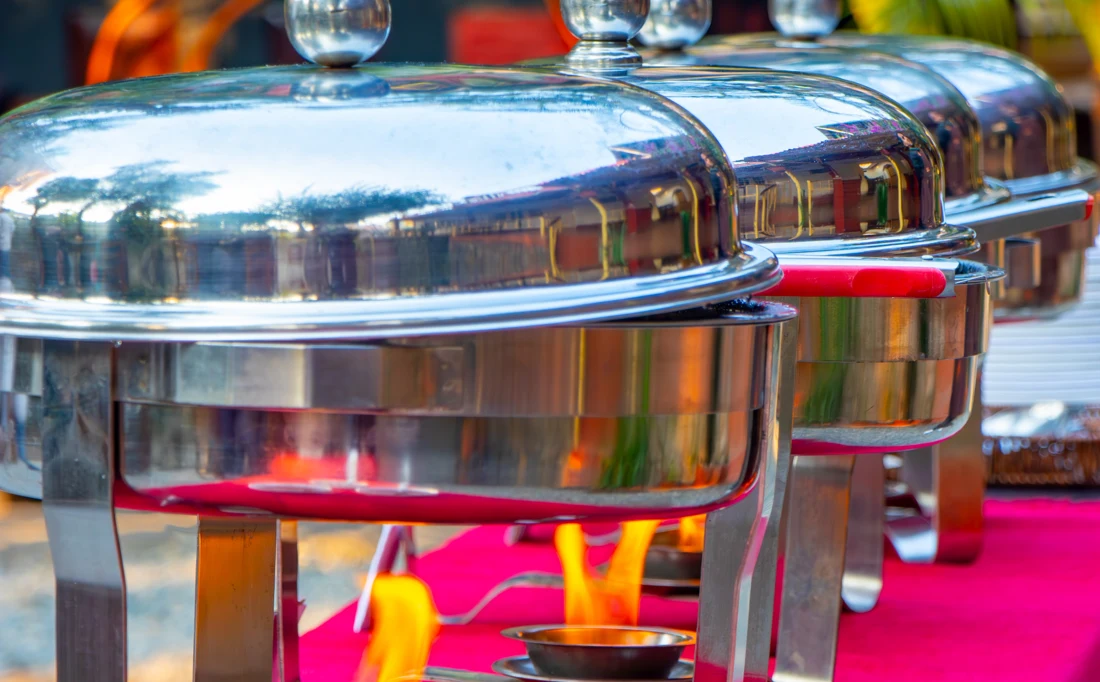
Photo: WordPress Photo Directory (CC0)
The 6-pack listing holds 4.8 stars across 1,716 Amazon ratings, and we are marking its evidence plainly thinner than the electrics’: chafing fuel is a commodity, and its review record is smaller and more scattered than one deep appliance listing. Two honest notes on hardware: the folding camp stove sold under the same brand is not the indoor shortcut it looks like — its own manual tells you to set it up outdoors — so at home, use the cans under a proper chafing stand or a heat-proof trivet arrangement exactly as caterers do, or not at all. Buy it if you want a last layer that asks nothing of any battery and keeps for years. Skip it if it would be your only plan — as a primary cooker it is a slow warmer pretending, and the electrics above are all cheap. A 6-pack of the 2.25-hour cans is $22.99 on Amazon today, sold by Amazon itself, and six cans hold roughly thirteen hours of flame — about two dozen warmed meals. The same cans sit on most grocery and party-supply shelves.
Which option spends the least battery per hot meal?
The Dash Mini Rice Cooker spends the least per meal it truly cooks — about 67 watt-hours a batch — and the HOTLOGIC Mini is close behind at about 90 watt-hours per reheated meal. A kettle of water for freeze-dried meals costs roughly 125 watt-hours a liter. The Duxtop induction burner is the spendthrift at roughly 420 watt-hours for a 25-minute meal at a mid setting — nine Dash batches for one skillet dinner. None of these numbers is a reason to skip the burner; they are a reason to sequence. Eat the fridge’s food first (HOTLOGIC), cook the pantry staples in small electric pots (Dash), and save the full burner for the one real cooked meal of the day. The household emergency checklist puts the same order into a tick-off list for the first three days; the 30-day pantry page prices the food itself.
Spend the battery in this order
1 · Fridge first — HOTLOGIC reheats, ~90 Wh a meal
2 · Pantry staples — the Dash cooks grains, ~67 Wh a batch
3 · One real meal — the Duxtop burner, ~420 Wh a meal
A kettle of water for freeze-dried meals: ~125 Wh a litre. The sequence is the saving.
Where does a propane stove fit, then?
Outside — and out there, it is excellent. A two-burner propane camp stove cooks anything, asks nothing of your battery, and its fuel keeps for years. The math: a 1-pound propane cylinder holds about 21,600 BTU, which runs one burner at full blast for roughly two hours, or both burners for about one — and far longer at the simmer most cooking actually uses. A standard 20-pound tank holds twenty times that, which is weeks of dinners. The storage rules are as plain as the cooking rules: cylinders and tanks live outdoors, upright, never in the house, garage, or basement; the stove cooks outdoors, well away from windows and doors, never in a garage with the door up — the CDC counts a garage as indoors for carbon monoxide, because it is. Used that way, propane is the deepest bench a house can own. Used indoors, it is the accident the outage headlines are made of. There is a linked propane pick in the mentions below, labeled outdoor-only, because that is the only honest label it can carry.
Propane: outdoors only, fuel stored outdoors
Two-burner stove — cooks outdoors. A 1 lb cylinder holds about 21,600 BTU (~2 h, one burner on full); a 20 lb tank is 20× the fuel
Never indoors — the garage counts as indoors (CDC); keep windows and doors clear
Cylinders + tanks: outdoors, upright — never in the house, garage or basement.
What would we skip?
Three things. First, any roundup’s “indoor” butane or propane camp stove with a line about cracking a window — the manufacturers rate those stoves for outdoor use, and carbon monoxide does not grade on effort. Second, a big electric hot plate or a full-size electric skillet as the outage plan: they draw induction-level power without induction’s efficiency, and most add no timer or shutoff. Third, counting on your electric range through a small station — a single range burner can draw 3,000 watts or more, past most portable stations entirely. Small, low, and honest beats big in every outage kitchen we priced.
Three more worth a look
Not reviewed or scored — listed because readers cross-shop them, with the same disclosure as everything here.
COSORI Electric Kettle (1.7 L)
The hot-water route: a 1,500 W kettle boils a liter in about five minutes (~125 Wh), which is all freeze-dried meals, ramen, oatmeal and instant coffee ever ask for.
Coleman Triton 2-Burner Propane Stove
Outdoor use only — never in a house, garage or carport. The classic two-burner camp stove: full cooking power for zero battery, with propane stored outside.
Instant Pot Duo Mini (3-Quart)
The pressure shortcut: at 700 W, sealed pressure cooks beans and rice in a fraction of the simmering time, so a pot of either costs far less battery than a stovetop hour.
As an Amazon Associate, Ordinary Prepper earns from qualifying purchases. The three products above have not been reviewed or scored.
Frequently asked questions
Can you cook indoors safely when the power is out?
Yes — with electric cooking powered by a battery station, or with food eaten as-is. Induction burners and small electric cookers make no flame and no fumes. Fuel-burning camp stoves, grills and charcoal are never indoor appliances, garage included, whatever the ventilation; that is the CDC’s outage guidance, not a preference.
Can a power station run an induction cooktop?
Yes, if two numbers line up: the station’s continuous output must meet the burner’s top draw (1,800 W for the Duxtop here, which rules out most 1 kWh stations), and its capacity decides the meals — about 420 watt-hours for a 25-minute meal at a mid setting, so roughly four such meals in a 2 kWh station’s usable charge.
How long will a power station cook for before it dies?
It depends entirely on the cooker’s watts. On the 2 kWh class (about 1,740 usable watt-hours): roughly 4 induction meals, 25 batches in the 200-watt Dash, or 19 reheated meals in the 45-watt HOTLOGIC — before the fridge’s roughly 1,200 watt-hours a day takes its share. Low watts are long dinners.
Can you use a propane camp stove indoors if you open a window?
No. Propane and butane camp stoves are rated for outdoor use; carbon monoxide builds up in enclosed and partly enclosed spaces faster than a window clears it, and it cannot be seen or smelled. Cook outdoors, away from windows and doors, and store the fuel outside too.
What can you cook with just hot water?
More than most pantries admit: freeze-dried meals, ramen and noodle cups, instant oatmeal, couscous, instant mashed potatoes, and coffee or tea. A liter of boiling water costs about 125 watt-hours from a kettle — which is why the just-add-water layer sits on top of the staples in our pantry plan.
Is canned heat enough to actually cook dinner?
It is enough to heat dinner through and hold it hot, and to simmer a small covered pot slowly. It is not enough to briskly boil a large pot of water — plan on warmed and simmered food, give it time, ventilate the room, and never leave a lit can alone.
Which one should you choose?
Choose the HOTLOGIC Mini first if your battery is modest and your fridge is full — reheating what you already own is the cheapest hot food there is, at about 90 watt-hours a meal. Add the Dash Mini Rice Cooker when the plan turns to the pantry: at about $36 and 67 watt-hours a batch, it is the highest-value cooker on this page, and it is the one that turns the rice-and-beans base of the 30-day pantry into dinner. Choose the Duxtop induction cooktop when your station is a 2 kWh-class machine with an inverter to match and your household expects to cook — really cook — through days without power; budget it one good meal a day and let the little cookers carry the rest. Keep a 6-pack of canned heat in the cupboard regardless: it is the layer that still works when every battery is spoken for. Then run your own numbers in the home power sizer, stock the food with the food storage calculator, and see the whole shelf on the Food hub.
Talk it over with other homeowners. If your outage kitchen is one appliance deep right now, tell us which meal it has to make — the right backup cooker looks very different for a fridge full of leftovers than for a pantry full of dry rice. The Ordinary Prepper Community on Facebook is where readers compare outage plans, show their setups, and help decide what we research next. Join the group →