
As an Amazon Associate, Ordinary Prepper earns from qualifying purchases. Prices last checked October 28, 2026.
Home Readiness — Guide
How Long Will a Power Station Run Your CPAP, Fridge, or Freezer?
Short answer: on one charge of a 2,000 watt-hour station, expect about a day and a half of refrigerator, about three days of chest freezer, or three to five nights of CPAP — and the CPAP spread is almost entirely one switch: the heated humidifier. Every number on this page uses the same honest math as our home power sizer: a station only delivers about 85% of its rated watt-hours to your appliances, because the inverter and the battery’s own protection take the rest. A 2,048 watt-hour station is really about 1,740 usable watt-hours. Plan on the usable number and the outage stops surprising you.
Planned on usable watt-hours, not rated. Every runtime on this page uses about 85% of rated capacity — the inverter and battery protection take the rest:
2,048 Wh station → about 1,740 usable Wh · 2,074 Wh station → about 1,763 usable Wh · 1,056 Wh station → about 898 usable Wh
How we researched this comparison
We scored 4 products for this comparison — the same 2 kWh-class stations as our main solar-generator comparison, scored here on a different job: how long each one runs a CPAP, a fridge, or a freezer, using the 85% usable-capacity factor explained on the page. The scores rest on the manufacturers’ specifications, on prices checked on October 28, 2026, and on patterns in verified-owner feedback, with samples from just under 900 to more than 2,100 reviews, named per station below. We never claim hands-on testing, and affiliate commissions are checked only after scores are set — the full method, with the scoring weights, is on our how we research and score page.
Bluetti Elite 200 V2
2,074 watt-hours — the most capacity in this group — and a 2,600 W inverter that starts a fridge compressor without drama. About 4 nights of humidified CPAP, or a day and a half of fridge.
EcoFlow DELTA 2 Max
2,048 watt-hours with the fastest wall charging in the class — the pick when the outage comes in rolling windows and the battery has to refill between them. Takes expansion batteries later.
Anker SOLIX C1000
1,056 watt-hours — half the battery above, at well under half the weight. Still about 2 nights of humidified CPAP or 5 nights dry, and its 1,800 W output starts a fridge for daytime cycling.
Jackery Explorer 2000 v2
2,042 watt-hours at roughly 39 pounds — the 2 kWh station one person can carry to a parent’s house. Runtime matches the group; solar refills are its slow lane.
If you buy through a link in this section, we may earn a commission from the seller. It never costs you extra, and it never changes a score.
How long does each load actually get?
Three loads, three very different answers. A refrigerator uses about 1,200 watt-hours a day in our standard math (most home fridges land between 1,000 and 1,500). A chest freezer is far cheaper to keep: ENERGY STAR’s certified chest freezers average about 215 kilowatt-hours a year, roughly 590 watt-hours a day, while a certified upright freezer averages about 395 kilowatt-hours a year — roughly 1,080 watt-hours a day, nearly fridge money. A CPAP is the swing load: measured draw on a ResMed AirSense runs about 30–45 watts with the humidifier off, and ResMed’s own specification for the AirSense 10 lists 53 watts as typical consumption with humidification — so we plan 440 watt-hours a night humidified, 320 dry, and 640 for the worst case of humidifier plus heated tube turned up.
What one charge of a ~2 kWh station runs
One load at a time, from the table on this page — split the charge and each shrinks.
| Load | Per day / night | ~1,000 Wh station | ~2,000 Wh station |
|---|---|---|---|
| Refrigerator | ~1,200 Wh a day | About 18 hours | About 1.5 days |
| Chest freezer | ~590 Wh a day | About 1.5 days | About 2.9 days |
| Upright freezer | ~1,080 Wh a day | About 20 hours | About 1.6 days |
| CPAP, humidifier off | ~320 Wh a night | About 2.8 nights | About 5.4 nights |
| CPAP, humidifier on | ~440 Wh a night | About 2 nights | About 4 nights |
| CPAP, humidifier + heated tube | ~640 Wh a night | About 1.4 nights | About 2.7 nights |
The station-by-station fridge numbers, at the prices we verified today:
| Product | Capacity | Fridge runtime | Price |
|---|---|---|---|
| Bluetti Elite 200 V2 | 2,074 Wh | About 1.5 days | $899 |
| EcoFlow DELTA 2 Max | 2,048 Wh | About 1.5 days | $1,029 |
| Jackery Explorer 2000 v2 | 2,042 Wh | About 1.4 days | $899 |
| Anker SOLIX C1000 | 1,056 Wh | About 18 hours | $499.99 |
Prices last checked: October 28, 2026.
Bluetti Elite 200 V2
Why this one: The most capacity in this group and a 2,600W inverter that starts a fridge compressor without drama — about 4 nights of humidified CPAP, or a day and a half of fridge.
Why is the Bluetti Elite 200 V2 the longest runner here?
The Elite 200 V2 runs the longest because it starts with the most: 2,074 watt-hours, about 1,763 of them usable. That is roughly 4 nights of humidified CPAP, five and a half nights dry, or a day and a half of fridge — and its 2,600 W inverter is the strongest here, which matters at 2 a.m. when the fridge compressor kicks and a weaker inverter would sag. Its LiFePO4 battery is rated for roughly 3,000+ cycles to 80% capacity, so the runtime you buy is the runtime you keep for years of outages.
One charge of the Elite 200 V2, by load
Days or nights per charge, from the figures in this section — one load at a time, or split the charge and shorten each.
Owners back the spec sheet. The Elite 200 V2 holds 4.7 stars across 950 Amazon ratings in this week’s tracker check (it was 947 when our solar generator comparison was researched); the praise that repeats is how much power fits in a small box and that it runs a fridge and freezer without drama. The complaints repeat too: at 53.4 pounds it is a place-it-once machine, the phone app drops its connection, and there is no expansion battery if you outgrow it. What it runs, in one line: fridge about 1.5 days, chest freezer about 2.9 days, CPAP about 4 nights humidified — pick any one, or split the charge and shorten each.
Buy it if one machine has to cover the fridge or the CPAP for as long as possible per charge. Skip it if you plan to grow the system later — there is nothing to add on.
When is the EcoFlow DELTA 2 Max the better outage battery?
The DELTA 2 Max is the better battery when the outage is not one long dark stretch but a series of windows — power back for two hours, gone again by dinner. Its 2,048 watt-hours (about 1,741 usable) match the Bluetti’s runtime within a rounding error: about 1.5 days of fridge, 2.9 days of chest freezer, about 4 nights of humidified CPAP. What separates it is refill speed, the fastest wall charging in this class, and expansion batteries that can double or triple the runtime later without replacing the unit.
Usable watt-hours: a rounding-error gap
Rated capacity at the 85% usable factor. The tie is real — this section’s case rests on refill speed and expansion, not runtime.
Owners rate it 4.7 stars across 1,358 Amazon ratings in this week’s tracker check. Praise repeats on the fast charging and an app people actually like; complaints repeat on fan noise under hard work, what the expansion batteries cost, and a smaller set of owners who hit trouble right after a software update. Their own advice is worth copying: set it up, confirm it works, and do not update firmware in storm season.
Buy it if you expect rolling outages or want a growth path. Skip it if the battery will sleep in a bedroom — the fans are honest workers, and you will hear them.
Is the Anker SOLIX C1000 enough if the CPAP is the priority?
Yes — for the CPAP alone, the SOLIX C1000 is enough for most households, and it is the pick we would hand a CPAP user first. Its 1,056 watt-hours (about 898 usable) work out to about 2 nights with the humidifier on, about 2.8 nights dry, and about 5 nights dry if you run it on a DC converter (that math is in the DC section below). Its 1,800 W output also starts a fridge, so the same box can cycle the refrigerator during the day — about 18 hours of fridge in total if the CPAP gets none of it. That split is the honest limit of the 1 kWh class: it can serve the fridge or the CPAP well, and both only briefly.
The C1000 as a CPAP battery, in nights
Nights per charge from its ~898 usable watt-hours, by humidifier setting — the figures in this section.
Anker built this machine’s reputation partly on this exact job: its own CPAP guide names the C1000 its all-round pick for a full night, crediting about 24 hours at a 40-watt dry load using a friendlier 90% efficiency factor — our 85% math is stingier and still lands at two humidified nights. Owners agree the machine is easy to live with: it holds 4.7 stars across 2,166 Amazon ratings, weighs 28.4 pounds, refills from the wall in about an hour by Anker’s rating, and carries a 5-year warranty — the longest promise on this page. The recurring caution is the one this page is built on: it is a two-night CPAP battery, not a four-night one, and owners who bought it expecting to run a fridge and a CPAP together around the clock met the same wall the math above shows.
Buy it if the CPAP is the load that cannot fail and the fridge can be cycled a few hours at a time. Skip it if the plan is fridge-plus-CPAP around the clock — that household needs the 2 kWh class, full stop.
Relevant pickAnker SOLIX C1000
The CPAP-first pick: half the battery above at well under half the weight — still about 2 nights of humidified CPAP or 5 nights dry, and its 1,800W output starts a fridge for daytime cycling.
1,056 Wh · 1,800W output
When does the Jackery Explorer 2000 v2 make sense?
The Jackery Explorer 2000 v2 makes sense when the battery has to move. At roughly 39 pounds it is by far the lightest 2 kWh station here, and its runtime is the group’s runtime: 2,042 watt-hours, about 1,736 usable — about 1.4 days of fridge, 2.9 days of chest freezer, about 3.9 nights of humidified CPAP. Jackery also carries the longest track record in this category, which shows up in parts and support years later.
Weight, where this page states it
Pounds. The EcoFlow’s weight is not stated on this page, so it is not charted. The Anker is the 1 kWh-class station; the other two are 2 kWh class.
It holds 4.4 stars across 893 Amazon ratings. Owners love the size, the quiet charging (under 30 decibels in quiet mode by Jackery’s rating), and the fast wall charging; one owner’s fridge-and-freezer test used only about 55% of the battery in the first 24 hours. The complaints are consistent: solar charging is slow next to the Bluetti and EcoFlow (its solar input ceiling is lower — the same limit we found sizing panels for a fridge), and panels and cases are sold separately.
Buy it if the station will travel between rooms or houses. Skip it if solar is your main refill plan.
How long will a power station run a CPAP with the humidifier on?
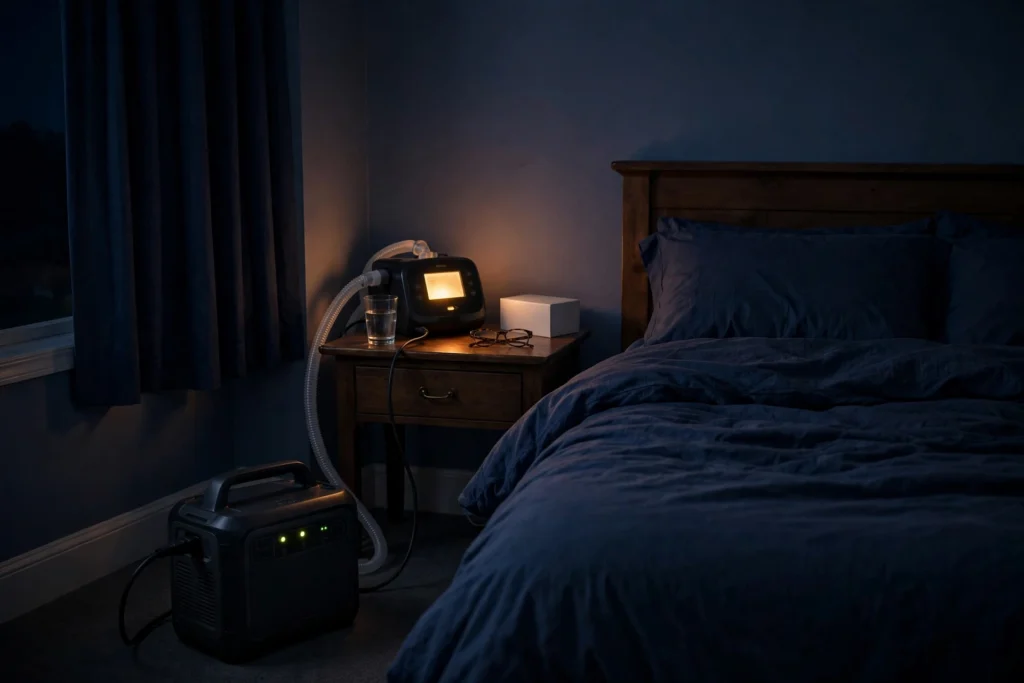
With the humidifier on, plan on about 440 watt-hours per 8-hour night — roughly 4 nights from a 2 kWh station and 2 nights from a 1 kWh station. The humidifier, not the blower, is the load: measured draw on a ResMed AirSense 11 runs 30–40 watts with no humidifier and 50–65 watts with it on, and ResMed’s own AirSense 10 specification lists 53 watts as the machine’s typical consumption. Add a heated tube turned up and draw climbs toward 80 watts — about 640 watt-hours a night, which cuts a 2 kWh station to about 2.7 nights. If you take one decision from this page, take this one before the outage: know whether you can sleep comfortably with the humidifier off or on its lowest setting, because that switch is worth more nights than the difference between any two stations on this page.
The humidifier is the load, not the blower
Measured draw on a ResMed AirSense; the maker’s typical figure with humidification is 53 W.
Should you run the CPAP on DC instead of the wall outlet?
Yes, if your machine has a proper DC converter — it is the cheapest runtime you will ever buy. A CPAP runs on DC power internally. Plugged into the station’s wall outlet, the energy converts twice: battery DC to outlet AC, then the machine’s power brick back to DC, and each conversion takes its cut. A DC converter (ResMed sells one for the AirSense 10 and 11) skips the inverter step and typically saves about 10–15% of the charge. On a dry CPAP that stretches a 1 kWh station from about 2.8 nights to past 3, and a 2 kWh station toward a full week of dry nights. Two cautions: use the converter made for your machine (these are 24-volt devices, and a generic cable is a bad experiment on medical equipment), and confirm the setup works on a normal night at home before you need it at 2 a.m. in the dark.
Wall outlet: two conversions
Battery (DC) → inverter → AC outlet → power brick → CPAP
Direct DC: one conversion
Battery (DC) → DC converter → CPAP — saves about 10–15% of the charge
Can one station run the fridge and the CPAP on the same night?
One 2 kWh station can run the fridge and a humidified CPAP together for about one day — and that sentence is the whole sizing argument for most houses. Add the loads: 1,200 watt-hours of fridge plus 440 of CPAP is 1,640 watt-hours a day, against about 1,740 usable in the 2 kWh class. There is almost nothing left for lights, phones, or a freezer. A 1 kWh station cannot finish that day at all. The workable patterns are these: let the fridge cycle (a shut fridge holds safe temperatures about 4 hours, so the battery only has to win back the cold a few times a day, not hold it every minute), turn the CPAP humidifier down or off, or put the freezer — the cheapest load here at about 590 watt-hours a day for a chest model — on the same battery instead of the fridge and move the fridge food you care about into it. Run your own combination in the home power sizer; it uses this same math.
Fridge plus CPAP against one charge
Watt-hours a day. Combined, the two loads leave about 100 watt-hours of headroom — nothing for lights, phones or a freezer.
What size generator do I need to run 2 refrigerators?
Two refrigerators need about twice one refrigerator — on the energy side. One fridge in our standard math uses about 1,200 watt-hours a day, so two use about 2,400 watt-hours a day. Against a 2 kWh station’s roughly 1,740 usable watt-hours, that is about 17 hours with both plugged in the whole time; a 1 kWh station, at about 898 usable watt-hours, covers roughly 9 hours. Run the pair in shifts instead — a closed fridge holds safe temperatures for about 4 hours — and the same battery stretches much further, because each fridge only needs the power back a few times a day to win its cold back.
Two fridges: the day’s need vs one charge
Watt-hours. Both fridges running the whole time, that is about 17 hours from the 2 kWh class and about 9 from the 1 kWh class.
The starting surge is where two fridges actually bite, and it is a timing problem, not a size problem. Each compressor kicks hard for a second when it starts. If both kick in the same second, a smaller inverter can sag or trip even though the steady draw of the pair is modest. The fix costs nothing: plug the second fridge in half a minute after the first one’s compressor has settled, and the machine never faces both kicks at once. On a generator the same logic sets the size — as planning math, you want enough headroom for one fridge starting while the other runs, plus lights and a router: roughly 2,500 to 3,000 watts of capacity covers two fridges and the small loads comfortably, where a 2,000-watt unit is the honest floor for the two fridges alone. Check your own pair in the home power sizer — enter both fridges and it uses this same math.
How big a generator do you need to run the freezer awhile, then the fridge awhile?
For the rotation in that question — freezer for a stretch, then fridge for a stretch, never both at once — the machine that does it is the same 2 kilowatt-hour class this page keeps landing on, behind an inverter of about 2,200 to 2,600 watts. One load at a time is what makes that size honest. You are not paying to start two compressors in the same second, and you are not feeding both machines around the clock. You are keeping two cold boxes cold in turns, and turns are cheap.
Start with the freezer, because it is the patient one — and with an 18-cubic-foot freezer full of beef, patience is the whole game. A full freezer, doors shut, holds safe temperatures for about 48 hours; the food in it is in no hurry on day one. What it costs to run depends less on those 18 cubic feet than on the shape: a chest freezer averages about 590 watt-hours a day in our standard math, an upright about 1,080 — nearly fridge money. The fridge is the urgent one at about 1,200 watt-hours a day, and a closed fridge only holds safe temperatures for about 4 hours, so the fridge gets the first and most frequent turns.
The day’s arithmetic, on a 2 kWh station with about 1,740 usable watt-hours, looks like this. The fridge’s full day is about 1,200 watt-hours. A chest freezer’s full day is about 590. Together that is about 1,790 — just over one charge, before lights or phones get anything. Rotating is what closes that gap: neither box runs every minute, the freezer can coast for long stretches inside its 48-hour window, and the fridge only needs the power back a few times a day to win its cold back. With an upright freezer the pair totals about 2,280 watt-hours a day, and the same charge covers roughly three-quarters of a normal day for the two — workable for a short outage, and a plain signal that day two needs a recharge plan, not a bigger promise.
Two habits make the rotation work. Stagger the starts: plug the second box in only after the first one’s compressor has settled — the same fix the two-fridge section above uses, because the starting surge is a timing problem, not a size problem. And run your own pair through the home power sizer before the storm, not during it. For what the freezer is doing hour by hour while it waits its turn — holdover times, the refreeze rule, and the frozen-jug trick — see the freezer in an outage, hour by hour.
What should you honestly not count on?
Four caveats, plainly. First, these are planning numbers, not promises: your pressure setting, a warm room, an old fridge with tired seals, and a freezer in a hot garage all move the real figure, usually downward. Second, a running inverter sips power even when the load cycles off — overnight, that idle draw comes out of the same battery, which is one more reason the 85% factor exists. Third, the percentage on a station’s display is an estimate, and it is least accurate exactly when you are counting on the last fifth of the charge; leave a margin for a medical device. Fourth — and this one matters more than any number here — a CPAP is medical equipment. Talk to your equipment provider about your outage plan, test the whole setup on an ordinary night, and never skip therapy to stretch a battery. If outages are long where you live, the honest answer is a bigger battery or a recharge plan, not a thinner margin.
Three more worth a look
Not reviewed or scored — listed because readers cross-shop them, with the same disclosure as everything here.
EcoFlow DELTA 2
The other 1 kWh-class EcoFlow (1,024 Wh) — the C1000’s closest rival, often discounted hard enough to change the math.
Bluetti AC200L
Another 2,048 Wh station, built to grow with add-on batteries — availability on Amazon comes and goes.
Goal Zero Yeti 1500X
The older name in portable power; heavier and slower-charging than this class, still widely owned and supported.
As an Amazon Associate, Ordinary Prepper earns from qualifying purchases. The three products above have not been reviewed or scored.
Frequently asked questions
Will a 1,000 Wh power station run a CPAP all night?
Yes, comfortably — about two nights with the heated humidifier on (roughly 440 watt-hours a night against about 870–900 usable watt-hours), and close to three nights with the humidifier off. It is the fridge-plus-CPAP combination, not the CPAP alone, that outruns a 1 kWh station.
How many nights will a 2,000 Wh station run a CPAP?
About four nights with the humidifier on, about five and a half with it off, and about two and three-quarter nights in the worst case — humidifier plus heated tube turned up. A DC converter stretches the dry figure toward a week by skipping the inverter’s conversion loss.
Does the CPAP humidifier really drain the battery that much faster?
Yes. The blower itself is a modest load — measured at roughly 30–40 watts on a current ResMed machine. The heated humidifier is a heating element, and it roughly doubles the draw; ResMed lists 53 watts as the AirSense 10’s typical consumption. Turning the humidifier off is worth more extra nights than upgrading one station size.
How long will a power station run a chest freezer?
Longer than most people expect. An ENERGY STAR chest freezer averages about 590 watt-hours a day, so a 2 kWh station runs one for about 2.9 days and a 1 kWh station for about 1.5 days. An upright freezer uses nearly twice the energy — about 1,080 watt-hours a day — and lands closer to the fridge’s numbers.
Can a power station start a refrigerator, or will the surge trip it?
Starting is about watts, runtime is about watt-hours. A fridge compressor’s startup surge is brief but real, and every station on this page has at least 1,800 W of continuous output — enough headroom for a home fridge. Small 300–600 W stations can run a CPAP beautifully and still fail to start a fridge; check the output rating, not just the capacity.
Do I need a pure sine wave station for a CPAP?
Use one. CPAP manufacturers specify pure sine wave power, and essentially every current station from the brands on this page provides it. Modified sine wave can make a power supply buzz or run hot — a pointless risk on equipment you rely on to breathe at night.
Which one should you choose?
Choose by the load that cannot fail. If it is the CPAP, the Anker SOLIX C1000 at $499.99 covers two humidified nights (more on DC, more again dry) and still starts the fridge for daytime cycling — most CPAP households do not need more battery than that. If the fridge and the CPAP both have to run around the clock, the honest floor is the 2 kWh class: the Bluetti Elite 200 V2 ($899) for the longest single charge, the EcoFlow DELTA 2 Max ($1,029) if you want expansion batteries and the fastest refill, the Jackery Explorer 2000 v2 ($899) if the station has to be carried. Expect about one full day of fridge-plus-humidified-CPAP from any of them, and plan the recharge — panels, a generator rotation, or a neighbor’s outlet — for day two. The rest of the first three days lives on the household emergency checklist, and the full shelf is on the Power hub.
Talk it over with other homeowners. If you sleep with a CPAP, tell us how many nights your battery actually lasted and whether you ran the humidifier — those real numbers are what the next household’s plan gets built on. The Ordinary Prepper Community on Facebook is where readers compare outage plans, show their setups, and help decide what we research next. Join the group →