
As an Amazon Associate, Ordinary Prepper earns from qualifying purchases. Prices last checked October 24, 2026.
Home Readiness — Guide
Best Rain Barrels and Collection Setups Compared
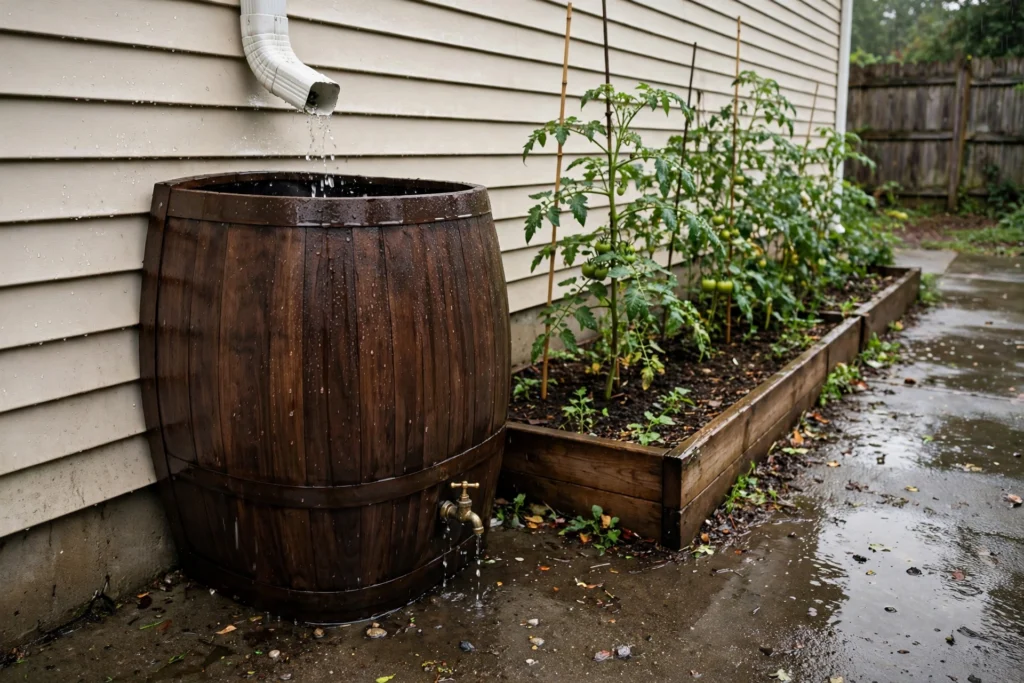
The best rain barrel for most houses is the RTS Home Accents 50-Gallon Flat Back — not because it holds the most water, but because it is the barrel owners keep for a decade: thick walls, a real brass spigot, and a back that sits flat against the house. But a barrel alone is not a setup. One inch of rain on a 1,000-square-foot roof makes roughly 600 gallons of water, so a 50-gallon barrel fills in the first minutes of a real storm — what you do with the other 550 gallons (a diverter that sends overflow back down the downspout) matters more than the barrel’s shape. This page scores four barrels as the systems they actually are: barrel, spigot, overflow, winter plan, and what the whole thing costs per gallon stored. The water itself is for the garden and the yard — rain off a roof is not drinking water, and every pick here is graded on that job.
How we researched this comparison
We scored 4 products for this comparison — the 50-gallon class, plus one 100-gallon collapsible — across rigid barrels, a linking system, and a fold-flat design. The scores rest on the manufacturers’ specifications and materials, on prices checked on October 24, 2026 — one barrel’s price could not be verified that day, so none is printed — and on patterns in verified-owner feedback, in samples of roughly 2,000 to 3,200 reviews, named per barrel below. We never claim hands-on testing, and affiliate commissions are checked only after scores are set — the full method, with the scoring weights, is on our how we research and score page.
RTS Home Accents 50-Gallon Flat Back Rain Barrel
The decade barrel: UV-stable plastic, a brass spigot that does not feel like a toy, a debris screen on top, and a flat back that hugs the wall instead of eating the walkway.
FCMP Outdoor Raincatcher 4000 (50-Gallon)
Recycled, BPA-free plastic with a proper overflow port and a linking system for a second barrel — built to become 100 gallons against the house. Buy it at its normal price, not this week’s; its section explains.
Good Ideas Rain Wizard 50
A flat-back 50 with a brass spigot and a fine mesh screen, made in the USA. Sound barrel; the handles are the weak point owners keep naming.
VINGLI 100-Gallon Collapsible Rain Barrel
Twice the gallons for the least money, and it folds flat for winter. The trade is durability: PVC fabric and zippers ask more care than a rigid barrel, and owners say so.
If you buy through a link in this section, we may earn a commission from the seller. It never costs you extra, and it never changes a score.
How do the four compare as setups?
Counted the way a house uses them: what arrives in the box, what you still have to buy (a diverter kit is a separate purchase for every barrel here), and what a gallon of storage costs once the setup is complete. None of these barrels ships with a downspout diverter — budget roughly the price of the EarthMinded kit in our mentions on top of any pick, or plan to cut the downspout and route overflow by hose.
Four barrels, four setups — every one still needs a diverter kit; none ships with one
RTS Flat Back — debris screen, brass spigot, 50 gal
FCMP Raincatcher — debris screen, overflow port, links to a second barrel, 50 gal
Rain Wizard 50 — debris screen, brass spigot, made in the USA, 50 gal
VINGLI Collapsible — PVC fabric, folds flat, 100 gal
A full barrel in a storm is a hose pointed at the foundation — plumb the overflow.
| Product | Capacity | Spigot | Price |
|---|---|---|---|
| RTS Home Accents 50-Gallon Flat Back | 50 gal | Brass | $99.00 |
| FCMP Outdoor Raincatcher 4000 | 50 gal | Plastic, with overflow port | Price not verified today |
| Good Ideas Rain Wizard 50 | 50 gal | Brass | $159.99 |
| VINGLI 100-Gallon Collapsible | 100 gal | Plastic, dual taps | $61.99 |
In plain terms: the RTS and the Rain Wizard are rigid flat-backs with brass spigots; the FCMP trades the brass for a better overflow-and-linking system in recycled plastic; the VINGLI is a fabric tank that folds away, with all the lifespan questions that implies. Every one needs its overflow plumbed somewhere safe — a full barrel in a storm is a garden hose pointed at your foundation if it is not.
Prices last checked: October 24, 2026.
RTS Home Accents 50-Gallon Flat Back Rain Barrel
Why this one: The barrel owners keep for a decade: UV-stable plastic, a brass spigot that does not feel like a toy, a debris screen on top, and a flat back that hugs the wall instead of eating the walkway.
Why does the RTS Home Accents barrel win?
The RTS 50-Gallon Flat Back wins on the two things that decide whether a rain barrel is still working in year five: the spigot and the wall. Its spigot is brass, threaded into a thick flat-backed body of UV-stable polyethylene — the flat back sits flush against siding, so the barrel takes inches of walkway instead of a foot and a half, and the lid carries a debris screen that keeps leaves and mosquitoes out of the water. It is the barrel the big test roundups keep landing on, and the design reason is boring in the best way: there is very little on it to break.
Flat back, against the wall — the RTS 50-gallon’s wall side is the design
The flat back sits flush to the siding, with a debris screen lid and a brass spigot, in a thick UV-stable body — it takes inches of walkway, not a foot and a half
When an RTS barrel leaks, it leaks at a fitting first — reseat the thread and the reports stop.
Owners have kept this barrel long enough to hold a settled opinion: it holds 4.4 stars across 2,060 Amazon ratings in this week’s tracker check. The pattern underneath is consistent — when an RTS barrel leaks, it leaks at a fitting, in the first week, because a spigot thread went in without tape or went in cross-threaded; reseat it properly and the reports stop. Reports of the barrel body itself splitting are rare, which is the right way around for a product whose whole job is to sit full of water against your house for ten summers. The gap in the box is the diverter: RTS sells the barrel, not the plumbing, so a complete setup adds the diverter kit from our mentions below.
Buy it if you want one barrel, installed once, against the house. Skip it if your budget has to cover the diverter too — the FCMP below leaves more room for it.
When is the FCMP Raincatcher 4000 the smarter buy?
The FCMP Raincatcher 4000 is the smarter buy when the plan is two barrels and you can get it at its normal price. It is a 50-gallon flat-back in BPA-free recycled polyethylene with an aluminum debris screen, a corrosion-proof screen guard, and — the detail that matters in a storm — a proper overflow port plus a linking kit path, so a second barrel fills from the first instead of the excess running down your foundation. At its normal price it is also the value route to 100 linked gallons — though “normal price” is doing real work in that sentence this week, for the reason given two paragraphs down.
One barrel, or two linked
Gallons against the house. The FCMP’s overflow port and linking path are the route from the first figure to the second.
Owners rate the Raincatcher 4000 family 4.5 stars across 3,172 Amazon reviews, and the reports gathered across this season’s test roundups repeat two themes: the barrel itself holds up — thick recycled plastic, no drama — and the fittings are where the leaks live, the spigot and overflow threads wanting plumber’s tape and a patient hand at install, the same fitting-first pattern as the RTS. A buying warning, because we hit it ourselves this week: this barrel’s Amazon presence is a mess of lookalike listings, and the genuine one — sold under the maker’s full name, Forest City Models and Patterns — currently has no Amazon-direct offer at all, only third-party sellers, at prices the two trackers put somewhere between about $225 and $240. That is more than double the RTS above, so this pick carries its link but no printed price, the same treatment we give anything we cannot price cleanly. The barrel is worth having at its normal price. At this week’s third-party pricing, buy the RTS twice instead.
Buy it if you are building toward 100 linked gallons. Skip it if the spigot will see daily use with a watering can — plastic spigots are the wear item on this barrel, and the RTS’s brass is worth its premium for heavy hands.
Relevant pickFCMP Outdoor Raincatcher 4000 (50-Gallon)
Recycled, BPA-free plastic with a proper overflow port and a linking system for a second barrel — built to become 100 gallons against the house.
50 gallons · Overflow port · Links to a second barrel
What does the Good Ideas Rain Wizard 50 do differently?
The Rain Wizard 50 is the American-made flat-back: rotationally molded HDPE, a brass spigot, a fine mesh screen that keeps bugs and debris out, and a linkable design if a second barrel joins later. On paper it matches the RTS feature for feature. It lands a step behind on the owner record — the handles molded into the body are the recurring complaint, splitting under load on some barrels, which matters every time you drag a full-ish barrel away from the wall for cleaning. A barrel you cannot move gets cleaned less, and a barrel cleaned less grows the mosquito and algae problems the screen was meant to prevent.
Linking: the second barrel fills from the first — FCMP Raincatcher 4000
The downspout diverter fills barrel 1 (50 gal). A link hose at the top carries the overflow into barrel 2 (50 gal), which fills from barrel 1 — 100 linked gallons, and both drain from barrel 1’s spigot
Overflow becomes capacity.
The owner record: the Rain Wizard family holds 4.3 stars across 3,202 Amazon reviews, and this week the black barrel sells through third-party sellers at $159.99 on both trackers — no Amazon-direct offer, so check who the seller is before you buy. What the roundups that handled the barrel repeat is the split already named: the barrel, the screen, and the brass spigot draw no complaints, and the molded handles draw all of them. Buy it as a barrel that lives in one place and it behaves like the RTS. Buy it as a barrel you will haul around and the handles become the story.
Buy it if made-in-USA matters and it costs less than the RTS the week you buy. Skip it if you will move the barrel often — plan to empty it first, every time.
Should anyone buy a collapsible rain barrel?
Yes — the household whose constraint is storage, not water. The VINGLI 100-Gallon Collapsible holds twice the water of the rigid picks for the least money here, stands on PVC legs with dual spigots and an overflow port, and at season’s end it folds down to a package that fits on a garage shelf. For a renter, a mild climate, or a first season of finding out whether you actually use rainwater, that is a rational trade. The honest cost is lifespan: the shell is PVC mesh fabric, not a molded wall, and the owner record is full of the expected words — leaks at seams and spigot, zippers and fabric aging in sun, stability worries when full. Treat it as a two-to-three-season tool, keep it out of deep freeze, and it earns its price. Expect a decade from it and you will be disappointed on schedule.
The collapsible trade: folds away, asks more care — VINGLI 100-gallon
PVC mesh fabric with dual spigots and an overflow port. Standing, it holds 100 gal; folded flat, it is a package for a garage shelf
Keep it out of deep freeze — folded away each winter is how it lasts. Honestly counted, a two-to-three-season tool.
Owners rate the VINGLI 3.7 stars across 3,089 Amazon ratings in this week’s tracker check — the weakest record on this page — and the reviews read like two different products. Renters and mild-climate owners who fold it away each winter are pleased with it. Owners who left it standing year-round in sun and freeze report the leaks — at the spigot threads first, then at seams and the zipper — that end its service early. Both groups are describing the same barrel honestly. Its lifespan is a decision you make at setup, not a lottery you enter.
Buy it if winter storage space is your real problem. Skip it if your winters freeze hard and the barrel would have to live outdoors through them.
Do you need a diverter, or can the barrel just sit under the downspout?
You need a plan for overflow, and a diverter is the cleanest version of one. The math is unforgiving: a quarter inch of rain on a modest 1,000-square-foot roof section is about 150 gallons — three barrels’ worth, in one passing shower. Without a diverter, you either cut the downspout to barrel height and let the excess pour out of the overflow port (which must be hosed well away from the foundation), or you use a diverter kit that fills the barrel and then automatically sends the rest back down the downspout where it always went. Every barrel on this page ships without one. That is not a scandal — diverters are downspout-size specific — but any setup price that leaves it out is understated by the price of the kit, and any installation that leaves overflow unplanned is a foundation problem scheduled for the first big storm.
Where the water goes when the barrel is full
The diverter kit sends downspout water into the barrel first. When the barrel is full, the overflow returns to the downspout — or hose the overflow port well away from the foundation
¼ inch of rain on 1,000 sq ft of roof ≈ 150 gallons — three barrels’ worth.
How do you keep mosquitoes out of a rain barrel?
A sealed barrel with an intact fine-mesh screen is not a mosquito nursery — mosquitoes need access to the water surface, and the screens on all four picks deny it. The breeders are the neglected barrels: a torn screen, a lid left ajar, an overflow port with no hose or mesh. Check the screen each spring, keep the lid seated, and if the barrel is ever opened or the screen damaged, a mosquito dunk (the Bti rings sold for birdbaths) makes the water lethal to larvae and is considered safe for gardens and pets. The cheapest mosquito control is turnover: a barrel that gets used and refilled is a poor nursery compared to one that sits stagnant all summer.
What happens to a rain barrel in winter?
Ice is what ends rain barrels. Water expands as it freezes, and a full rigid barrel in a hard freeze can split at the seam or crack around the spigot — the damage owners report in spring usually happened in January. The winter routine for cold climates: drain the barrel before the first hard freeze, leave the spigot open, disconnect it from the downspout (a diverter makes this a two-minute job; a cut downspout needs its elbow put back), and store it upside down or under cover so it cannot refill and freeze. The collapsible VINGLI skips most of this by folding onto a shelf — its one structural advantage. In mild-winter country, draining and leaving the spigot open is enough.
What can you actually use rain barrel water for?
Gardens, lawns, trees, car washing, and rinsing tools — the outdoor jobs. Not drinking, not cooking, not the kiddie pool: roof runoff picks up whatever the roof holds (shingle grit, bird droppings, airborne residue), and the CDC and EPA both treat harvested rainwater as non-potable without real treatment. Water the soil, not the salad leaves, and wash vegetables from the tap. Where it shines in a readiness plan is different: it is 50 to 100 gallons that is already at the house for flushing, washing, and garden survival in a dry outage — a working reserve next to the sealed drinking water in our water storage comparison, not a replacement for it. Legality is rarely a barrier: rain harvesting is broadly legal across the US, Colorado is the notable cap (two barrels, 110 gallons total, single-family homes), and a few HOAs have their own say. Check your local rules once, then collect.
Rain barrel water: the outdoor jobs — roof runoff is not drinking water; the CDC and EPA treat it as non-potable
✓ Gardens + lawns — water the soil, not the leaves
✓ Trees, car washing, rinsing tools
✓ Outage reserve — flushing and washing
✗ Not for drinking — not cooking, not the kiddie pool. Wash vegetables from the tap
Colorado caps collection at 2 barrels, 110 gal.
Three more worth a look
Not reviewed or scored — listed because readers cross-shop them, with the same disclosure as everything here.
EarthMinded DIY Rain Barrel Diverter Kit
The missing half of every setup on this page: fills the barrel, then routes overflow back down the downspout automatically.
Oatey Mystic Rainwater Collection System
The other diverter route: a two-piece unit that cuts into a standard 2×3 downspout and fills the barrel through a hose — often the cheapest way to plumb overflow properly.
Algreen Cascata 65-Gallon Rain Barrel
The decorative route: 65 gallons behind a stone-look body with a planter top, for a barrel that has to live in the front garden.
As an Amazon Associate, Ordinary Prepper earns from qualifying purchases. The three products above have not been reviewed or scored.
Frequently asked questions
How much water does one rain barrel actually save?
The EPA estimates a rain barrel saves the average home about 1,300 gallons over a summer — water that comes off the roof in minutes and would otherwise be gone. The barrel is small; the roof is big; the saving is in the turnover, filling and emptying again and again through the season.
Is rain barrel water safe for vegetable gardens?
For the soil, yes — that is the standard guidance and the main use. Water at the base of plants rather than over leaves you will eat, and wash harvested vegetables with tap water. The cautions are about drinking and food contact, not about tomatoes growing in watered soil.
Can I link two rain barrels together?
Yes, and it is the cheapest capacity upgrade there is. The FCMP and the Rain Wizard are built for it with linking ports near the top; the first barrel fills, overflow passes to the second, and both drain from the first barrel’s spigot. Two linked 50s beat one exotic 100 for most houses — and give you a spare if one cracks.
Does a rain barrel need to sit on a stand?
It does if you want to fill a watering can. A spigot near the barrel’s base has a can’s height of clearance problem: raise the barrel on blocks, pavers, or a stand and gravity does the rest; leave it on the ground and you are dipping or pumping. Full barrels weigh over 400 pounds at 50 gallons, so whatever it stands on must be level and solid.
Is it legal to collect rainwater?
Almost everywhere in the US, yes for household garden use. Colorado is the famous exception with a cap — two barrels and 110 gallons total for single-family homes — and some cities and HOAs add conditions. It is a five-minute check of your state and local rules before the barrel arrives.
Should rain barrels be emptied before winter?
In any climate with hard freezes, yes: drain it, leave the spigot open, take it off the downspout, and store it so it cannot refill. Ice expansion is the main killer of rigid barrels, and the spring leak that seems to come from nowhere usually started as a January crack.
Which one should you choose?
Buy the RTS Home Accents 50-Gallon ($99.00) if this is a one-and-done install against the house — it is the barrel least likely to need replacing. Buy the FCMP Raincatcher 4000 (price not verified this week — see its section) if the plan grows to two linked barrels or the diverter has to fit the same budget. Take the Rain Wizard 50 ($159.99) when made-in-USA matters and you will not be dragging it around. Take the VINGLI collapsible ($61.99) if winter storage decides everything, and price it as a few seasons, not a decade. Whichever you choose, buy the diverter in the same order, raise the barrel on something solid, and size the drinking-water side of the house separately with the water storage calculator — the full shelf is on the Water hub.
Talk it over with other homeowners. If you run a rain barrel, tell us what your overflow does in a real storm and whether your barrel has survived a winter — that is the part of the setup no product page describes. The Ordinary Prepper Community on Facebook is where readers compare outage plans, show their setups, and help decide what we research next. Join the group →