
As an Amazon Associate, Ordinary Prepper earns from qualifying purchases. Prices last checked October 27, 2026.
Home Readiness — Guide
Automatic Backup Without Solar: A Power Station the Generator Recharges
Short answer: Yes — and it is the quietest way to own a loud machine. The station sits inside and carries the furnace, both sump pumps, the fridge, and the lights by itself. The generator never powers the house directly; it goes outside a few times a day and does one job, refilling the station. On the load table below — about 5,000 watt-hours a day — that takes roughly 3½ hours of generator time a day, and the cycle repeats for as many days as you have fuel.
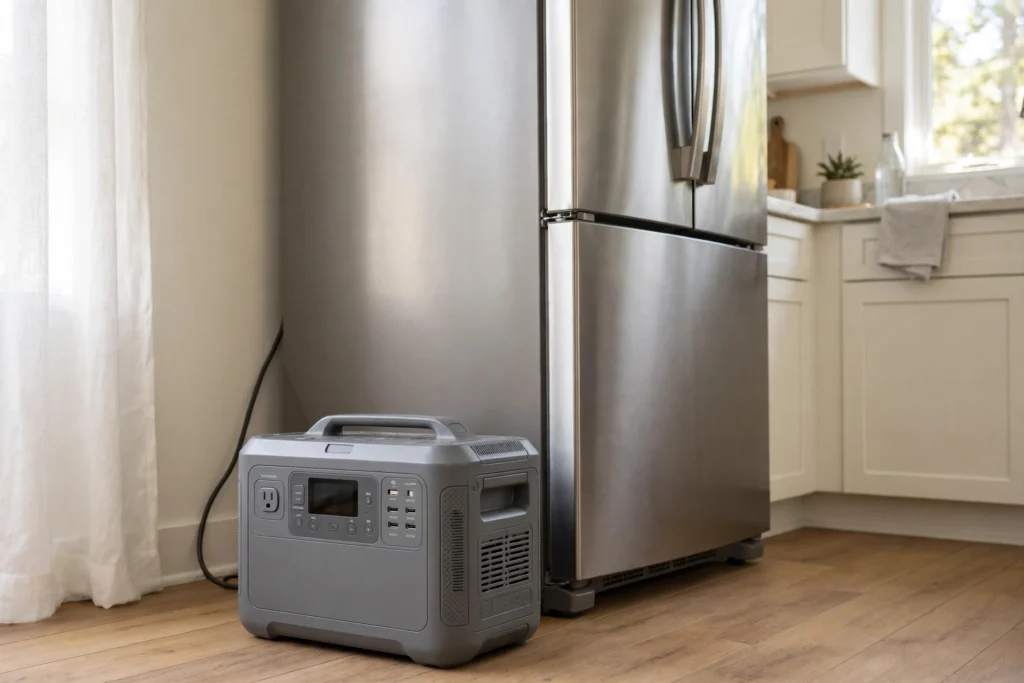
EcoFlow DELTA 2 Max
1,800W AC input — the fastest refill in its class, full in about 80 minutes — and the only pick that can grow later, to 6,144 Wh. What it runs: the whole load table below for about 8 hours per charge, on the roughly 1,741 usable watt-hours you actually get from its 2,048.
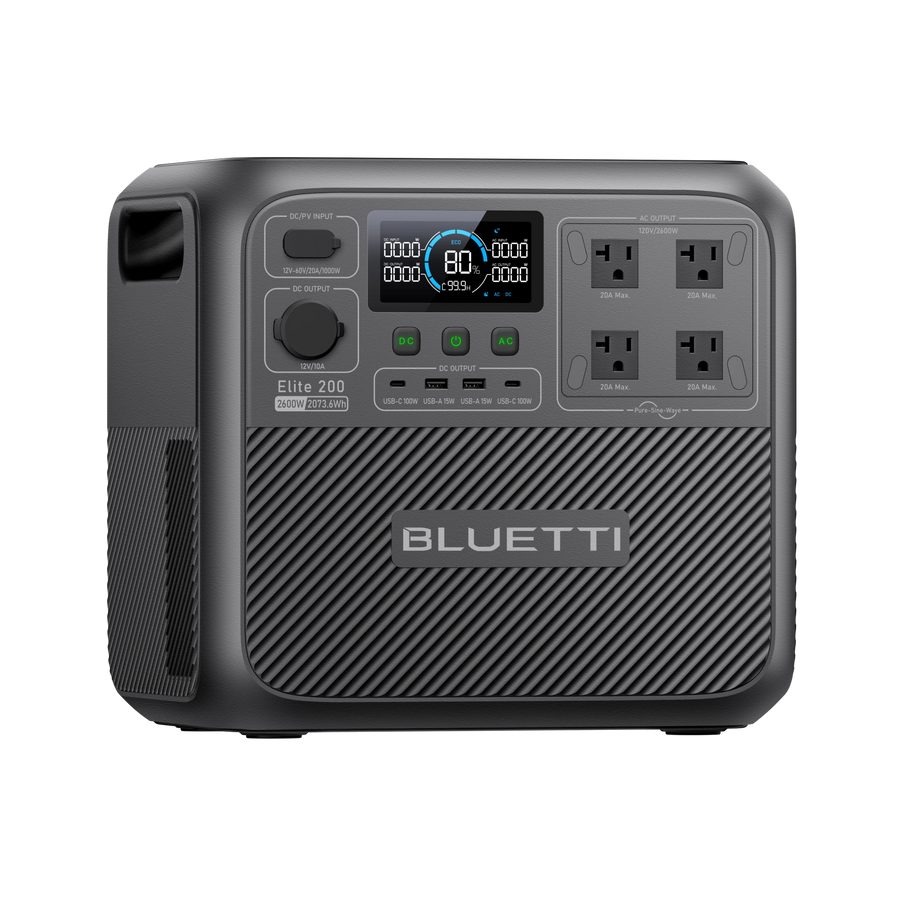
Bluetti Elite 200 V2
The strongest inverter here at 2,600W, a battery rated for 6,000+ cycles, and the same 1,800W top charge speed in Turbo mode. What it runs: the same load table for about 8 hours per charge, on roughly 1,763 usable watt-hours of its 2,074.
Champion 2500W Dual Fuel Inverter Generator (200961)
2,500 starting watts, 1,850 running on gasoline (1,665 on propane), 39 pounds, 53 dBA. What it does: refills either station above in runs of about 1½–2 hours, then shuts off. Amazon pricing on this listing swings too much to print honestly; check it before you buy.
The load table for this house
The house in the question is 2,200 square feet with an oil furnace and two sump pumps. Square footage does not draw power — machines do. “Hours a day” means actual run time: the furnace, fridge, and pumps all cycle on and off.
| Load | Running watts | Hours a day | Watt-hours |
|---|---|---|---|
| Oil furnace (burner + blower) | 800 | 3 | 2,400 |
| Sump pump 1 (1/3 hp) | 800 | ½ | 400 |
| Sump pump 2 (1/3 hp) | 800 | ½ | 400 |
| Refrigerator | 150 | 8 | 1,200 |
| Lights, router, phones | 75 | 8 | 600 |
| Total | 5,000 |
Two honesty notes. First, the pumps: a pump runs a minute or two per cycle, so half an hour of actual pumping per pump is a wet-weather day; on a dry day they may not run at all, and the total drops toward 4,200 watt-hours. Second, the furnace: a bitter cold day can double its run time, pushing the day toward 7,000 watt-hours — the plan still works, the generator just runs longer.
One catch: a station delivers about 85% of its rated capacity after inverter losses — 1,741 usable watt-hours for the EcoFlow, 1,763 for the Bluetti. The station is a bucket, not a well. The generator is the well.
One day in this house: 5,000 watt-hours. Oil furnace (burner + blower) 2,400 Wh · refrigerator 1,200 Wh · lights, router, phones 600 Wh · sump pump 1 (1/3 hp) 400 Wh · sump pump 2 (1/3 hp) 400 Wh.
The math: Furnace 800 W × 3 hours; fridge 150 W × 8 hours; lights, router and phones 75 W × 8 hours; each pump 800 W × half an hour. Hours a day means actual run time — furnace, fridge and pumps cycle on and off. On a dry day the pumps may not run at all and the total drops toward 4,200 watt-hours.
EcoFlow DELTA 2 Max
Why this one: 1,800W AC input — the fastest refill in its class, full in about 80 minutes — and the only pick that can grow later, to 6,144 Wh. It runs the whole load table for about 8 hours per charge, on roughly 1,741 usable watt-hours.
The recharge cycle, in numbers
Both stations can accept up to 1,800W of AC charging. The Champion only makes 1,850 running watts on gasoline, so do not run it flat out — dial the station’s charge rate down to about 1,500W (the Bluetti’s standard mode is 1,440W; the EcoFlow’s rate adjusts in its app). At 1,500W, putting back 5,000 watt-hours plus charging losses takes roughly 3½ hours a day. Split it into two runs — morning, and a top-up before bed — and the house never hears it at night.
Fuel follows the same math: roughly a gallon of gasoline a day on this schedule — an estimate, since burn varies with load and temperature. Run the house straight off a generator instead and it idles along all 24 hours: roughly three times the fuel, all of the noise, and everything dies each time it runs dry. On propane, one grill tank stretches the same work across several days.
Placement is not negotiable. Outside only, at least 20 feet from any window, door, or vent, exhaust pointed away. Never in a garage — not even with the door open — a porch, or a basement. Carbon monoxide has no smell and builds up fast. Keep battery-backed CO alarms in the house, and let it cool before refueling.
EcoFlow DELTA 2 Max — the fastest refill
The DELTA 2 Max stores 2,048 watt-hours in an LFP battery rated for 3,000 cycles, puts out 2,400W (4,800W surge) across six AC outlets, and charges at up to 1,800W — full in about 80 minutes, the quickest AC refill in this class, and every minute of charging is a minute of engine noise. It is also the only station here that grows, to 6,144 watt-hours with extra batteries.
The owner record is the deepest here: 4.7 stars across 1,357 Amazon ratings, rechecked for our October 25 comparison. The complaint in independent reviews is about output, not reliability — 2,400W gives up a step to stronger rivals.
When/who: pick this one if short generator runs are the priority, or if you can already see yourself adding a battery next year.
Bluetti Elite 200 V2 — the longest-lived battery
The Elite 200 V2 stores 2,073.6 watt-hours, puts out 2,600W — the strongest inverter here — and rates its LFP battery for 6,000+ cycles, twice the EcoFlow’s rated life. Charging comes in three modes: Silent at 800W, Standard at 1,440W, Turbo at 1,800W (full in about 1.4 hours). Standard is the quiet gift — 1,440W is almost exactly what a small generator can hand over without straining. No way to add capacity later.
Owners rate it 4.7 stars across 947 Amazon ratings in the sample behind our October 25 comparison. The recurring knocks are physical: 53.4 pounds with no wheels is a two-hand carry, and there is no weatherproofing, so it lives indoors — fine for this job. Its Power Lifting mode (3,900W) covers heating-type loads only, so the honest motor budget is 2,600W.
When/who: pick this one if the station will sit in one corner for years and you want the battery rated to outlast the other options.
The 85% rule: A station delivers about 85% of its rated capacity after inverter losses — plan on the usable figure, not the box figure. Same job, about 8 hours per charge each — the difference is refill speed versus battery life.
EcoFlow DELTA 2 Max: 2,048 Wh rated becomes 1,741 usable watt-hours; battery rated for 3,000 cycles; full charge in about 80 minutes at up to 1,800 W; the only pick that grows, to 6,144 Wh with extra batteries.
Bluetti Elite 200 V2: 2,073.6 Wh rated becomes 1,763 usable watt-hours; battery rated for 6,000+ cycles; charge modes Silent 800 W, Standard 1,440 W, Turbo 1,800 W (full in about 1.4 hours); capacity is fixed — no way to add more later.
Champion 2500W Dual Fuel (200961) — the charger
The Champion makes 2,500 starting watts and 1,850 running watts on gasoline, or 1,665 on propane, from a 1.05-gallon tank. It weighs 39 pounds, is rated at 53 dBA from 23 feet, makes clean power under 3% THD, and carries a 3-year warranty. Dual fuel is the real feature: gasoline for full output, or the propane tank under the grill — propane does not go stale.
Owners rate it 4.4 stars across about 2,320 Amazon reviews in the listing data we pulled. The most useful account: an owner who charged a battery bank with it almost daily for two years, on both fuels, calls it a “rock solid work horse” — while noting the 12V outlet failed after he pushed too many amps through it (his words: his own fault) and the pull cord frayed and needed retying. Our fresh score: Evidence 23/30, Cost 21/25, Owner experience 20/25, Fit 16/20 — fit loses points because 1,850 running watts leaves little headroom over a fast-charging station.
When/who: pick this one if you want a light machine you can carry out alone, and a propane option for long outages.
Output: 2,500 starting watts; 1,850 running watts on gasoline, 1,665 on propane. Its one job: refill either station in runs of about 1.5 to 2 hours, then shut off.
The headroom rule: Set the station’s charge rate to about 1,500 W — under the generator’s running watts, with headroom, the same rule this page’s FAQ gives.
Fuel and size: A 1.05-gallon tank; 39 pounds — light enough to carry out alone; propane from the grill tank never goes stale.
Power quality: Clean power under 3% THD, rated 53 dBA from 23 feet, with a 3-year warranty.
Relevant pickChampion 2500W Dual Fuel Inverter Generator (200961)
The charger in this setup: 2,500 starting watts, 1,850 running on gasoline (1,665 on propane) — it refills either station in runs of about 1½–2 hours, then shuts off.
2,500 starting W · 39 lb · 53 dBA
The three picks, side by side
| Model | Price | Capacity / output | Recharge |
|---|---|---|---|
| EcoFlow DELTA 2 Max | $1,029 | 2,048 Wh / 2,400W | 1,800W AC in, full in ~80 min |
| Bluetti Elite 200 V2 | $899 | 2,074 Wh / 2,600W | 1,800W Turbo, full in ~1.4 hrs |
| Champion 2500W Dual Fuel | Check listing | 1,850W running (gas) | Refills a station in ~1½–2 hr runs |
Prices last checked October 27, 2026.
Three more worth a look
Jackery Explorer 2000 v2 — the lightest station in this class at 39.5 pounds, if the box will also travel.
Honda EU2200i — the quiet, fuel-sipping generator standard (1,800 running watts, 48 dBA at light load) if the budget stretches.
Cummins Onan P4500i — a bigger inverter generator (3,700 running watts) if you want the charger to double as a standalone backup that can run more of the house on its own.
The questions that come next
How much fuel can I keep at home?
Less than you think, at a gallon a day. Gasoline goes in approved cans, away from living space and ignition sources, with stabilizer, rotated through the car every few months — many fire codes cap home storage around 25 gallons, so check yours. Propane stores easier: a sealed tank keeps for years.
Can the station start both sump pumps at the same time?
Running together, the two pumps draw about 1,600W — easy. Starting is the catch: a 1/3 hp pump can spike to roughly 1,300W or more for a second, so both starting in the same second, with furnace and fridge running, can ask for 3,500W or better in that instant. The EcoFlow’s 4,800W surge covers it; the Bluetti is tighter, since its lifting mode does not apply to motors. Two float switches rarely fire in the same second.
What happens at hour 30?
Nothing new — and that is the point. A day and a quarter in, about a gallon and a quarter down, the routine is set: station carries the house, generator tops it up twice a day. Check the oil daily. A 5-gallon can is roughly five days of charging here.
Transfer switch, or extension cords?
Cords cover most of this house: the fridge and both pumps plug in. The furnace is the exception — usually hardwired, with no plug to move. The clean fix is a single-circuit furnace transfer switch, installed by an electrician, so the station feeds the furnace through its own wiring. Never backfeed a panel through a wall outlet; that can energize lines outside your house.
Frequently asked questions
Will generator power hurt the station’s battery?
No, with an inverter generator. Its output is clean (under 3% THD, like the Champion’s). The one rule is sizing: keep the charge rate under the generator’s running watts, with headroom — about 1,500W from a 1,850W machine.
Why not just run the house off the generator and skip the station?
You can, and plenty of people do. The trade: the generator runs all day and night — more fuel, constant noise, and refueling stops where everything goes dark. The station covers those gaps silently, and turns the generator into an appliance you run a few hours a day on your schedule.
Will one charge get the house through the night?
Close, if you plan it. Overnight loads — fridge, furnace cycling, a pump now and then, the router — run roughly 1,500–1,800 watt-hours across eight hours, against about 1,750 usable watt-hours in a full station. Do the evening top-up run, start the night full, and the generator stays off until morning.
Which setup should you choose?
For most houses like this one, the Bluetti Elite 200 V2 plus the Champion is the value pair: the longest-lived battery, a charge mode that matches the generator without fuss, and propane in reserve. Choose the EcoFlow instead if fast refills matter more than cycle life. Either way, the pairing is the purchase: station for the silence, generator for the stamina.
This page answers one question from our hub of what people ask about home generators — sizing, fuel, noise, and what these machines will actually run. Read the rest at What People Are Asking About Home Generators.
Talk it over with other homeowners
The Ordinary Prepper Community on Facebook is where readers compare outage plans, show their setups, and help decide what we test next.