
As an Amazon Associate, Ordinary Prepper earns from qualifying purchases. Prices last checked October 28, 2026.
Home Readiness — Guide
Can a Power Station Run My Furnace Blower?
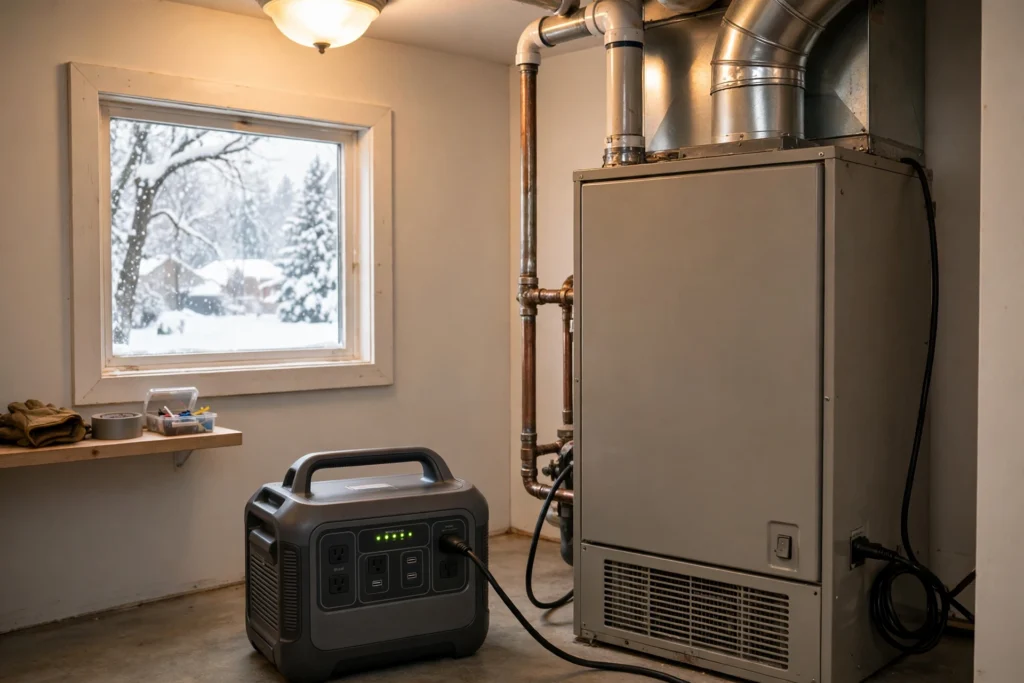
Short answer: Yes — and it is the cheapest whole-house heat in an outage, because a gas furnace does the heating with gas. Electricity only runs the blower, the inducer fan, the igniter, and the control board: roughly 300–800 watts while it runs, depending on the blower motor. A 2,000Wh-class power station delivers about 3.5 hours of straight blower run time — roughly 7 hours of heated house on a cold night when the furnace cycles half the time. The catch is never the math; it is that most furnaces are hardwired, so the connection has to be made before the outage, with a small transfer switch.
Bluetti Elite 200 V2
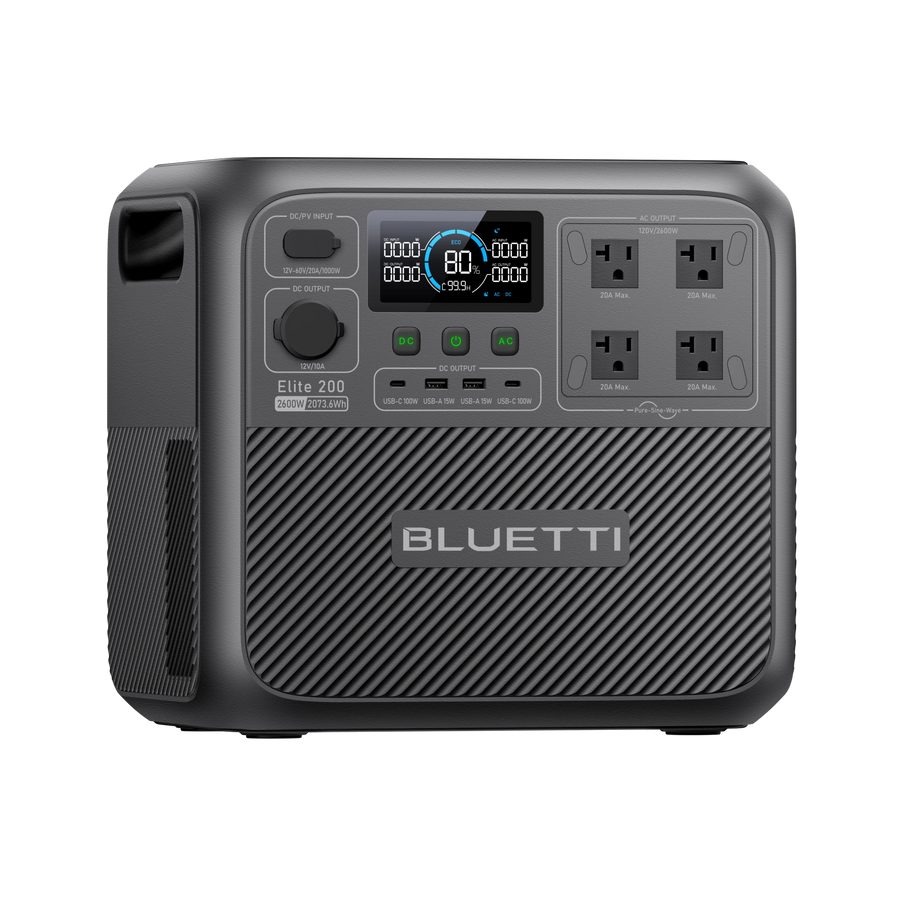
Photo: Bluetti
2,073.6Wh and a 2,600W inverter that swallows a PSC blower’s start without blinking. What it runs: a ~500W furnace blower for about 3.5 hours straight, 7 hours cycling — plus the fridge when the furnace rests.
EcoFlow DELTA 2 Max
2,048Wh, expandable later if winter proves the point. What it runs: the blower about 3.5 hours straight or 7 hours cycling, and it recharges fast from a generator between runs — the station-and-generator pairing below.
Anker SOLIX C1000
1,056Wh — half the runtime of the big boxes, half the price. What it runs: the blower for about 1.7 hours straight, 3.5 hours cycling; enough to take the chill off repeatedly through a night if you ration it.
What a furnace actually draws
People picture the furnace as a huge electrical load. The burners are not electric at all. The electric bill for gas heat is three small motors and a brain:
| Blower type | Running watts | Starting watts | Where you find it |
|---|---|---|---|
| PSC (older, single-speed) | ~600–800W | ~1,200–1,800W | Most furnaces over ~10 years old |
| ECM (variable-speed) | ~300–500W | ~600–900W | Newer high-efficiency furnaces |
| Inducer + controls (add) | ~100W | — | Every gas furnace |
Your furnace’s number is measurable in five minutes with a plug-in usage monitor if it plugs in, or from the rating plate’s blower amps × 120 if it does not. The planning figure we use below is 500 watts all-in for a mid-age furnace — honest for most houses, conservative for ECM owners.
Bluetti Elite 200 V2
Why this one: 2,073.6Wh and a 2,600W inverter that swallows a PSC blower’s start without blinking — a ~500W furnace blower for about 3.5 hours straight, 7 hours cycling, plus the fridge when the furnace rests.
Runtime: the table people actually came for
Stations deliver about 85% of their rated watt-hours after inverter losses. At a 500W draw, running straight:
| Station size | Usable energy | Blower, straight | Heated house at 50% cycle |
|---|---|---|---|
| 1,056Wh | ~900Wh | ~1.7 hours | ~3.5 hours |
| 2,048Wh | ~1,740Wh | ~3.5 hours | ~7 hours |
| 2,074Wh | ~1,760Wh | ~3.5 hours | ~7 hours |
| 4,000Wh (with expansion) | ~3,400Wh | ~6.8 hours | ~13.5 hours |
The 50%-cycle column is the one that matters in real weather: a furnace holding a house at temperature on a cold night runs roughly half the time. In severe cold the cycle stretches toward 70% and the hours shrink toward the straight-run column — plan against the worse number if your winters bite.
Blower run time, straight and cycling (at a 500 W draw, on about 85% usable energy): 1,056 Wh station — ~1.7 h straight · 2,048 Wh station — ~3.5 h straight · 2,074 Wh station — ~3.5 h straight · 4,000 Wh with expansion — ~6.8 h straight.
Cycling: A heated house at a 50% cycle roughly doubles these hours: about 3.5, 7, 7, and 13.5 hours. In severe cold the cycle stretches toward 70% and hours shrink toward the straight column.
The connection problem — solve it in October, not during the outage
Most furnaces have no plug. They are hardwired through a switch on the furnace or the ceiling joist, by code, so there is nothing to plug a station into. The standard fix is a small single-circuit transfer switch mounted beside the furnace — an electrician’s hour or two — with an inlet your station or generator cord plugs into. In an outage you flip one switch and the furnace thinks the grid is back.
Two things never belong in this plan: a homemade cord arrangement that backfeeds the furnace circuit (same backfeed danger as any panel backfeed), and an extension cord run to a furnace someone has “converted” with a plug in ways their local code would not accept. The transfer switch is not the expensive part of this project; skipping it is.
Station, generator, or both?
The blower is where the station-plus-generator pairing shines brightest. The station runs the furnace silently all night; once or twice a day the generator runs for an hour or two outside — recharging the station, catching the fridge up, running the well pump — then shuts down again. Fuel burn drops to a fraction of running a generator around the clock, the neighbours stay friendly, and the house never goes cold. For a one-night outage, the station alone suffices; for a three-day ice storm, the pairing is the grown-up answer.
Relevant pickAnker SOLIX C1000
The budget version: the blower for about 1.7 hours straight, 3.5 hours cycling — enough to take the chill off repeatedly through a night if you ration it.
1,056 Wh · Half the runtime, half the price
Follow-up questions
Can a station run an oil furnace the same way?
Yes — an oil burner adds the burner motor and igniter, landing in the same few-hundred-watt neighbourhood as a gas furnace’s total. The same transfer-switch connection and the same runtime math apply.
What about a boiler’s circulator pumps?
Even kinder: a circulator draws roughly 50–100 watts, so a mid-size station runs a boiler’s pumps for many hours. Hot-water heat is quietly one of the easiest systems to back up in the whole house.
Will the furnace’s electronics mind station power?
Modern stations output clean sine-wave power, and furnace boards are built for far dirtier grid power than that. The pairing is well-trodden; the issues owners actually report are undersized inverters on PSC blower starts, which the table above sizes around.
Frequently asked questions
Does the thermostat need power too?
It gets it from the furnace itself — power the furnace and the thermostat, board, and safety controls all come with it. Battery thermostats keep their settings through the gap either way.
Can I just run the blower fan by itself for air conditioning?
The blower alone, yes — but that moves air without cooling it. The compressor outside is the big load in AC, and it is a different, larger question.
How do I keep pipes safe if the station runs dry at 4 a.m.?
The house coasts for hours on stored heat — that is the finding of our freeze-protection work: set the thermostat up before bed, keep interior doors open, and drip the furthest faucet. A station that dies at 4 a.m. is a cold breakfast, not burst pipes; a house left unheated for days is the real risk.
The verdict
If your house heats with gas or oil, the furnace blower is the best-value load in backup power: a few hundred watts buys whole-house heat, indoors and silent. A 2,000Wh-class station plus a furnace transfer switch — fitted now, on a mild day — turns a winter outage from a pipe-threatening emergency into a quiet inconvenience.
The full set is at What People Are Asking About Outage Living, with the generator side in our Power hub.
Talk it over with other homeowners
The Ordinary Prepper Community on Facebook is where readers compare outage plans, show their setups, and help decide what we test next.