
As an Amazon Associate, Ordinary Prepper earns from qualifying purchases. Prices last checked October 28, 2026.
Home Readiness — Guide
How Long Will a Sump Pump Battery Backup Run — and Do You Need One With a Generator?
Short answer: A typical 100Ah sump-pump battery backup delivers roughly 600–700 usable watt-hours — which is not an hours number until you know the duty cycle. At a gentle 10% cycle (the pump runs 6 minutes an hour) that is about 6 hours; in a hard storm at a 50% cycle it is about 1.2 hours; with the pump running nonstop, under an hour. And yes, you still want one with a generator: the battery covers the gap between the power dying and anyone getting the generator started — and the 3 a.m. gap when nobody does.
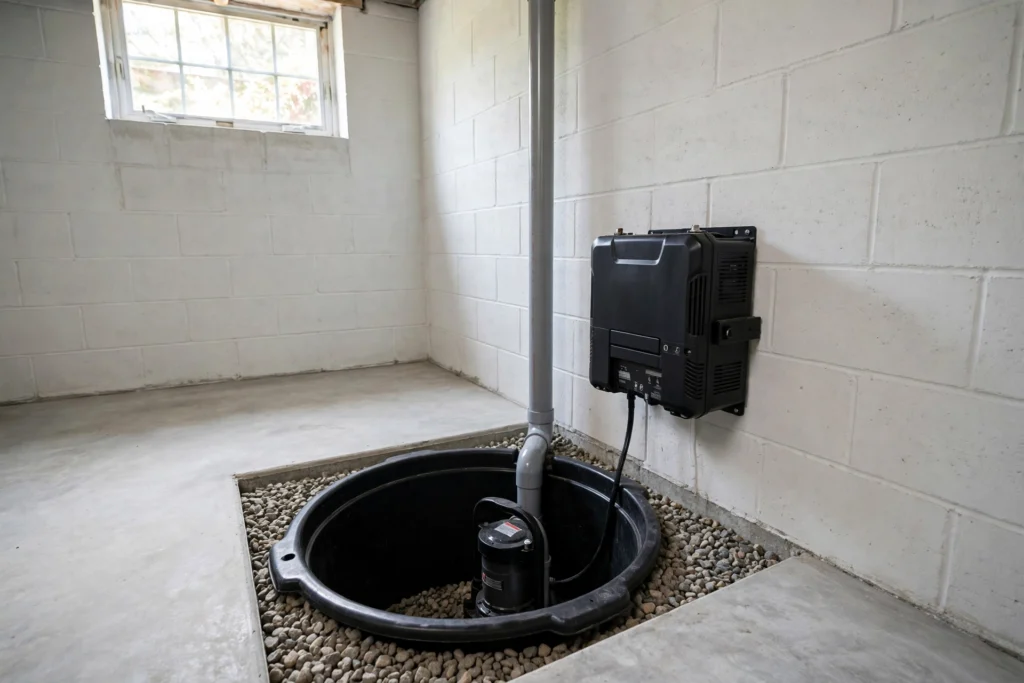
Anker SOLIX C1000
1,056Wh with a 2,000W inverter that can start most 1/3–1/2 hp sump pumps. What it runs: a 1/3 hp pump at a 10% storm cycle for about 9 hours — then it still works as the house’s fridge-and-lights station.
Bluetti Elite 200 V2
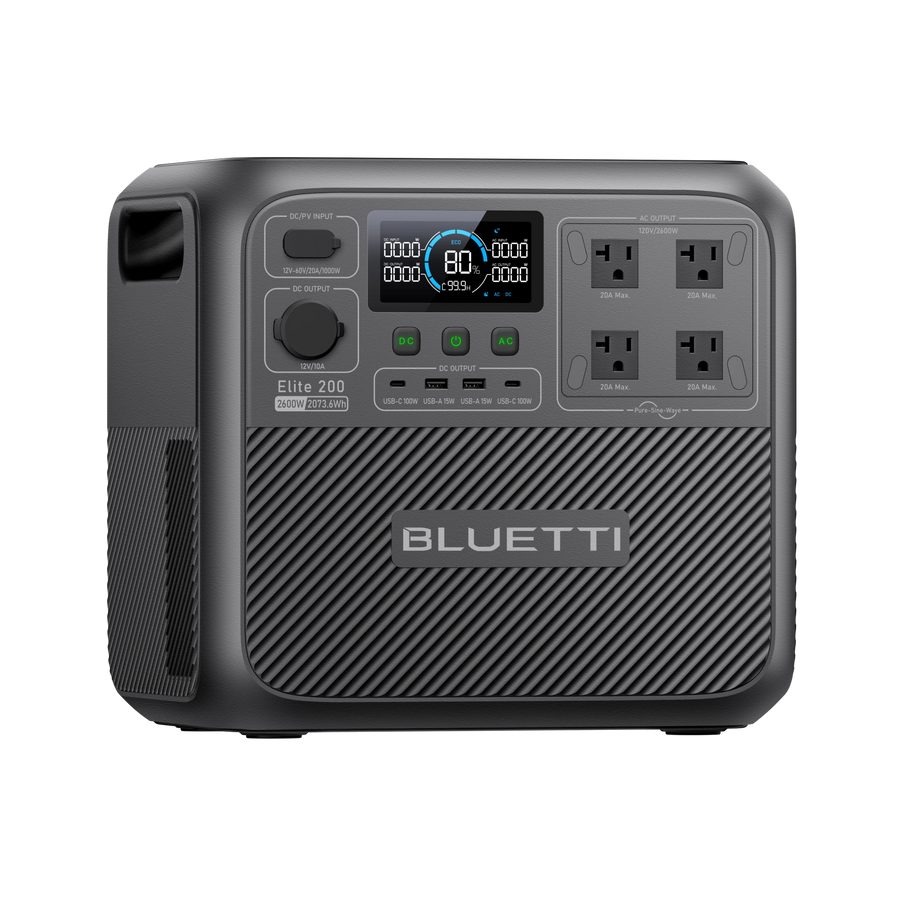
Photo: Bluetti
2,073.6Wh, a 2,600W inverter, a battery rated for 6,000+ cycles. What it runs: the same sump pump at a 10% cycle for roughly 17 hours, or a 50% cycle for about 3.5 hours — the storm-night answer if the pump is the house’s weak point.
The only math that matters: duty cycle
Sump pumps do not run; they visit. Water seeps into the pit, the float rises, the pump clears the pit in 10–30 seconds, and it sleeps again. How often that happens — the duty cycle — is set by your water table and the weather, and it swings the runtime answer by a factor of ten. A 1/3 hp pump draws roughly 800–1,000 watts while it runs. Multiply by the cycle and you get the real load:
| Duty cycle | What it feels like | Average draw | 100Ah backup lasts |
|---|---|---|---|
| ~5% | Dry-season seepage | ~50W | ~12+ hours |
| ~10% | Steady rain | ~100W | ~6 hours |
| ~25% | Heavy storm | ~250W | ~2.5 hours |
| ~50% | Spring melt, high water table | ~500W | ~1.2 hours |
| 100% | Pump cannot keep up | ~1,000W | ~35 minutes |
The battery column assumes a 12V 100Ah deep-cycle battery behind an inverter: 1,200 nominal watt-hours, about half honestly usable from lead-acid without wrecking it, minus inverter losses — call it 600 watt-hours delivered. Double the battery and you double every row; that, not brand choice, is the lever. A lithium power station plays by better rules (about 85% of its rating is usable), which is why the 1,056Wh Anker above outlasts the “bigger” lead-acid box.
One measurement beats every table: time your pump in the next hard rain. Count runs in 10 minutes and how long each lasts. A plug-in usage monitor like the P3 Kill A Watt gives you your pump’s true running watts in the same sitting. Your house has a number; find it before you buy anything.
Duty cycle decides the runtime — average draw and hours on one 100Ah battery backup (~600 Wh delivered): ~5% (dry-season seepage) ~50 W avg, lasts ~12+ hours · ~10% (steady rain) ~100 W avg, ~6 hours · ~25% (heavy storm) ~250 W avg, ~2.5 hours · ~50% (spring melt, high water table) ~500 W avg, ~1.2 hours · 100% (pump cannot keep up) ~1,000 W avg, ~35 minutes.
Why the swing: A 1/3 hp pump draws roughly 800–1,000 watts while it runs — but sump pumps do not run, they visit: 10–30 seconds to clear the pit, then sleep. The duty cycle swings the answer by a factor of ten.
Bluetti Elite 200 V2
Why this one: The same 1/3 hp sump pump at a 10% cycle for roughly 17 hours, or a 50% cycle for about 3.5 hours — the storm-night answer if the pump is the house’s weak point.
Dedicated backup or power station?
The dedicated battery backup (a second, 12V pump beside the main one, with its battery box and charger) has one virtue nothing else matches: it is automatic, forever, in the dark, while you are on holiday. Its limits are the small pump’s modest flow, the lead-acid battery’s 3–5 year life whether it works or not, and the fact that it does exactly one job.
The power station route runs the main pump itself at full flow, doubles as the house’s outage station the other 360 days a year, and its lithium battery shrugs off a decade of standby. Its limit is the human: someone has to plug the pump in when the power dies, unless you leave it connected through the station full-time — which many owners do, accepting a small standby drain as the price of automatic cover.
Relevant pickAnker SOLIX C1000
Best runtime per dollar on the station route: a 1/3 hp pump at a 10% storm cycle for about 9 hours — then it still works as the house’s fridge-and-lights station.
1,056 Wh · 2,000W inverter
So do you need one if you have a generator?
Yes — because the generator has a start time and the storm does not. Generators fail sump pumps in three ordinary ways: the outage starts while nobody is home; it starts at 3 a.m. and the basement floods before anyone wakes; or the generator runs out of fuel at hour nine of a two-day storm, during the fuel run. A battery backup — dedicated or station — covers minutes-to-hours of gap automatically, which is precisely the window those three failures live in. Think of it as the bridge: battery carries the first hours, generator carries the days, and the generator recharges the battery in the overlaps.
The houses that skip the battery are the ones whose pump almost never runs and whose owners are always home. If your pit cycles in every hard rain, that is not your house.
The battery carries the first hours: Automatic cover for the gap between the power dying and anyone getting the generator started — and the 3 a.m. gap when nobody does.
The generator carries the days: Generators fail sump pumps three ordinary ways: the outage starts while nobody is home, it starts at 3 a.m., or the fuel runs out at hour nine of a two-day storm.
They recharge each other: In the overlaps, the generator recharges the battery — so the automatic cover is restored for the next gap.
Follow-up questions
Can a power station actually start a sump pump?
Starting surge is the gate: a 1/3 hp pump wants roughly 1,300–2,000 watts for the first half-second. Stations with 2,000W-plus inverters start most 1/3 and many 1/2 hp pumps; a 1,000W-class station often cannot, however big its battery. Check the inverter rating first, the watt-hours second — the opposite of how they are marketed.
How long will the backup run during spring melt?
Spring melt is the brutal case: a high water table can hold a pump at a 25–50% cycle for days. From the table, that is 1–2.5 hours on a single 100Ah battery — which is why melt-season houses either wire two batteries, keep a station on the pump, or accept that the generator becomes a twice-a-day appointment, not an emergency measure.
When should the battery be replaced?
Lead-acid backup batteries age out in 3–5 years even if they never pump a gallon; most backup units beep or show a light when the battery fades, and most owners ignore it until the storm. Write the install date on the battery with a marker today — the cheapest fix on this page.
Replace on a clock: Lead-acid backup batteries age out in 3–5 years even if they never pump a gallon. Most units beep or show a light when the battery fades — write the install date on the battery with a marker today.
Spring melt: A high water table can hold a pump at a 25–50% cycle for days: 1–2.5 hours on a single 100Ah battery. Melt-season houses wire two batteries, keep a station on the pump, or make the generator a twice-a-day appointment.
If the main pump fails: The smaller backup inherits a 50–100% cycle and buys hours — time to notice, time to swap in a spare pump. That is the real job; houses with serious inflow keep a spare primary on the shelf.
Frequently asked questions
What about a water-powered backup pump?
Where city water pressure is strong and codes allow it, a water-powered backup needs no battery at all and runs as long as the water flows — a genuinely good answer for city houses. It does nothing for well houses (no pressure without the electric pump) and it spends treated water to move groundwater, which some towns restrict.
Will a battery backup keep up with a failed main pump?
Usually not for long: backup pumps are smaller, and a main-pump failure during inflow means the backup inherits a 50–100% cycle. It buys hours — time to notice, time to swap in a spare pump — which is the real job. Houses with serious inflow keep a spare primary pump on the shelf.
Does the backup need its own discharge pipe?
Dedicated backups usually tee into the main discharge or run a parallel line; either way the check valve matters — without it, water the backup just pumped falls straight back into the pit and the pump fights its own exhaust.
The bottom line
Measure your duty cycle in the next storm, then size the battery to the honest version of it: a 10%-cycle house is covered by a single 100Ah battery or a 1,000Wh station; a melt-season house needs double that and a generator routine behind it. With or without a generator, something automatic should stand between a dead grid and a rising pit.
The full set is at What People Are Asking About Basement Water, and the rest of the water picture lives in our Water hub.
Talk it over with other homeowners
The Ordinary Prepper Community on Facebook is where readers compare outage plans, show their setups, and help decide what we test next.