
As an Amazon Associate, Ordinary Prepper earns from qualifying purchases. Prices last checked October 28, 2026.
Home Readiness — Guide
What Size Generator Runs a Well Pump?
Short answer: Most home well pumps are 1/2 to 1 horsepower. A 1/2 hp pump runs on roughly 1,000 watts and needs about 2,000–2,500 watts to start; a 1 hp pump runs near 1,900 watts and can demand 4,000–5,000 watts for the first second. That starting surge — plus one hard fact, that most 3/4 hp and larger pumps run on 240 volts — puts most well houses in the 5,000–7,500 watt generator class with a 240V outlet, connected through a transfer switch. Smaller 120V pumps are the one case where a big power station can do the job.
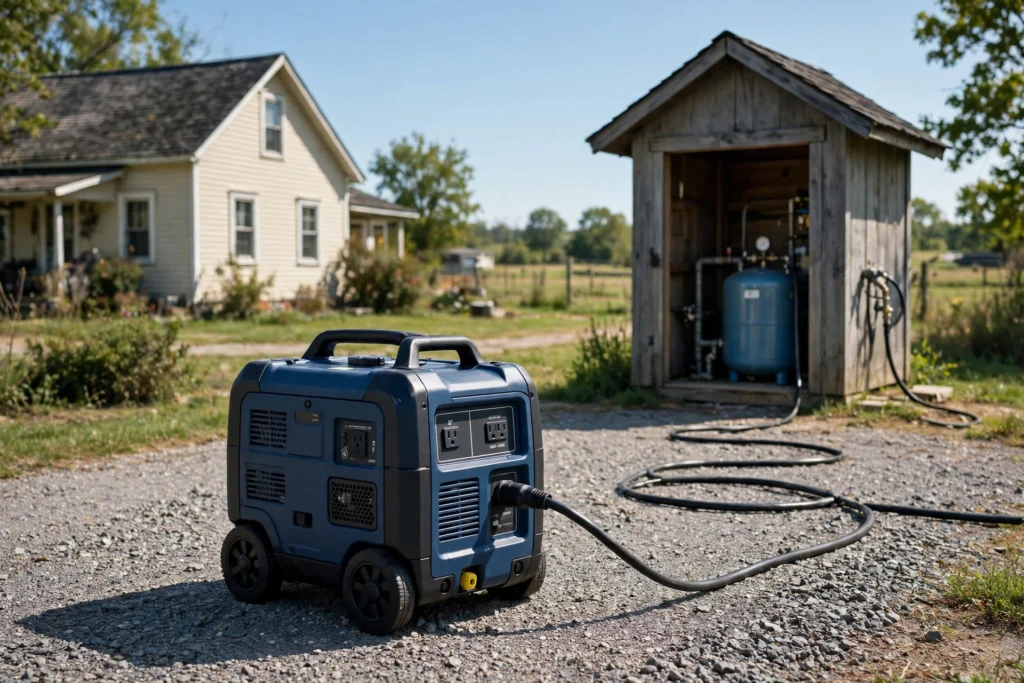
DuroMax XP12000HX
12,000 peak / 9,500 running watts with a true 240V 50-amp outlet — enough surge for a 1 hp pump with the house basics on top. What it runs: the well pump, fridge, furnace blower, and lights, through a transfer switch.
Westinghouse iGen4500
4,500 starting / 3,700 running watts, quiet inverter power — but 120V only, so it fits 1/2 hp 120V pumps, not the 240V majority. What it runs: a 120V well pump, fridge, and lights, with fuel for up to 18 hours at light load.
Bluetti Elite 200 V2
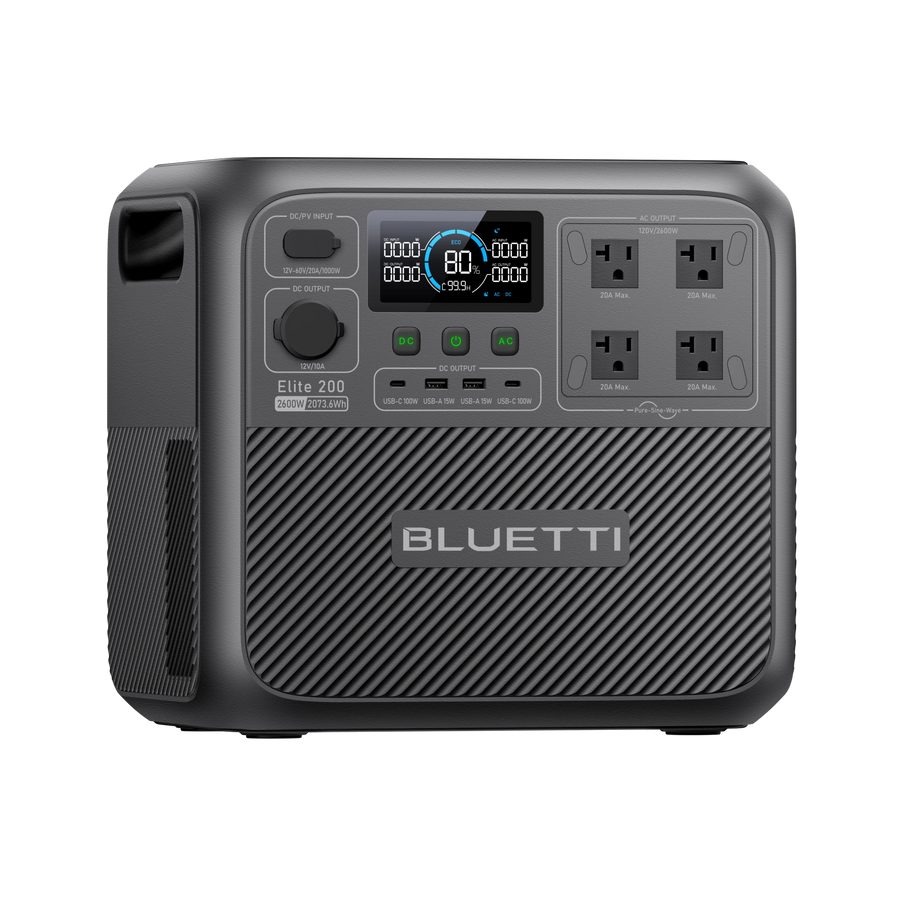
Photo: Bluetti
2,073.6Wh and a 2,600W inverter. What it runs: a 1/2 hp 120V pump cycling against a pressure tank — roughly a full day of normal household water use — indoors, with no fuel and no noise. It cannot touch a 240V pump.
Start with the pump, not the generator
Well pumps are sized in horsepower, and horsepower converts to watts with a catch: the running number is only half the story. A submersible pump motor draws two to two-and-a-half times its running watts for the first half-second while it spins up against a column of water. Size the generator to the surge and the pump starts every time; size it to the running watts and it will hum, strain, and trip.
| Pump size | Running watts | Starting watts | Typical voltage |
|---|---|---|---|
| 1/2 hp | ~1,000W | ~2,000–2,500W | 120V or 240V |
| 3/4 hp | ~1,400W | ~3,000–3,500W | Usually 240V |
| 1 hp | ~1,900W | ~4,000–5,000W | 240V |
| 1.5 hp | ~2,600W | ~5,500–6,500W | 240V |
Your pump’s real numbers are on its control box or the installer’s paperwork: horsepower, voltage, and running amps. Running watts are roughly amps × volts; starting watts, plan on amps × volts × 2.5. No paperwork? The breaker tells the voltage story — a double-width breaker in the panel means 240V — and a clamp meter or a plug-in usage monitor on a 120V pump tells the rest. Deep wells and long wire runs push surges higher, which is why the table carries ranges, not promises.
Running is half the story: A pump motor draws two to two-and-a-half times its running watts to start. Your pump’s real numbers are on its control box or the installer’s paperwork. Running watts are roughly amps times volts; for starting watts, plan on amps times volts times 2.5. Deep wells and long wire runs push surges higher.
Size to the surge: The bars in the table above reach the top of each pump’s starting range. Size the generator to the surge and the pump starts every time. Size it to the running watts and it will hum, strain, and trip.
DuroMax XP12000HX
Why this one: 12,000 peak / 9,500 running watts with a true 240V 50-amp outlet — enough surge for a 1 hp pump with the house basics on top: the well pump, fridge, furnace blower, and lights, through a transfer switch.
The voltage question decides the machine
Here is the part most sizing guides bury: a generator can have watts to spare and still be useless, because a 240V pump needs 240V. Many popular inverter generators — including the quiet 4,500W class — are 120V-only machines. They will run a small 120V jet pump happily and a 240V submersible not at all, at any wattage.
So the decision tree is short. 120V pump, 1/2 hp: a 3,500–4,500W inverter generator covers the surge with room for the fridge, and a large power station becomes a real option (below). 240V pump, any size: you need a generator with a 240V outlet — the L14-30 or 14-50 receptacle — which starts around the 5,000W class and is standard on 7,500W and up. 1.5 hp and deep: plan on 7,500–10,000 peak watts once the rest of the house joins in.
Relevant pickWestinghouse iGen4500
Quiet inverter power — but 120V only, so it fits 1/2 hp 120V pumps, not the 240V majority. What it runs: a 120V well pump, fridge, and lights, with fuel for up to 18 hours at light load.
4,500 starting / 3,700 running W · 120V only
What is actually in the tank when the power dies
The question behind this one is usually “will we have water at all?” — and the honest answer starts with yes, a little. A pressure tank does not hold its rated gallons as usable water. A common 44-gallon tank delivers roughly 11–13 gallons between pump cycles before pressure fades; a 20-gallon tank, about 5–6 gallons. That is flushing and hand-washing water for a few hours, not showers. Every gallon after that has to be pumped, which is why the well pump is the load rural houses size around first — before the fridge, before the lights.
It also means the pump cycles rather than runs: a few minutes on, long stretches off. That duty cycle is what makes the power-station route below work at all.
What is actually in the tank: A 44-gallon tank delivers about 11–13 gal usable between pump cycles; a 20-gallon tank about 5–6 gal usable.
What that means: A pressure tank does not hold its rated gallons as usable water. That drawdown is flushing and hand-washing water for a few hours, not showers — every gallon after it has to be pumped.
Can a power station run a well pump instead?
For a 120V 1/2 hp pump, yes — and the math is kinder than people expect. The pump draws about 1,000 watts but only while it refills the tank: call it 8–12 short runs a day for a careful household, perhaps 25–35 minutes of total run time, or roughly 450–600 watt-hours a day. A 2,048Wh-class station delivering about 85% of its rating — around 1,740 usable watt-hours — covers a day of water with room left over, provided its inverter can swallow the 2,000–2,500W starting surge. A 2,600W inverter clears it; a 1,800W inverter is a coin flip you will lose at 6 a.m.
For a 240V pump, no mainstream portable station applies — they are 120V boxes. (A few large home batteries output 240V, but that is an installed system, not a box by the pump house.) The generator, or stored water, is the answer there.
How it connects — and the one thing never to do
A well pump is hardwired. There is no outlet to plug a cord into, which is the point: the connection is a transfer switch or a panel interlock fitted by an electrician, with the generator outside, 20-plus feet from the house, exhaust pointed away. What never belongs in the plan is backfeeding through a dryer outlet or a homemade double-ended cord — it energizes the lines outside your house and endangers the crews working on them, and it is illegal in most places for exactly that reason.
Follow-up questions
How do I find my pump’s horsepower?
Check the pump control box in the basement or well house — the label lists horsepower and voltage — or the well company’s install record. If neither exists, the breaker size and a clamp-meter reading while the pump runs get you close: a 240V pump drawing about 8 amps is a 1 hp class machine.
Will a 5,000W generator run a 1 hp well pump?
On surge alone, it is tight: 4,000–5,000 starting watts against a 5,000 peak rating leaves nothing for the fridge starting in the same second. It often works in practice because surges rarely stack — but “often” is a poor plan for your only water supply. The 7,500W class is the comfortable answer.
Can I run the pump on a schedule to save fuel?
Yes, and most rural houses do: run the generator in blocks — morning and evening — pump the tank full, fill tubs and containers while it runs, and let the house coast between blocks. Water is the easiest load to time-shift because the tank and a filled bathtub are storage you already own.
Find the horsepower: The control box label lists horsepower and voltage; failing that, the install record — or the breaker and a clamp meter: a 240V pump drawing about 8 amps is a 1 hp class machine.
The 5,000 W question: Against a 1 hp pump it is tight on surge alone: surges rarely stack, but ‘often works’ is a poor plan for your only water supply — the 7,500 W class is the comfortable answer.
Run it in blocks: Morning and evening: pump the tank full, fill tubs and containers while the generator runs, and let the house coast between blocks.
If you do nothing: The tank’s drawdown is all you have — which is why the outage playbook starts with filling the tub.
Frequently asked questions
Does a soft starter help a well pump?
Soft starters exist for well pumps and cut the starting surge substantially, which can drop a pump a full generator class. They are a pump-tech install, not a plug-in gadget, and worth pricing if the alternative is a much bigger generator bought for one second of surge.
How long can a well pump sit unused in an outage?
The pump itself is fine for weeks. The practical limits are the pressure tank emptying and, in freezing weather, exposed pipes at the well head. Drain-down protection and a heat lamp on a generator circuit are the cold-climate details to sort before winter.
What if I do nothing — how long does the water last?
The tank’s drawdown — about 11–13 gallons from a 44-gallon tank — plus whatever you store. That is why our outage playbook starts with filling the tub: it turns a few hours of water into days of flushing.
The verdict for most well houses
240V pump (most houses): a 7,500W-class dual-fuel generator with a 240V outlet, a transfer switch, and surge headroom to spare — the DuroMax class above. 120V 1/2 hp pump: a 4,500W inverter generator, or a 2,600W-inverter power station if silent indoor power matters more than unlimited runtime. Either way, find the pump’s horsepower and voltage this week, while the lights are on and the label is easy to read.
The full set is at What People Are Asking About Home Generators, and the water side of the house lives in our Water hub.
Talk it over with other homeowners
The Ordinary Prepper Community on Facebook is where readers compare outage plans, show their setups, and help decide what we test next.