
As an Amazon Associate, Ordinary Prepper earns from qualifying purchases. Prices last checked October 27, 2026.
Home Readiness — Guide
Can a Generator Run My Heat Pump in a Winter Outage?
Short answer: Yes — but only with a generator in the 9,000–12,500 peak-watt class, a soft starter on the heat pump, and the heat strips locked out. A typical 3-ton heat pump runs on 2,500–3,300 watts yet needs 17,000–19,000 watts to start — and that surge, not the running watts, decides everything. And with a gas furnace too, like the setup behind this question, the cheaper winter plan is usually to skip the heat pump and run the furnace blower — about 500 watts — off a power station.
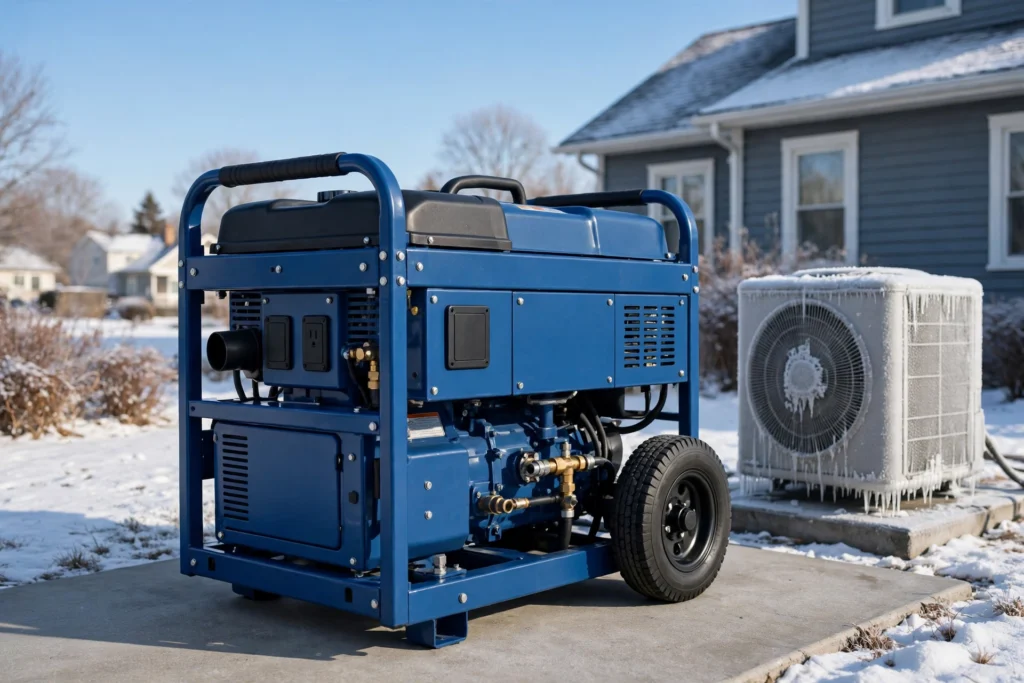
DuroMax XP12000HX
12,000 peak / 9,500 running watts on gas (9,025 running on propane), with a true 50-amp outlet. What it runs: a soft-started 3-ton heat pump with the strips off, plus fridge and lights — soft starter fitted first.
EcoFlow DELTA 2 Max
2,048Wh that cannot run a 240V heat pump — and does not need to. What it runs: a gas furnace blower at ~500W for 3.5 hours straight, or 7 hours of cycling on a cold night.
Bluetti Elite 200 V2
2,073.6Wh, a 2,600W inverter, a battery rated for 6,000+ cycles. What it runs: the same furnace blower, about 3.5 hours continuous or 7 hours cycling.
What a heat pump actually draws
Two numbers run this question: running watts, what it sips once going, and the starting surge, the first half-second gulp. Generators fail on the second number.
| Heat pump size | Running watts | Starting surge | With soft starter |
|---|---|---|---|
| 1.5 ton | ~1,500W | ~10,800W | ~3,600W |
| 2 ton | ~1,900W | ~13,200W | ~4,300W |
| 3 ton | ~2,900W | ~17,000–19,000W | ~6,200W |
| 4 ton | ~3,800W | ~25,200W | ~8,400W |
| 5 ton | ~4,800W | ~32,400W | ~10,800W |
Ranges for common single-speed units. Your own numbers are on the outdoor unit’s rating label: RLA is running amps, LRA is locked-rotor (starting) amps — multiply by 240 for watts. A 3-ton showing 78 LRA asks for about 18,700 watts at the start.
Then the load that breaks the plan: auxiliary heat strips. Most heat pumps carry electric resistance strips indoors, sized at 5, 10, or 15 kW. They switch on when the heat pump falls behind in deep cold, during defrost, and in Emergency Heat mode. A 3-ton drawing 3 kW with 10 kW of strips lit is a 13 kW load. On generator power they must be locked out — thermostat setting, breaker, or a relay fitted ahead of time — or the honest answer is no.
A soft starter makes the surge survivable: it eases the compressor up to speed instead of slamming it on. Micro-Air rates its EasyStart line at a 65–75% cut in starting current against LRA, turning that start into ~6,200 watts. It does nothing to running watts — only the first half-second.
Reading your own unit’s label: The surge figures in the table above are for common single-speed heat pumps. Your own numbers are on the outdoor unit’s rating label: RLA is running amps, LRA is locked-rotor (starting) amps — multiply by 240 for watts. A 3-ton showing 78 LRA asks for about 18,700 W at the start. Running watts are far lower — a 3-ton runs on about 2,900 W once it is going.
DuroMax XP12000HX
Why this one: 12,000 peak / 9,500 running watts on gas (9,025 running on propane) with a true 50-amp outlet: a soft-started 3-ton heat pump with the strips off, plus fridge and lights — soft starter fitted first.
The three honest plans
Plan 1: Big generator plus soft starter runs the heat pump
If the heat pump is your only heat: soft starter first, strips locked out, a generator sized for the softened surge, the running load, and the rest of the house. For a 3-ton that is the 9,000–12,500 peak-watt portable class, fed through a transfer switch or interlock (hardwired 240V — no extension-cord version). A 4- or 5-ton pushes past portables into standby money. And it lives outdoors, 20+ feet out, exhaust away from windows — generator CO kills in winter outages every year; never in a garage, door up or not.
Plan 1 — the heat pump runs: Soft starter + big portable: 9,000–12,500 peak W for a 3-ton · 240V transfer switch · outdoors, 20+ ft out — exhaust away from windows.
Plan 2 — gas does the heating: Station → blower only: about 500 W · ~1,740 usable Wh ≈ 3.5 h running · about 7 hours of heated house at a 50% duty cycle.
Plan 3 — one warm room: Generator → space heater: 1,500 W · straight into the outlet — never a cord or strip · 3 ft clear on every side · off while you sleep.
Plan 2: Gas furnace plus blower on a station or small generator
With dual-fuel — a heat pump and a gas furnace, like the setup behind this question — this is probably your plan, and it is not close. The gas does the heating; electricity only runs the blower, inducer fan, igniter, and control board — about 500 watts while it runs. The math: a 2,048Wh station delivers about 85% of its rating, roughly 1,740 usable watt-hours: about 3.5 hours of blower run time, roughly 7 hours of heated house at a 50% cold-night duty cycle — indoors and silent. One catch: furnaces are usually hardwired, so the connection is an electrician-fitted transfer switch beside it.
Plan 3: Skip the heat pump and warm one room safely
One warm room may be enough — though a 1,500-watt space heater empties a power station in a little over an hour, so this belongs on generator power or very short gaps. Heater straight into the outlet — never an extension cord or power strip — three feet clear on every side, off when you sleep or leave. Everyone in one room, doors closed; a slow faucet drip guards the pipes. Anything burned for heat needs venting and its own CO alarm. Never a grill, never an oven with the door open.
DuroMax XP12000HX: the big portable that fits Plan 1
12,000 peak and 9,500 running watts on gasoline; 11,400 peak / 9,025 running on propane. Against a soft-started 3-ton — ~6,200 watts to start, ~2,900 to run — that leaves real headroom for the fridge and lights. Two details matter more: a proper 50-amp 120/240V outlet, so a transfer switch can draw what the machine makes (many rivals stop at 30 amps), and CO Alert, which shuts it down if carbon monoxide builds up. Retailer roundups put it at 4.4 out of 5 stars across about 565 ratings. The limits: loud at a rated 74 dBA, well over 220 pounds, and power rated under 12% harmonic distortion — fine for motors, not inverter-clean. One owner report worth copying: after a CO shutoff, a unit would not restart until its spark plug was swapped — keep a spare. Scored 80/100: strong specs and record, held back by noise, weight, and dirty power.
The DuroMax against a soft-started 3-ton, in watts
Gasoline ratings, against what the soft-started heat pump asks for — the headroom is the point.
EcoFlow DELTA 2 Max: the blower battery that can grow
Carried at 85/100, $1,029 today. It stores 2,048Wh, puts out 2,400 watts of clean 120V power, and can add extra batteries later, up to 6,144Wh. About 1,740 usable watt-hours into a 500-watt blower is roughly 3.5 hours of run time, about 7 hours of clock time at a cold-night duty cycle, indoors and silent. It cannot run your heat pump — 120V only, against a 240V load, and its whole battery is about 35 minutes of heat-pump running besides.
Bluetti Elite 200 V2: the blower battery built to last
Carried at 86/100, and at $899 the cheapest pick here. It stores 2,073.6Wh behind a 2,600W inverter, with a battery rated for 6,000+ charge cycles — about double the EcoFlow’s count. The blower math is the same: about 1,760 usable watt-hours, roughly 3.5 hours continuous or about 7 hours cycling. Same limits: 120V only, so no heat pump, and the size is fixed — no extra battery later.
What the furnace asks: With a gas furnace, gas does the heating; electricity runs only the blower, inducer fan, igniter, and control board — about 500 W while it runs. That is why Plan 2 costs a fraction of Plan 1 in a dual-fuel house.
EcoFlow DELTA 2 Max: About 1,740 usable watt-hours (85% of 2,048 Wh): roughly 3.5 hours of blower run time.
Bluetti Elite 200 V2: About 1,760 usable watt-hours: the same roughly 3.5 hours continuous.
On a cold night: At a 50% duty cycle, that is about 7 hours of heated house per charge — indoors and silent.
The catch: Furnaces are usually hardwired, with nothing to plug in — the connection is an electrician-fitted transfer switch beside the furnace.
| Product | Score | Price | Its job on this page |
|---|---|---|---|
| DuroMax XP12000HX | 80/100 | $1,599 | Runs a soft-started 3-ton heat pump |
| EcoFlow DELTA 2 Max | 85/100 | $1,029 | Runs the furnace blower, expandable |
| Bluetti Elite 200 V2 | 86/100 | $899 | Runs the furnace blower, longest rated life |
Prices last checked October 27, 2026.
Relevant pickBluetti Elite 200 V2
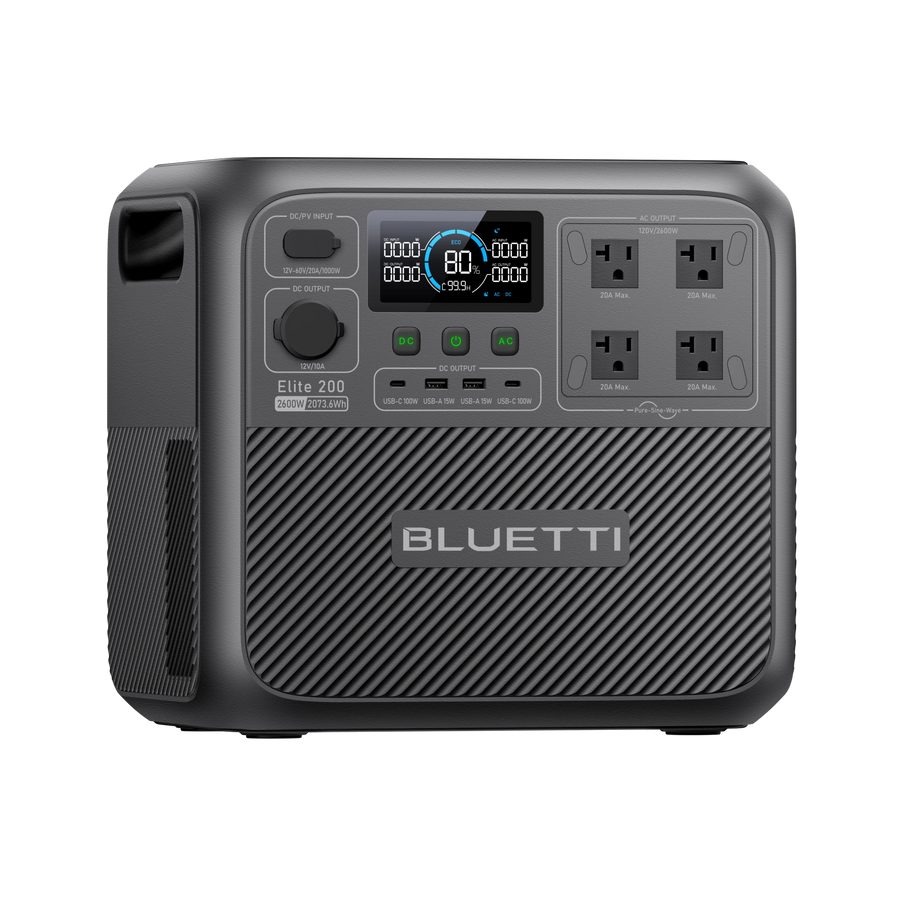
Photo: Bluetti
The blower battery built to last: the same gas furnace blower at ~500W — about 3.5 hours continuous or 7 hours cycling — from the battery rated for 6,000+ cycles.
2,073.6 Wh · 2,600W inverter · 6,000+ cycles
Three more worth a look
Micro-Air EasyStart Flex soft starter — the part that makes Plan 1 possible. The home version, sized up to 6 tons. Fit it first, size the generator after; an HVAC tech installs it.
Reliance Controls PB50 50-amp inlet box — the weatherproof box an electrician mounts outside so a 50-amp generator can feed a transfer switch or interlock without a cord through a window: a two-minute hookup in the sleet instead of one improvised at midnight.
Westinghouse WGen7500DF — the smaller dual-fuel step down, 7,500 running watts on gas and 6,750 on propane, 30-amp outlet. Not the pick for a 3-ton, but a sensible size for a soft-started 2-ton, or a blower-only plan that wants days of runtime.
The questions that come next
Will a 7,500-watt generator do it?
Depends on the tonnage outside; a 7,500-watt machine peaks around 9,500 watts. A soft-started 2-ton starts near 4,300 watts and runs near 1,900 — yes, strips locked out, house kept light. A 3-ton without a soft starter needs 17,000–19,000 watts to start: not a near miss, double the machine. Soft-started, it starts near 6,200 watts, but ~2,900 running watts against a 7,500 rating leaves little once a fridge or well pump starts.
Can a power station run a heat pump?
Not a conventional one, and it is not close. Voltage first: a standard heat pump runs on 240V; the big stations are 120V boxes. Energy second: about 1,740 usable watt-hours would feed a 3,000-watt heat pump for roughly 35 minutes.
What about a mini-split?
A different story. Mini-splits use inverter compressors that ramp up gently — no locked-rotor wall: a common 12,000 BTU unit draws roughly 700–1,300 watts running, and a mid-size generator (or a large station, for a few hours) can carry one. The catch is coverage: it heats one zone. Whole-house heat depends on how many heads you have.
What changes in deep cold?
Three things, all the wrong way. Output falls — a standard unit may hold a little over half its rated heat at 17°F, less at 5°F — while defrost cycles come more often, each melting coil ice; on many systems the strips fire during defrost. Below the balance point, the strips — or, in a dual-fuel house, the gas furnace — take over. Cold-climate models do better, but the colder the night, the more Plan 2 looks like the grown-up answer.
Frequently asked questions
Where do I find what my heat pump draws?
On the outdoor unit’s rating label. The model number carries the tonnage — a 36 usually means 36,000 BTU, a 3-ton — and the label lists RLA and LRA; multiply by 240 for rough watts. Photograph it before outage season — any tech will ask for it first.
Do I need to turn the heat strips off myself?
You need them not to run on generator power, set up in advance: a thermostat lockout, a dedicated strip breaker, or a lockout relay fitted by a tech. Do not discover it live, mid-defrost. Set it up on a mild day and test it.
Can I just plug the furnace into a power station with a cord?
Usually there is nothing to plug in — most furnaces are hardwired. The standard fix is a small transfer switch beside the furnace, wired by an electrician, with an inlet your cord plugs into. It also keeps backup power from feeding back to the street and endangering line crews. Budget for it inside Plan 2.
Which plan fits your house?
Heat pump is your only heat: Plan 1, started now — soft starter, strip lockout, 9,000–12,500 peak-class generator for a 3-ton, electrician’s inlet and transfer switch. Heat pump plus a gas furnace: Plan 2 — a 2 kWh-class station and a furnace transfer switch give whole-house heat for a cold night at a fraction of Plan 1’s cost. Short outages, mild winters, tight budget: Plan 3 plus the fridge. Either way: label photo, lockout, and connection hardware, sorted while the lights are on.
The full set is at What People Are Asking About Outage Living, and browse generators, stations, and sizing guides in our Power hub.
Talk it over with other homeowners
The Ordinary Prepper Community on Facebook is where readers compare outage plans, show their setups, and help decide what we test next.