As an Amazon Associate, Ordinary Prepper earns from qualifying purchases. Prices last checked October 28, 2026.
Home Readiness — Guide
Chest Freezer vs Upright — and What Size for a Family of Four (or Half a Cow)?
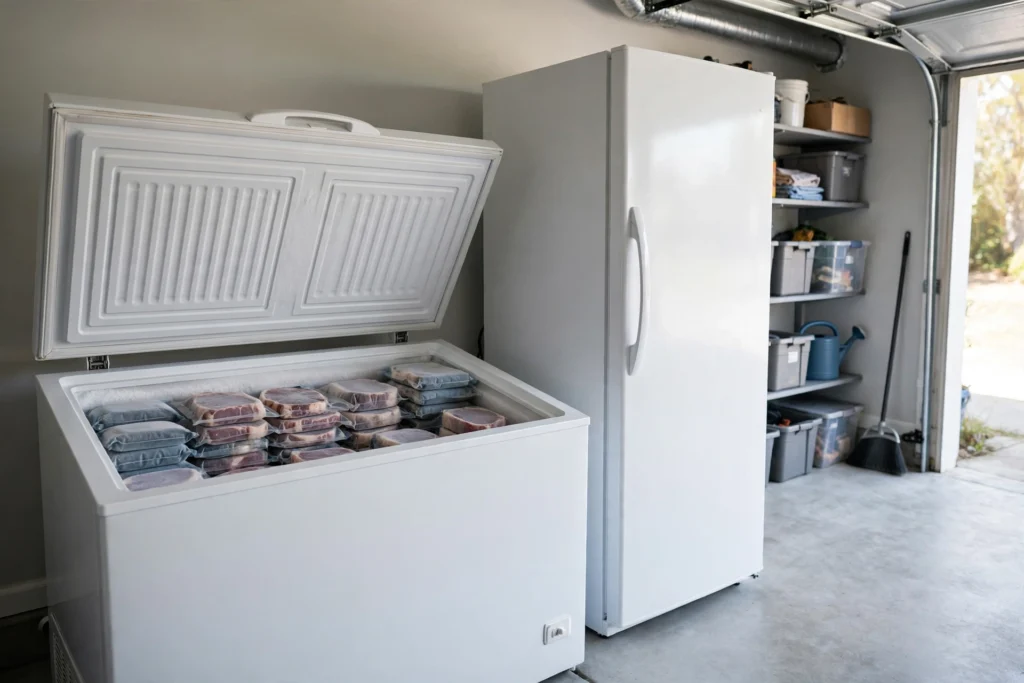
Short answer: For a family of four, start at 10–14 cubic feet — and if “family of four” really means “family of four plus half a cow,” the honest figure is 14–16 cubic feet, because half a cow is roughly 200–250 pounds of packaged meat and frozen food packs at about 25–35 pounds per cubic foot. Between the two shapes, the chest wins the outage argument (it holds its cold far longer with the power off and uses less electricity) and the upright wins the Tuesday-night argument (you can find the peas). Most bulk-meat houses end up with a chest; most convenience-first houses end up with an upright and no regrets — until the first long outage.
The only sizing math you need
Freezers are sold by cubic feet and filled by the pound, so convert once and the shopping gets honest. Well-wrapped frozen meat packs at roughly 30 pounds per cubic foot; mixed family food — vegetables, bread, ready meals, the odd pizza — packs looser, nearer 25. Working figures:
Frozen food to store, by household job
The top of each weight range this page gives — and the freezer size to buy for it.
| Household job | Frozen weight | Size to buy | Shape advice |
|---|---|---|---|
| Couple, garden + sales | ~150–200 lb | 7 cu ft | Either |
| Family of four, normal bulk buying | ~250–350 lb | 10–14 cu ft | Upright for sanity |
| Family of four + half a cow | ~450–550 lb | 14–16 cu ft | Chest, and bins |
| Whole cow / serious homestead | ~600–800 lb | 20–25 cu ft | Chest, or two smaller |
About that half cow: a typical half yields 200–250 pounds in the packages you actually bring home (the hanging weight you paid on is higher — bone and trim are the difference, and arguing about it is a county-fair tradition). Anyone who tells you a 7-cubic-foot freezer swallows a half cow has not met either. Two smaller freezers beat one giant one for big households, by the way: half the food is never at risk in a single failure, and a small one can be emptied into the big one and switched off when stores run low in spring.
Bluetti Elite 200 V2
Why this one: A power station sized to the freezer: the longest freezer bridge of the three stations scored for this job — a chest freezer at roughly 590 watt-hours a day runs about three days on one charge at the honest 85% factor.
Chest vs upright, head to head
| Chest | Upright | |
|---|---|---|
| Cold loss when opened | Low — cold air stays in the box | High — cold air pours out |
| Outage holdover (full) | ~48 hours | ~24–36 hours in practice |
| Electricity use | Lower | Higher, esp. frost-free |
| Finding things | Diving required | Shelves and door bins |
| Footprint | Wide, low | Narrow, tall |
| Frost | Manual defrost, mostly | Frost-free options |
The holdover row deserves a footnote, because it drives the outage pages on this site: the widely-quoted “48 hours for a full freezer” figure assumes a full, cold, unopened box, and chest freezers come closest to earning it — the lid seals on top, where gravity helps, and opening it for ten seconds dumps almost nothing. An upright’s door opens like a fridge door and spills its cold in the same ten seconds, which is why experienced outage hands quote upright owners a day, maybe a day and a half, and chest owners two.
The garage question, answered while we are here
Most of these freezers live in garages, so: a freezer in an unheated garage needs a “garage ready” rating (built to work in ambient temperatures swinging roughly 38–110°F) or, below freezing outside, a compressor that may simply refuse to start on the coldest nights — the machine reads the garage as already cold and takes the night off, politely warming your beef. Garage-ready models carry a heater or controls that handle it. Northern garage, winter outage: the one happy exception — a 20°F garage is a friend to a dead freezer, not a threat.
Making a chest freezer findable
The chest’s one real flaw is archaeological: food descends in strata and the bottom layer achieves legend status. Three fixes that actually work: bins or milk crates by category (beef, chicken, veg, ready meals), a whiteboard inventory on the lid with a marker tied to it — cross off what you take, or the board becomes fiction — and newest food at the bottom on loading day, not dropped on top. Ten minutes of system per shop saves the “we have four pork shoulders?” conversation.
Keeping the freezer you choose frozen when the power goes
Choosing the box is only half the plan — the other half is what keeps it cold on day two of an outage. A chest freezer is a small load: an ENERGY STAR chest uses roughly 590 watt-hours a day, so a 2,000Wh-class power station, at the honest 85% factor we use on this site, carries one for about three days. The stations we have already scored for exactly this job are the Bluetti Elite 200 V2 (2,073.6Wh — the longest freezer bridge of the three), the EcoFlow DELTA 2 Max (2,048Wh, and it recharges fast from a generator between runs), and the smaller Anker SOLIX C1000 (about a day and a half on a chest freezer — a bridge, not a plan). No prices are printed here because they move; the links show today’s figure.
Days of chest-freezer cover on one charge
A chest freezer uses roughly 590 watt-hours a day; these are the bridges the stations scored for this job give, at the honest 85% factor.
The EcoFlow DELTA 2 Max (2,048 Wh) sits in the Bluetti’s class, and recharges fast from a generator between runs.
Your next step: run your own freezer’s numbers on our power station runtime page for CPAP, fridge and freezer, or size the station against everything else in the house with the Home Power Sizer.
Relevant pickAnker SOLIX C1000
The smaller station of the three scored for this job — about a day and a half on a chest freezer. A bridge, not a plan: the honest size when the freezer only has to outlast the gap until the generator runs or the grid returns.
About a day and a half on a chest freezer
Follow-up questions
How much electricity does each shape use?
A modern 14-cubic-foot chest freezer typically runs about 250–350 kilowatt-hours a year; a comparable frost-free upright, 450–600. Per day that is roughly 0.8 kWh against 1.4 kWh — the difference decides how long a power station can keep one frozen, which is its own page in this series.
Is one big freezer or two small ones better in an outage?
Two small ones, for the same total capacity, hold cold about as well and halve the failure risk — but only the one you open stays cold longest. In a long outage, consolidate into one, fill the gaps with water jugs, and let the empty one go.
What temperature should it actually be set to?
0°F, and verified with a cheap freezer thermometer rather than trusted from the dial. Food keeps safely colder for longer, and in an outage every degree below zero is time in the bank.
Frequently asked questions
How long does a half cow feed a family of four?
At roughly 200–250 packaged pounds and a family eating beef three times a week, most households land between 8 and 12 months — which is the other reason the freezer matters: it is not storage, it is a year of dinners.
Do I need a generator just for the freezer?
Not for the first day or two — a full, unopened chest freezer is its own battery. You need a plan by hour 24–48: a station that can cycle it a few hours a day, a generator, or a neighbour with power and a strong friendship. The hour-by-hour version of that math is the next page in this cluster.
What does “frost-free” cost you in an outage?
Frost-free uprights periodically warm their coils to melt frost — powered, that is convenience; measured over a year it is a chunk of the upright’s higher energy use, and it means slightly larger temperature swings for the food. It changes convenience, not safety.
The verdict
Buying for bulk meat and outage country: a 14–16 cubic foot chest, garage-rated if it lives in the garage, with bins from day one. Buying for a busy kitchen’s overflow: a 10–14 cubic foot upright and honest acceptance of the shorter outage clock. Either way, buy the size the pounds demand — an overstuffed small freezer and an echoing big one are the two standard regrets, and both are visible in the table above before any money moves.
The full set is at What People Are Asking About Freezers, and the food-storage shelves live in our Food hub.
Talk it over with other homeowners
The Ordinary Prepper Community on Facebook is where readers compare outage plans, show their setups, and help decide what we test next.