
As an Amazon Associate, Ordinary Prepper earns from qualifying purchases. Prices last checked October 28, 2026.
Home Readiness — Guide
Summer Outage With No AC: Keeping the House (and People) Cool
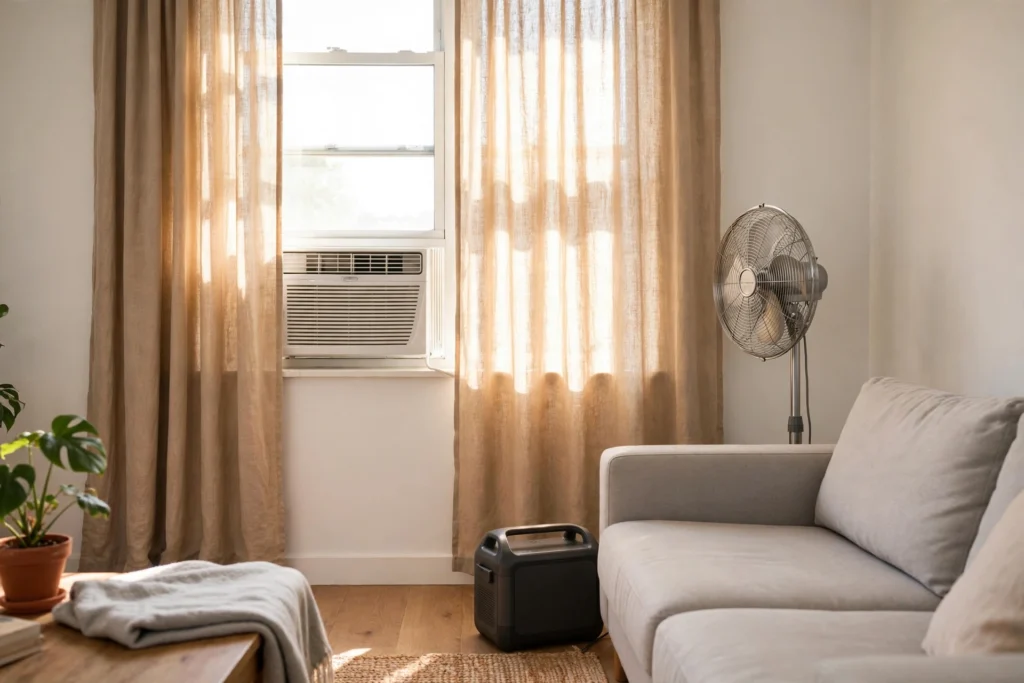
Short answer: Cool one room, not the house. A fan draws 50–100 watts and a power station runs one for a day or more; a small window AC draws 500–900 watts and the same station runs it about 2–3 hours — long enough to cool a bedroom before sleep, which is the highest-value cooling there is. The order of operations matters more than the hardware: block the sun before the house heats up, move air, cool the people (water, rest, light clothing) before the rooms, and know the heat-illness thresholds, because the plan changes the moment someone in the house is elderly, very young, or unwell — for them, a cooled room at a relative’s house or a public cooling centre is not defeat, it is the plan working.
Anker SOLIX C1000
1,056Wh — about 900 usable. What it runs: a 75W fan for roughly 12 hours, the router and phones alongside, or a 600W window AC for about 1.5 hours to take a bedroom down before sleep.
EcoFlow DELTA 2 Max
2,048Wh, about 1,740 usable. What it runs: a 600W window AC for about 2.5–3 hours, or a fan for a full day and night with the fridge rotated in — the one-box summer outage answer for most houses.
The watts table, so the plan is arithmetic
| Cooling option | Draw | On ~1,740 usable Wh | Cooling you actually get |
|---|---|---|---|
| Ceiling or pedestal fan | ~50–100W | ~17–30 hours | Feels 4–6°F cooler on skin |
| Window AC, 5,000 BTU | ~450–600W | ~3 hours | One small room, properly cool |
| Window AC, 8,000 BTU | ~700–900W | ~2 hours | One bedroom, properly cool |
| Portable AC (single hose) | ~1,000–1,300W | ~1.4 hours | Least cooling per watt — avoid |
| Central AC | ~3,000W+ | Under an hour | Generator territory, not station |
Two entries deserve emphasis. Fans do not cool rooms — they cool people, by moving air across skin — which is why they are the best value on the table and also why health guidance says fans alone stop protecting you when indoor air climbs into the high 90s and beyond: past that, moving hot air across a person who cannot sweat effectively adds heat instead of removing it. And the portable single-hose AC is the watt-waster of the category; if a window unit fits the window, it wins by a third.
Cooling hours on one station charge (from ~1,740 usable watt-hours, a 2,048 Wh station): fan, 50–100 W — ~17–30 hours · window AC, 5,000 BTU — ~3 hours · window AC, 8,000 BTU — ~2 hours · portable AC, single hose — ~1.4 hours · central AC, 3,000 W+ — under 1 hour.
The fan point: Fans cool people, not rooms — moving air feels 4–6°F cooler on skin. The portable single-hose unit is the watt-waster of the category: if a window unit fits, it wins by a third.
Anker SOLIX C1000: 1,056 Wh, about 900 usable: a 75 W fan for roughly 12 hours, or a 600 W window AC for about 1.5 hours to take a bedroom down before sleep.
EcoFlow DELTA 2 Max: 2,048 Wh, about 1,740 usable: a 600 W window AC for about 2.5–3 hours, or a fan for a full day and night with the fridge rotated in.
The pattern: Fan hours are counted in days, AC hours in single digits — which is why the plan spends the AC budget at night, on the bedroom. Usable watt-hours, not the headline rating, are what the cooling plan is built on.
Anker SOLIX C1000
Why this one: About 900 usable watt-hours: a 75W fan for roughly 12 hours, the router and phones alongside — or a 600W window AC for about 1.5 hours to take a bedroom down before sleep.
The house tactics, in the order to do them
Before the heat builds (morning): close curtains and blinds on the sun side — exterior shade beats interior by a wide margin if you have awnings or can hang a shade outside the glass — and close off unused rooms. A house is a battery for heat; every degree you refuse in the morning is a degree you do not fight at midnight. Midday: no cooking indoors beyond the minimal, lights and appliances off (they are small heaters that happen to do other jobs), everyone based in the coolest room — usually the lowest floor, on the shaded side. Evening: if outside air drops below inside, cross-ventilate hard with windows on opposite sides and the fan in a window exhausting; this night flush is how houses without AC stayed livable for centuries. Night: spend the station’s AC budget here — a bedroom taken down to sleeping temperature buys the whole household’s next day.
Cooling people, which is the actual job
Water first and constantly — thirst lags need in heat, and older adults feel it least reliably, so glasses get refilled on a schedule, not on request. Cool, damp cloths on the neck, wrists, and armpits; a tepid shower or a basin for feet; light, loose clothing; activity moved to the cool hours and cut hard at midday. Alcohol makes all of it worse. Pets get the same logic with paws and shade, and never a closed car or a hot room “for a minute.”
The thresholds that change the plan
Heat illness escalates on a published ladder, and the rungs matter more than any gear on this page. Heat cramps and heavy sweating with weakness — rest, shade, fluids, and stop activity. Heat exhaustion — nausea, headache, dizziness, pale or clammy skin, fast pulse: move to cooling, loosen clothing, sip water, and if vomiting starts, symptoms worsen, or an hour passes without improvement, that is medical care, not home management. Heat stroke — body temperature around 104°F or higher, confusion or slurred speech, hot skin that may be dry, seizures: this is a 911 call and aggressive cooling by any means at hand while help comes; it is life-threatening and it is not a wait-and-see condition. Babies, elderly people, and anyone on certain heart or blood-pressure medicines reach these rungs faster — public-health guidance is consistent on that — so for houses with those members, the plan’s trigger for relocating to a cooled space should be early and unembarrassed: a library, a mall, a cooling centre, a friend’s powered house two towns over.
Relevant pickEcoFlow DELTA 2 Max
The bedroom-cooling budget: a 600W window AC for about 2.5–3 hours, or a fan for a full day and night with the fridge rotated in — the one-box summer outage answer for most houses.
2,048 Wh · About 1,740 usable
Follow-up questions
Can a generator run the central AC?
Sometimes — it is the heat-pump problem from our winter pages wearing summer clothes: a 3-ton system’s running watts are manageable and its starting surge is not, and a soft starter plus a generator in the 9,000–12,500 peak class is the usual honest route. Price that against the window-unit plan; for a two-day outage the window unit wins for most houses.
Should I open windows at night if it is humid?
If the outside air is cooler, yes — temperature beats humidity for sleeping comfort in most cases, and the flush still dumps the day’s stored heat from walls and furniture. Where nights stay hot and saturated, the fan-plus-AC-budget plan carries the load instead.
What is the coolest room trick for apartments?
The bathroom, often: interior, tiled, small, and built around cold water. A tepid bath or shower before bed, plus the fan, is the apartment dweller’s air conditioning — and upper-floor renters should know their heat risk runs higher and plan the relocation trigger earlier.
Frequently asked questions
Does a wet sheet over a fan actually work?
Evaporative tricks work in dry heat and fade as humidity climbs — in a humid climate the gain is small and the added moisture is real. The fan alone, aimed at people, keeps most of the benefit everywhere.
How hot is too hot to stay?
There is no single number; sustained indoor temperatures in the 90s are dangerous territory for vulnerable people, and health agencies advise relocating rather than enduring multi-day heat without cooling. The honest rule: when someone in the house shows the exhaustion symptoms above, the debate is over.
Will blackout curtains really change anything?
Sun through glass is hundreds of watts per window of pure heat gain; blocking it on the outside, or with tight interior shades as second best, is one of the largest free wins on this page — measured in the degrees your AC budget does not have to buy back at night.
The bottom line
Shade the glass, close the house down, cool one room at night, hydrate on a schedule, and treat relocation as a tool rather than a surrender. The station’s job in summer is narrow and vital: a fan all day, and a cool bedroom at the end of it.
The full set is at What People Are Asking About Outage Living, and its winter mirror is Can a Generator Run My Heat Pump?
Talk it over with other homeowners
The Ordinary Prepper Community on Facebook is where readers compare outage plans, show their setups, and help decide what we test next.