
As an Amazon Associate, Ordinary Prepper earns from qualifying purchases.
Home Readiness — Guide
How Does a Family Reach Each Other When Cell Service Is Down?
Short answer: You do not reach each other by trying harder on the same jammed network. You reach each other with a plan written down before anything happens: one out-of-area contact everybody checks in with, texting instead of calling, two meeting places, and — for the streets around home — a set of simple FRS hand radios on a channel the whole family knows. FEMA’s guidance and the FCC’s rules agree on the shape of it. The plan fits on one card. This page is that card, filled in.
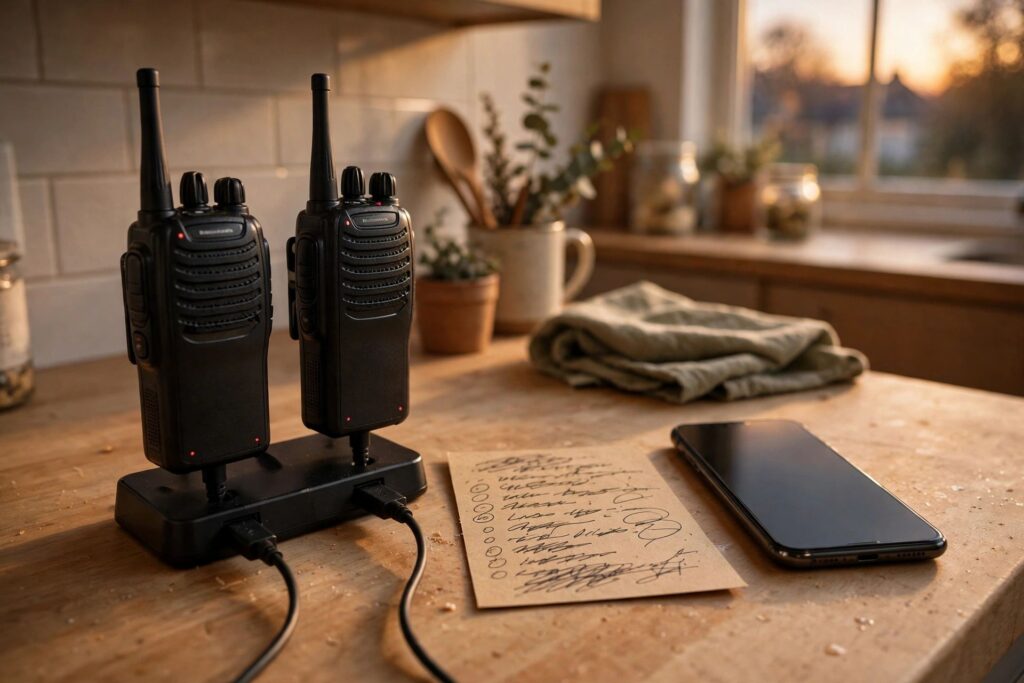
The one-page family communications plan
Ready.gov publishes a free family emergency communication plan card, and its structure is the right one — which means the honest advice is to copy its bones and fill them in tonight, not someday. Five things go on the card.
The plan fits on one card — Ready.gov’s card structure; fill it in tonight, not someday
• Out-of-area contact
• Check-in rule — text first
• Meeting place 1 — outside the house
• Meeting place 2 — outside the neighbourhood
• Radio channel + check-in times
Copies: wallets (a copy each), school bags (one per child), on the fridge (the house copy)
Paper works at 4% battery. Phones do not.
| Part of the plan | What to write down |
|---|---|
| Out-of-area contact | One name, one number, outside your region |
| Check-in rule | Text that person first; short and factual |
| Meeting place 1 | Right outside the house — for a fire |
| Meeting place 2 | Outside the neighbourhood — if you cannot get home |
| Radio channel | Your family’s FRS channel and check-in times |
Paper copies matter more than the app version of any of this. A copy in each wallet, one in each child’s school bag, one on the fridge. Phones die, get left in cars, and spend blackouts at 4 percent. Paper does none of those things, and it works for the family member whose phone is the one that died.
Midland WR120B Weather Radio
Why this one: The plan above reaches people. This reaches the facts: warnings for your county wake the house, and warnings for three counties away do not — it is the receiver our outage plan already points to.
Why the out-of-area contact works
This is the oldest piece of advice in emergency planning, and it survives because the network really does behave this way: in a local disaster, local circuits jam with everybody calling across town at once, while a call or text out of the area often routes around the worst of it. So the family does not try to reach each other directly through the jam. Each person checks in with the one contact — an aunt two states away, a college friend in a city the storm is not touching — and that person becomes the switchboard: who is safe, who is where, who is heading to which meeting place. Pick somebody who will actually answer and write things down, tell them they have the job before the emergency, and put their number at the top of every card. A switchboard who does not know they are the switchboard is just another person wondering.
One contact, outside the jam
Family in the area, local circuits jammed → the out-of-area contact, the switchboard → family in the area hears it relayed back
✗ Not this: calling across town through the jam
The switchboard relays: who is safe · who is where · which meeting place
Tell them they have the job before the emergency.
Text first. Call second. Keep both short.
FEMA and the FCC give the same instruction, for a mechanical reason: a text message uses a fraction of the network capacity a voice call holds open, so texts slip through congestion that voice calls cannot — and when they cannot get through immediately, they queue and deliver when a gap appears, instead of failing like a dropped call. So the family rule is text first, and the text itself is written in advance, the same short shape every time: your name, that you are safe, where you are, and when you will check in next. Four facts. Nothing else needs the network in the first hour. If a call is truly needed, keep it brief and pass only the vital facts — every long call in a jammed area holds capacity that a 911 call somewhere else is waiting for, and drains the battery you are trying to stretch. One more phone habit, set up on the calm day: an ICE contact — In Case of Emergency — saved under that name in each phone, so a helper or first responder holding the phone knows who to call.
Text first. Call second. — FEMA + FCC: a text uses a fraction of a call’s capacity
Text message — queues, and delivers when a gap appears
Voice call — holds capacity open, and drops when jammed
The text, every time: name · safe · where · next check-in
If you must call: brief — vital facts only
Save an ICE contact in every phone on the calm day.
The meeting places settle what the phones cannot
Two places, no more, and everybody — including the kids, at their level — knows both. The first is close: the big tree, the neighbour’s porch, the corner. It answers the sudden event, the house fire at midnight, where the family simply needs to find each other in the dark and count heads. The second is outside the neighbourhood: a relative’s house across town, a library, a church car park. It answers the longer event, where home is not reachable or not habitable and the question is where the family reassembles over hours, not minutes. The rule that makes meeting places work is the boring one: if you are heading to one, leave word where word can be left — a note on the fridge, a text to the switchboard — saying which place, and when you left. Half of all “we couldn’t find each other” stories are two halves of a family waiting at two correct places.
Two meeting places, no more — what the phones cannot settle, the places do
Close place — the corner, a neighbour’s porch. The sudden event: count heads
Neighbourhood place — a relative’s house, a library. The longer event: reassemble over hours
Leave word — a note on the fridge, and text the switchboard: which place, when you left
FRS and GMRS: the radios for the streets around home
Phones, even texting cleverly, still depend on somebody else’s network. The layer that depends on nothing but batteries is a set of handheld two-way radios — the kind sold in pairs and three-packs in every big-box store. The FCC runs two services on the same 22 channels, and they talk to each other.
Power limits, by service and channel
Watts, from the FCC rules as stated on this page. FRS channels 8–14 run at half a watt (0.5 W), stated here rather than charted at this scale.
| Service | Licence | Power | Best for |
|---|---|---|---|
| FRS | None, ever | Up to 2 watts | The whole family, today |
| GMRS | $35 FCC, 10 yrs, no test | Up to 5 watts handheld | More range, repeaters |
FRS — Family Radio Service — needs no licence at all, and that is why it is the family default: a radio can be handed to a child, a grandparent, or the neighbour helping you move a tree off the drive, and it is legal as it leaves your hand. The shared channels are numbered 1–22; channels 8–14 run at half a watt, the rest at up to 2 watts on an FRS set. GMRS steps up the same dial — more power, removable antennas, and repeaters that re-send a signal across a county — and it does require the licence, stated plainly: $35 to the FCC, good for ten years, no test, and one licence covers your immediate family. If your household buys GMRS radios to use at GMRS power, that licence is part of the purchase, not paperwork for later. For the wider listening picture — what to tune to for warnings and news while these radios handle the talking — keep our companion chart beside this plan: what to listen to in a blackout.
Set the family channel now, and write it on the card. Pick one of the full-power channels, agree that it is the family channel in any outage, and agree on check-in times — the top of each hour, radios on for five minutes — instead of leaving sets switched on and draining. That last habit is the difference between radios that work on day three and radios that were wonderful on day one. And manage the range expectation at the kitchen table, not in the street: the mileage on the box is measured over open water. In a real suburb, plan on a mile or two, house to house. That covers the neighbourhood. It does not cover the family member across the county — that person is the switchboard’s job, by text, or the satellite layer’s job, which we compare here: satellite communicators for home emergencies.
Keeping it all charged
Every layer of this plan runs on something that goes flat. The charging rules are simple and unglamorous. Radios live on their charging base or in one named drawer with their charger — never scattered — and their batteries get topped up on the first of the month, the same round that tests the smoke alarms. Spares are plain: a set of AA batteries beside any radio that takes them. Phones stretch further with three habits set in advance — low-power mode on, screen brightness down, and one family power bank kept charged and kept in the same drawer as the radios, rotated through normal use so it is never a three-year-old brick. If the house has a power station, the plan should say, in writing, what it is reserved for in an outage — and a share of it belongs to communications, because a fridge you can monitor is worth less than a family you cannot reach. Our runtime math for the house loads lives here: how long a power station runs your fridge, freezer, or CPAP.
One drawer, everything charged — the unglamorous rules
Radios — on their base or in the drawer, with their charger, never scattered
AA spares — beside any radio that takes them
Family power bank — kept charged, rotated through use
First of the month — a top-up round, the same round as the smoke alarms
Phones: low-power mode on, brightness down — set in advance.
Relevant pickAnker PowerCore Essential 20000 PD
The family power bank in the plan: 20,000 mAh is several full phone charges held in reserve, which is what texting-first actually consumes over a three-day outage.
20,000 mAh · Several full phone charges
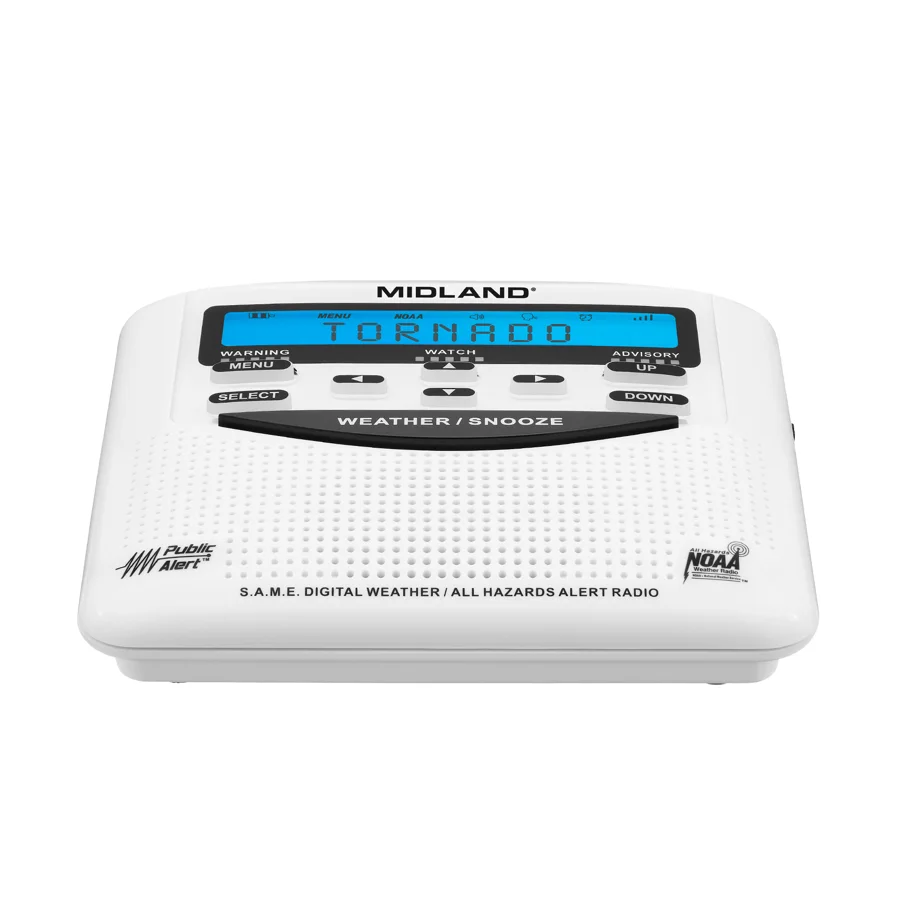
Photo: Midland
Midland WR120B Weather Radio
The plan above reaches people. This reaches the facts: all seven NOAA weather channels with SAME county programming, so warnings for your county wake the house and warnings for three counties away do not. Wall power with AA backup — it is the receiver our outage plan already points to.
Anker PowerCore Essential 20000 PD
The family power bank in the plan: 20,000 mAh is several full phone charges held in reserve, which is what texting-first actually consumes over a three-day outage. It earns its drawer space by being boring — charged monthly, rotated through normal use, there on the night.
Prices last checked: October 29, 2026. No prices are printed for these picks in this run — neither listing price could be verified cleanly today, and an unverified price does not go on the page.
Follow-up questions
What do we do if the out-of-area contact cannot be reached either?
Fall back down the card, in order: text again later — congestion eases in waves, often within the first hours — then the meeting places, which need no network at all. That ordering is the whole reason the plan has layers. A plan with one method is a hope.
Should the kids have phones, radios, or both?
Both, at different ages for different reasons — but the piece that matters at any age is the paper card in the school bag and knowing the two meeting places and the switchboard’s number by heart if they are old enough to dial it. Kit is handed out; knowledge is what survives a dead battery.
How often should we practise this?
Once, out loud, at the kitchen table, the week you write it — and a two-minute refresher when the clocks change. A plan nobody has ever said out loud falls apart at the first surprise, usually over something small: a channel nobody agreed, a meeting place two people picture in two different spots.
Frequently asked questions
What is the best way for a family to communicate when cell service is down?
Layered: text the out-of-area contact first, use FRS radios on your agreed channel for the neighbourhood, and fall back on two meeting places that need no signal at all. No single method carries a real outage alone.
Do we need a licence for family walkie-talkies?
Not for FRS — it is licence-free by FCC rule. GMRS, the higher-power service on the same channels, requires one $35 FCC licence, no test, ten years, covering your immediate family.
Why not just keep calling until a call gets through?
Because in a congested network that is the least likely method and the most expensive one — in battery and in network capacity. FEMA’s guidance is text first for exactly this reason: texts need a fraction of the capacity and queue for delivery instead of failing.
The verdict
Reaching each other in an outage is not a shopping problem. It is a one-card problem — a switchboard contact, a texting rule, two meeting places, one radio channel, check-ins on the hour — written on a calm evening and practised once out loud. The radios and the power bank are the easy part, and they are the only part money buys. Write the card first.
The full set is at What People Are Asking About Outage Living. The plan above is one of the six problems in when the power goes out: the six problems every house has to solve.
Talk it over with other homeowners
The Ordinary Prepper Community on Facebook is where readers compare outage plans, show their setups, and help decide what we test next.