
As an Amazon Associate, Ordinary Prepper earns from qualifying purchases. Prices last checked October 25, 2026.
Home Readiness — Guide
The Ordinary Home Readiness Audit: A Room-by-Room Checklist
Short answer: most homes that feel ready are missing something basic, and you can find out which thing in about 45 minutes, room by room. In the U.S. Consumer Product Safety Commission’s 2024 household survey of 1,060 homes, about 46% of households were missing a smoke alarm, a carbon monoxide alarm, or both — in homes whose owners mostly believed they were covered. Alarms are one line on this audit. The rest is the same kind of check, applied to water, food, light, power, heat, and the paperwork: 34 yes-or-no questions, six rooms, no buying required. Count your yes answers as you go. The household emergency checklist is the shopping-list companion to this page — this audit is how you find out which lines on it your house actually fails.
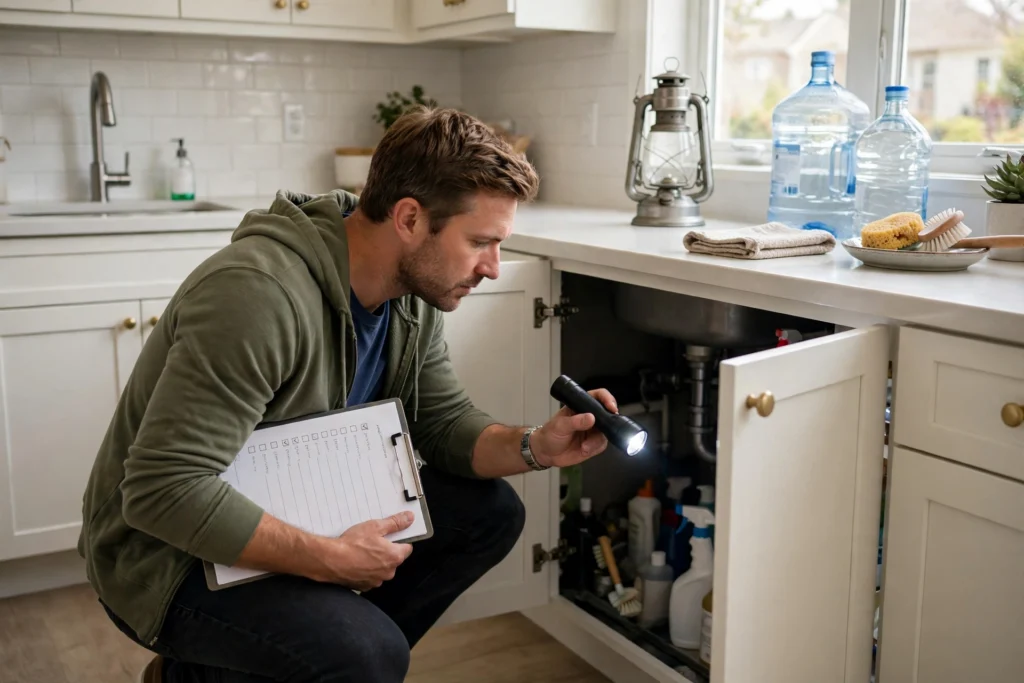
How does the scoring work?
Every check below is a yes or a no — no partial credit, because an outage does not give partial credit either. A lantern with dead batteries is a no. Water you meant to buy is a no. Score the house you have today, not the one you are planning. The bands: 30–34 yes answers means this house rides out a bad weekend — a two- or three-day outage, a burst of severe weather — with what is already in it. 22–29 means the basics exist but one system is thin, and the room sections below will show you which one. Under 22 means start where this page starts every beginner: water, light, and food you can eat without cooking, in that order. One more rule: any no on an alarm, the water shutoff, or drinking water outranks the total. Fix those first whatever your score says.
| Room | Checks | Most-missed item | Fix first |
|---|---|---|---|
| Kitchen | 6 | Manual can opener | Water for 3 days |
| Bathroom | 5 | Medicines past date | Backup toilet plan |
| Bedrooms | 6 | CO alarm missing | Light at each bed |
| Living areas & entry | 5 | No written plan | Contacts on paper |
| Garage, basement & utility | 7 | Shutoff nobody can find | Tag the shutoff |
| Outside | 5 | Hoses still connected | Drain outdoor faucets |
The pattern in that middle column is the finding, and it holds across every survey and every reader story we have seen: homes rarely fail on the expensive gear. They fail on a two-dollar can opener, an alarm that was never bought, and a valve nobody can find in the dark.
The 34 checks, room by room
The utility spaces carry the most checks — and fail most often.
Most-missed items, from the table on this page: kitchen — a manual can opener; bedrooms — a CO alarm missing; utility spaces — a shutoff nobody can find.
EcoFlow DELTA 2
Why this one: The original 1 kWh EcoFlow — the smaller power-station step for households whose audit shows phones-and-lights gaps, not fridge gaps. It is the fix the power checks in this audit are pointing at when the score comes back thin on light and charging.
What should you check in the kitchen?
The kitchen decides whether an outage is an inconvenience or a hungry problem, so it gets six checks. ☐ Drinking water for three days: one gallon per person per day is the Ready.gov figure, so a household of four needs 12 gallons within reach — and extra for pets. If you cannot point at it, it is a no; size your real number with the water storage calculator and store it in containers that survive a garage, from our water container comparison. ☐ Food you can eat with no cooking: at least a few days of it, separate from the food that needs a stove. ☐ A manual can opener — the single most-missed item on this entire audit; an electric opener in a blackout is a paperweight. ☐ A way to cook if the power stays out, from the indoor-safe options in our backup cooking comparison. ☐ The fridge plan: everyone in the house knows a closed fridge holds safe temperatures about four hours, a full freezer about 48, and the door stays shut. ☐ A flashlight or lantern that lives in this room, batteries checked — the emergency lights we compared start at a two-pack of plug-in lights that come on by themselves.
The kitchen checks — six checks: water, food, tools, cold and light
Water store — 12 gal for four, 1 gal per person per day
No-cook food — a few days that eat as they are
Manual can opener — in the drawer; the most-missed item on the audit
Backup cooking — an indoor-safe option
Fridge + freezer — door shut: ~4 hours; ~48 hours full
A lantern — one that lives in this room
If you cannot point at the water, it is a no.
What should you check in the bathroom?
The bathroom is the medicine cabinet and the sanitation plan, and both quietly expire. ☐ Medicines in date, with a buffer: prescription medicines organized so a refill delay is not an emergency — Ready.gov notes about half of Americans take a prescription daily. This audit gives no medical advice; the check is only whether the supply and the list exist. ☐ A basic first-aid kit you have opened: if you have never looked inside it, you do not know what is missing. ☐ Sanitation if the water stops: wipes, garbage bags with ties, and a plan for a toilet that will not flush — a bucket, liners, and a lid are the simple version. ☐ Water set aside for flushing and washing that is not your drinking water. ☐ A light for this room at night that does not depend on the hallway switch — bathrooms are where outage injuries happen, on wet floors, in the dark.
The bathroom checks — five checks: medicines, first aid, sanitation, water, light
Medicine cabinet — in date, a refill buffer, the list exists
First-aid kit — opened once, so you know what is missing
Sanitation — bucket, liners, lid, wipes, bags
Flush + wash water — kept apart from drinking water
A light for this room — not on the hallway switch; wet floors in the dark are where outage injuries happen
What should you check in the bedrooms?
Bedrooms are where the alarm checks live, and where this audit finds its worst national number. The CPSC survey behind our opening figure tested alarms in 985 households: about 55% had a CO alarm at all, and an estimated 16% of households had no fully functional alarm of either kind. ☐ A smoke alarm in every bedroom, outside each sleeping area, and on every level — tested this month, not “when it chirps.” ☐ A CO alarm on every level and near the sleeping areas in any house with fuel-burning heat, a fireplace, or an attached garage. ☐ No alarm older than 10 years: the replace-by date is printed on the back; alarms age out even when the test button still beeps. ☐ A light within reach of each bed — a lantern or flashlight, not a phone that spends the night at 20%. ☐ Phones charging where people sleep, with a cord that reaches, so the morning of an outage does not start with dead phones. ☐ Warm layers and blankets for a night with no heat, one set per person, including for guests who did not plan to stay.
Relevant pickMPOWERD Luci Original Solar Lantern
A solar lantern that charges on a windowsill — the bedroom-light check, answered for houses that keep forgetting batteries.
Solar charging · Charges on a windowsill
The alarm numbers behind the bedroom checks — about 46% of households were missing a smoke alarm, a CO alarm, or both
The survey — CPSC 2024 household survey: 1,060 homes surveyed, alarms tested in 985 households
CO coverage — only about 55% of tested households had a CO alarm at all
No working alarm — an estimated 16% of households had no fully functional alarm of either kind
The placement rule — smoke alarms in every bedroom, outside each sleeping area, and on every level; CO alarms on every level and near sleeping areas
The age rule — no alarm older than 10 years; alarms age out even when the test button still beeps
What should you check in the living areas and the entry?
This is the paperwork room — the checks here cost nothing and are the ones nobody does. ☐ Emergency contacts on paper, on the fridge or by the door: an out-of-area contact, the utility’s outage line, a plumber, and the non-emergency police number. Phones die; paper does not. ☐ Important documents copied — insurance policies, ID, bank records — in a waterproof container you can grab, or stored electronically where another family member can reach them, exactly as Ready.gov’s kit list puts it. ☐ Cash in small bills: card readers need power and networks; a modest amount of small bills covers gas and groceries in the first day of a wide outage. ☐ A battery or hand-crank radio that gets the weather and the news when the internet is the thing that is out. ☐ An escape route everyone has walked: two ways out of the house, one meeting spot outside, said out loud once a year — including how the pets come along, because a plan for pets is part of the plan.
The living-area and entry checks — five checks: paper, documents, cash, radio, the way out
Paper contacts — on the fridge or by the door
Document copies — insurance, ID, bank records
Waterproof container — grab-and-go, or shared electronically
Small-bill cash + radio — first-day money; a battery or hand-crank radio
The escape route — two ways out, one meeting spot outside, the pets come along
What should you check in the garage, basement, and utility spaces?
Seven checks, and this room holds the audit’s highest-stakes item. ☐ Every adult can find and turn the main water shutoff — in the dark, by flashlight, today. A burst pipe leaks by the gallon per minute until that valve closes; tag it, and walk the household to it once. ☐ The same for the breaker panel and the gas shutoff, with the one caution that gas is turned back on only by the utility or a professional. ☐ A working fire extinguisher that is charged (needle in the green), reachable, and not buried behind paint cans. ☐ The freeze checks pass: pipes in unheated spaces insulated, outdoor faucets drained, hoses off — our cold-snap freeze protection guide walks through all of it with the numbers. ☐ Stored water stored right: off a cold concrete floor where practical, out of direct sun, dated, and with headspace if the space can freeze — water expands about 9% as it turns to ice. ☐ Backup power that is charged: if the house owns a power station, it is stored charged and tested, sized against the fridge math in our runtime guide and the home power sizer. ☐ Fuel stored safely and legally, in approved containers, away from living space and ignition, in date — gasoline goes stale in months, not years.
Garage, basement and utility checks — seven checks; the shutoffs are the highest-stakes items on the audit
Main water shutoff — tagged; every adult can find and turn it
Breaker panel + gas — gas goes back on only by the utility
Fire extinguisher — charged, needle in the green, reachable
Freeze checks — pipes insulated, faucets drained, hoses off
Stored water — off concrete, out of sun, dated
Backup power — stored charged, and tested
Fuel, stored safely — approved containers, away from living space and ignition, in date
What should you check outside?
Five quick ones, mostly seasonal. ☐ Outdoor faucets winterized before the first hard freeze: hoses disconnected and drained, interior valve closed, exterior faucet opened to drain, cover on. ☐ A way to see and be seen: the house number readable from the street at night — the check responders quietly care about most. ☐ Trees and gutters: dead limbs over the roof and power drop noted, gutters cleared before storm season; you are not fixing these mid-audit, you are writing them down. ☐ The car is part of the house system: fuel kept above half a tank in storm season, a phone charger and blanket in it, because the car is the backup charger and the backup warm room. ☐ Neighbors: you know which neighbor would need a check-in during a long outage, and one neighbor knows the same about you. It is the cheapest item on this list and the one that saves the most people in real events.
The outside checks — five quick ones, mostly seasonal
Outdoor faucets — hoses off and drained, valve closed, cover on
House number — readable from the street at night
Trees + gutters — dead limbs noted, gutters cleared
The car — fuel above half, charger and blanket aboard
Neighbours — one who would need a check-in, and one who knows the same about you
Which room fails most often?
The utility spaces fail most often, and it is not close. Kitchens fail on one or two items; bedrooms fail on alarms in nearly half of homes nationally; but the garage and basement are where the shutoff nobody can find, the extinguisher nobody can reach, the uninsulated pipe, and the stored water quietly freezing all live at once. If your audit time runs short, do this room first and the bedrooms second. The order matters for a simple reason: the failures in these two rooms are the ones that hurt people or destroy property. A missing can opener ruins dinner. A missing CO alarm, or a shutoff nobody finds while a pipe runs, ruins much more.
What are the honest caveats?
Four. First, this is a readiness audit, not a safety inspection: it does not certify wiring, plumbing, gas lines, or structure, and anything that looks wrong in those systems is a call to a licensed professional, not a DIY line item. Second, several checks are seasonal — the outside list matters most before winter and before storm season; run the full audit twice a year (the clock-change weekends are a natural rhythm) and the seasonal slice before its season. Third, the national figures here are survey findings, not a judgment of your house: the CPSC’s 2024 survey (1,060 households surveyed, alarms tested in 985) found most homes covered on smoke alarms and nearly half missing full smoke-and-CO coverage — your count is the only one that matters, which is the point of walking the rooms. Fourth, a high score expires: batteries die, food rotates out, medicines pass their dates. An audit is a habit with a date on it, not a certificate. Date yours at the top of the page.
Three more worth a look
Not reviewed or scored — listed because readers cross-shop them, with the same disclosure as everything here.
EcoFlow DELTA 2
The original 1 kWh EcoFlow — the smaller power-station step for households whose audit shows phones-and-lights gaps, not fridge gaps.
MPOWERD Luci Original Solar Lantern
A solar lantern that charges on a windowsill — the bedroom-light check, answered for houses that keep forgetting batteries.
Instant Pot Duo Mini 3-Quart
A small electric cooker that sips power compared with an oven — the audit’s cooking check, sized for a power station.
As an Amazon Associate, Ordinary Prepper earns from qualifying purchases. The three products above have not been reviewed or scored.
Frequently asked questions
How often should you run a home readiness audit?
Twice a year for the full 34 checks — the weekends the clocks change work well, since alarms want testing anyway. Run the outside and utility sections again before winter, and re-score any room you fixed, the same week you fix it.
How long does a room-by-room audit take?
About 45 minutes for an average house, clipboard in hand, if you score honestly and do not stop to fix things mid-walk. Write fixes down instead. Apartments run faster — skip the rooms you do not have and score only yours.
How much water should a house store?
One gallon per person per day, for drinking and sanitation — three days is the floor, two weeks is the comfortable target Ready.gov points households toward. A family of four at three days is 12 gallons, plus extra for pets. Our water storage calculator does the math for your household.
How many smoke and carbon monoxide alarms does a house need?
Smoke alarms in every bedroom, outside each sleeping area, and on every level. CO alarms on every level and near sleeping areas, in any home with fuel-burning appliances or an attached garage. Replace any alarm at 10 years, tested monthly until then.
What do homes most often forget?
The manual can opener, the CO alarm, and the water shutoff — in roughly that order of embarrassment. After those: medicines with no buffer, documents with no copy, and stored water with no date on it. None of the top six costs real money.
Does this audit work for renters and apartments?
Yes — most checks are about what is in the home, not the building. Renters skip permanent changes, lean on the landlord for alarms and shutoffs (and learn where those are anyway), and weight the kitchen, bedroom, and paperwork rooms, which are fully in their control.
What should you fix first?
Fix in this order, whatever your score: any missing or dead alarm; drinking water under three days; a shutoff nobody can find; a bedroom with no light. Those four close most of the real risk on this page, and three of them are free. After that, work room by room in the order the sections run, and re-run the audit when you finish — the second score is the one worth keeping. Size the food shelf with the food storage calculator and the first-30-days pantry plan, keep the tick-off version beside it in the household emergency checklist, and see the rest of the system on the Home Readiness hub.
Talk it over with other homeowners. If your audit turned up a room that scored worse than you expected, bring the number — comparing which checks other houses fail is the fastest way to spot the gap you walked past. The Ordinary Prepper Community on Facebook is where readers compare outage plans, show their setups, and help decide what we research next. Join the group →