
As an Amazon Associate, Ordinary Prepper earns from qualifying purchases. Prices last checked October 28, 2026.
Home Readiness — Guide
Transfer Switch, Interlock, or Extension Cords?
Short answer: Extension cords are the free answer that runs two or three things and nothing hardwired — no furnace, no well pump, no sump on a switch. An interlock kit (typically $150–$250 in parts plus an electrician’s hour or two) lets your portable generator feed chosen circuits through your own panel, safely and legally, and is the value pick for most houses. A transfer switch ($800–$1,500 installed, commonly) does the same job in a separate box with less to remember. What none of them may ever be replaced with is a cord plugged into a dryer outlet: backfeeding can kill a line worker streets away, and it is the one option that is never on the table.
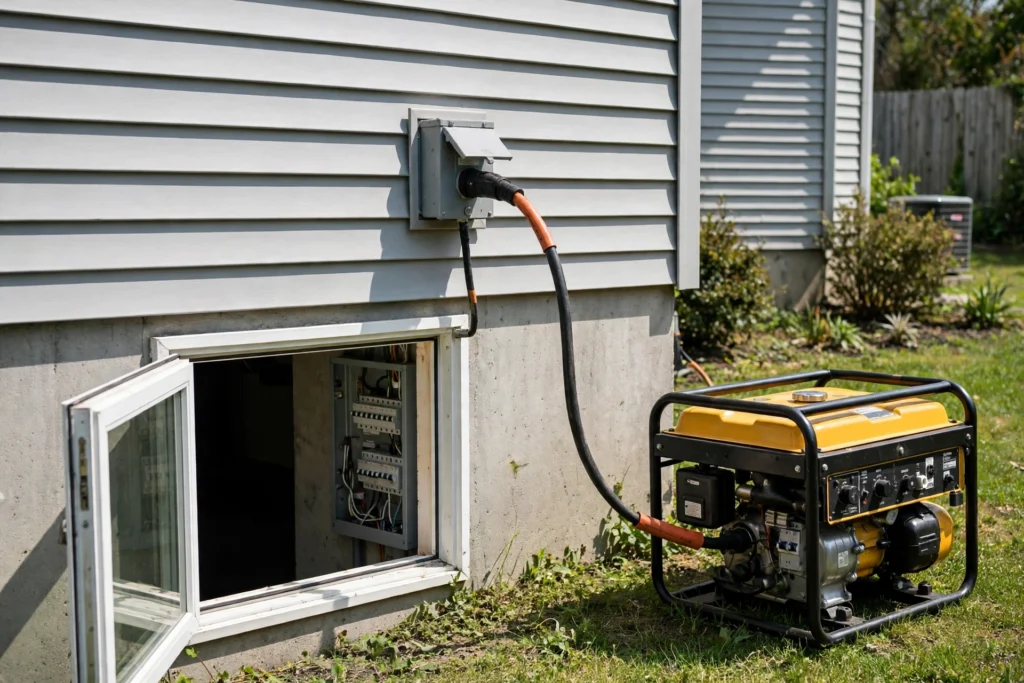
Reliance Controls PB50 Inlet Box
A 50-amp power inlet box: the weatherproof socket on the outside of the house that a generator cord plugs into, wired to the panel’s interlock or transfer switch. It is the piece that makes the whole setup a plug-in routine instead of a tangle. No price printed — check the listing.
The three options, honestly compared
| Option | Typical installed cost | Powers | Hardwired loads? |
|---|---|---|---|
| Extension cords | $0–$100 | 2–3 plug-in items | No |
| Interlock kit | ~$400–$800 total | Chosen panel circuits | Yes |
| Transfer switch | ~$800–$1,500 | 6–16 chosen circuits | Yes |
| Automatic standby | $12,000+ | Whole house, automatic | Yes |
Costs are typical ranges, not quotes — panel condition and local labour move them. What does not move is the shape of the trade: cords cost nothing and cover almost nothing that matters in a long outage; the two panel options cost hundreds and cover the furnace, the well, the sump, and the fridge in one motion.
Reliance Controls PB50 Inlet Box
Why this one: A 50-amp power inlet box: the weatherproof socket on the outside of the house that a generator cord plugs into, wired to the panel’s interlock or transfer switch. It is the piece that makes the whole setup a plug-in routine instead of a scramble.
Extension cords: the honest limits
Cords work for a fridge, some lights, and phone charging, and for a one-night outage that can be enough. Their failures are structural: the furnace and well pump have no plug to receive one; cords run through a cracked door or window, which is how houses lose heat and gain weather; a long thin cord sags voltage at a motor’s start, which is hard on the fridge compressor; and a cord through a dark house at 2 a.m. is a trip line with a current. Cords are a fine first night and a poor plan.
The interlock: how it works
An interlock is a sliding metal plate on your existing panel. It mechanically prevents the main breaker and the generator breaker from being on at the same time — which is the entire safety requirement, enforced by geometry instead of memory. The routine: main off, slide, generator breaker on, start the generator outside, and the panel’s chosen circuits are live. You manage the load yourself (the water heater and the well pump do not start in the same minute), and your panel must have space and a listed kit for its model — the two reasons an electrician, not a video, should fit it.
The transfer switch: how it differs
A transfer switch is a separate small panel beside the main one. Six to sixteen circuits are moved into it permanently; each gets a three-position switch — line, off, generator. It costs more and asks less of the operator: no load juggling at the main panel, and a single-circuit version is exactly what we recommend for the furnace-only job elsewhere in this series. Automatic versions pair with standby generators and remove the human entirely — at standby money.
The backfeed warning, without softening it
Plugging a generator into a dryer outlet or a homemade double-ended cord sends power backwards through your panel and out to the street, where it steps back up through the transformer to line voltage. A crew that has isolated a “dead” line can meet your generator at the other end of it. This is not a code technicality or an insurance quibble; it is the specific way line workers get killed in storm restoration, it is illegal essentially everywhere, and no version of it — “I turned my main off, I was careful” — changes the physics if a step is missed once. Interlocks and transfer switches exist precisely so that the safe way is also the easy way.
Follow-up questions
Can a power station use an interlock or transfer switch?
Yes — the inlet does not care what is plugged into it, and a station feeding a transfer switch is the silent version of this whole page, limited by the station’s watt-hours rather than a fuel tank. Furnace-only transfer switches plus a station are the pairing we recommend for winter.
What size inlet and cord do I need?
Match the generator’s largest outlet: 30-amp inlets suit generators up to about 7,500 watts; 50-amp inlets (like the PB50) suit the 9,500-watt-and-up class and give headroom. The cord is part of the circuit, not an accessory — buy the rated one.
Do I need a permit or inspection?
In most jurisdictions, panel work means a licensed electrician and often a permit — and the paperwork protects you twice: once in code compliance, and again at insurance claim time after any electrical fire, related or not.
Can a station use one? Yes — the inlet does not care what feeds it. A station on a transfer switch is the silent version, limited by watt-hours, not fuel.
30-amp inlet: Suits generators up to about 7,500 watts.
50-amp inlet: Like the PB50: suits the 9,500-watt-and-up class and gives headroom. Buy the rated cord — it is part of the circuit.
Permit and inspection: Panel work usually means a licensed electrician and often a permit — protection in code compliance, and again at insurance claim time.
Frequently asked questions
Which should I choose, interlock or transfer switch?
If your panel accepts a listed interlock and you are comfortable managing loads, the interlock is the same safety for less money. If you want set-and-forget circuit selection, multiple family members should be able to run it, or only a few circuits matter (furnace, well, sump), the transfer switch earns its premium.
Can I install an interlock myself?
The kits are simple and the temptation is real; the panel is also the one box in the house that can kill you with the main breaker off, because the service lugs stay live. Our standing advice: electrician. It is an hour or two of labour, once, for the life of the house.
What about a GenerLink or meter-socket device?
Meter-collar transfer devices are a legitimate fourth option where the utility approves them — whole-panel, automatic isolation, no panel work. Approval varies by utility, which is the entire caveat: ask yours before buying.
The verdict
Cords for tonight if you must; an interlock for most houses as the permanent answer; a transfer switch where simplicity or a single critical circuit justifies it. Any of the three beats the improvised fourth option, every time, at any price.
The full set is at What People Are Asking About Home Generators, and the sizing shelves live in our Power hub.
Talk it over with other homeowners
The Ordinary Prepper Community on Facebook is where readers compare outage plans, show their setups, and help decide what we test next.