
As an Amazon Associate, Ordinary Prepper earns from qualifying purchases. Prices last checked October 28, 2026.
Home Readiness — Guide
Can a Gas Generator Recharge a Home Battery (Powerwall and Others)?
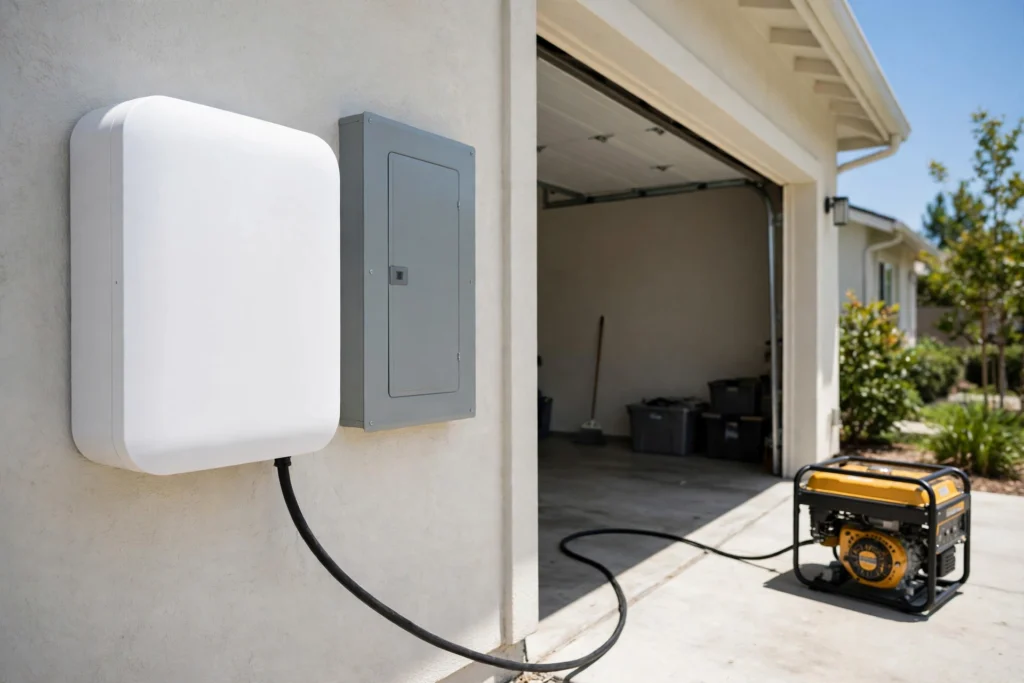
Short answer: Usually no — and it surprises owners every storm. A Tesla Powerwall cannot be charged by a portable generator: Tesla’s own documentation excludes it, and most wall-mounted home batteries (Enphase IQ, Franklin, SolarEdge) take the same position, because their inverters are built to accept grid or solar power in specific forms and a portable generator’s output is neither clean nor stable enough for their charge controls. The big exception is portable power stations: nearly all of them will happily charge from a generator, which is exactly why the station-plus-generator pairing keeps winning on this site. Standby whole-home generators are the other exception — a permanently installed standby unit integrated with the battery system by its installer is a designed feature, not a workaround.
The compatibility rundown
| Battery | Portable generator charging? | What works instead |
|---|---|---|
| Tesla Powerwall | No — not supported | Grid, solar, integrated standby (installer) |
| Enphase IQ Battery | No — grid/solar only | Solar; standby integration on some systems |
| Franklin WH | Standby generator port on some models | Designed generator input — check your unit |
| SolarEdge / LG home batteries | No — not supported | Grid, solar |
| Portable power stations | Yes — standard AC charging | Generator as charger is the design case |
Model generations change these answers — Franklin’s generator module is the proof — so the row for your battery is a starting point for checking your manual, not a verdict carved in stone. What does not change is the reason underneath: a hybrid inverter decides what it will drink, and most wall batteries’ inverters are specified for grid-formed or solar power. Feed a battery through an input it does not recognize and the kindest outcome is that it refuses; the unkind outcomes involve fault codes during the exact week you needed it.
Which charging paths each battery accepts — a hybrid inverter decides what it will drink; most wall batteries are specified for grid or solar:
Tesla Powerwall: Grid ✓ · solar ✓ · standby generator ✓ · portable generator ✗.
Enphase IQ Battery: Grid ✓ · solar ✓ · standby generator — some · portable generator ✗.
Franklin WH: Grid ✓ · solar ✓ · standby generator — some · portable generator ✗. (Franklin: a designed generator input or standby port on some models — check your unit.)
Portable power stations: Grid ✓ · solar ✓ · portable generator ✓. The station is the exception: generator-as-charger is its design case.
EcoFlow DELTA 2 Max
Why this one: The exception that makes the station route work: a power station accepts generator charging as a matter of course, with fast AC charging that keeps generator hours short — a fridge most of a day, lights and router through the night.
Why owners expect it to work
The intuition feels sound: the battery charges from the wall, the generator makes wall power, therefore the generator charges the battery. The break in the chain is that during an outage the battery is not sipping from the wall — it has disconnected your house from the grid and is forming its own little grid, at its own frequency, with its own rules. A generator arriving at that arrangement is a second grid trying to join the first, and without synchronization gear designed for the marriage, the battery declines the relationship. That is also why the integrated standby case works: the integration gear is the marriage counsellor, installed and configured ahead of time.
The worked example behind this question
The asker had a 30-amp transfer switch and a sensible picture: run the generator a few hours, fill the Powerwalls, shut down, live silently on battery. The honest re-cut of the same picture, with the same hardware budget logic, is: the generator feeds the house through the transfer switch while it runs (and the house’s ordinary loads with it), the Powerwalls wait for solar or the grid, and if silent hours are the goal, a large power station joins the system as the component the generator can charge. In practice many Powerwall houses already own the answer — their solar refills the battery by day whenever the sun cooperates, and the generator’s job shrinks to covering grey stretches directly.
The station route, with numbers
A 2,048Wh station charging from a generator at roughly 1,500 watts refills in about an hour and a half of generator run time, then delivers its ~1,740 usable watt-hours silently — the furnace blower through the night, the fridge, the lights. One gallon of fuel, converted this way, is an evening and a night of a quiet house; the same gallon burned powering loads directly through the night buys a fraction of the runtime at full noise, because a generator loafing at 10% load is a machine wasting most of its fuel staying ready. That efficiency argument — not convenience — is the deepest reason the pairing wins.
Capacity, rated and usable, in watt-hours
The EcoFlow’s usable figure is what actually reaches the loads. Charging runs at roughly 1,500 watts, so a refill takes about an hour and a half of generator time.
EcoFlow DELTA 2 Max
2,048Wh of battery that accepts generator charging as a matter of course, with fast AC charging that keeps generator hours short. What it runs: a furnace blower ~3.5 hours straight, a fridge most of a day, lights and router through the night.
Bluetti Elite 200 V2
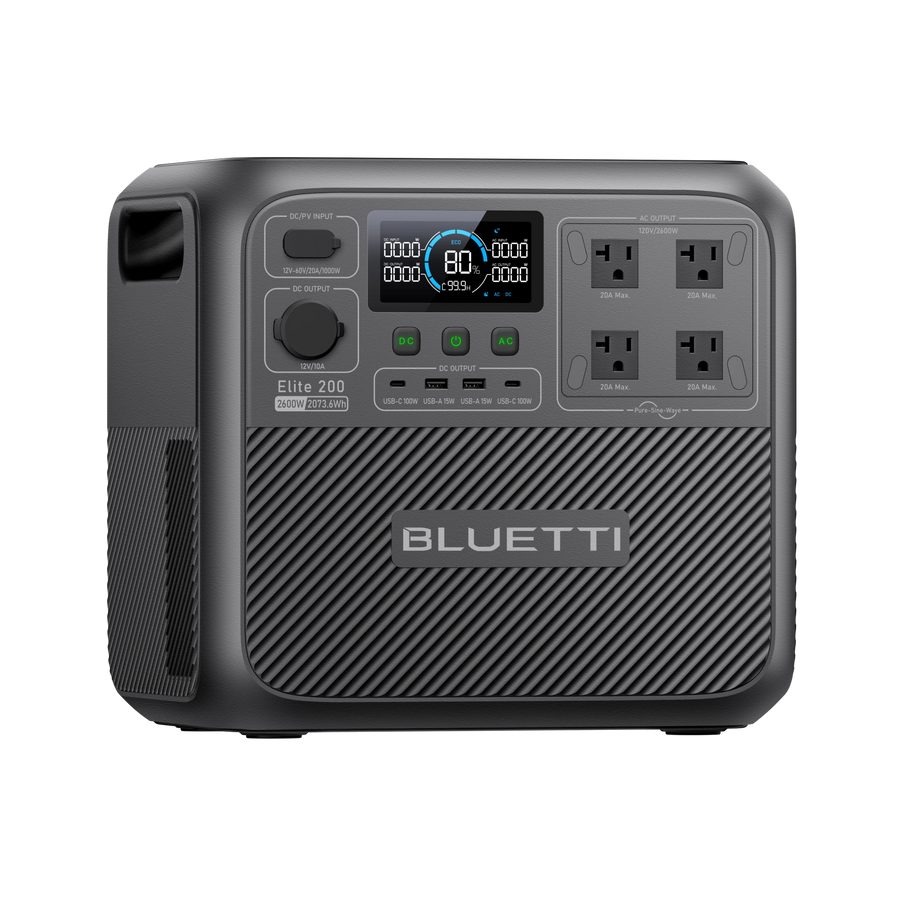
Photo: Bluetti
2,073.6Wh rated for 6,000+ cycles — the battery you can charge from a generator every day of a long outage without spending its life. What it runs: the same silent-night loads, about 3.5 hours of furnace blower straight or 7 cycling.
Relevant pickBluetti Elite 200 V2
The longest cycle life here — the battery you can charge from a generator every day of a long outage without spending its life: the same blower about 3.5 hours straight, or 7 cycling.
86/100 in our scoring · Longest cycle life here
Follow-up questions
Can solar charge my Powerwall during the outage instead?
Yes — that is the designed path. A grid-tied array with a battery and the right controller keeps producing in an outage (that is the subject of our solar-in-a-blackout page), and the battery fills by day and spends by night. Grey weeks are the limit, which is where the generator covering house loads directly earns its place.
What about charging a station from a car?
Slowly, yes: a car’s 12V or its inverter if fitted delivers 100–400 watts — a top-up, not a refill. It keeps phones and a router alive indefinitely and a fridge on a rotation; it does not substitute for the generator in the worked example.
Will a generator damage a power station’s battery?
Stations are built for dirty input within limits — their chargers rectify and condition what arrives. The prudent version of the rule: an inverter generator’s cleaner output is the kinder diet for daily charging; a conventional generator works, and the station’s own manual is the authority for its limits.
Frequently asked questions
My installer says my standby can charge my battery. Who is right?
Both of us: an integrated standby system — generator, automatic transfer switch, and battery configured as one system by the installer — is the designed exception this page names. The “no” is about a portable generator and a cord meeting a wall battery on their own.
Can I charge an EV from a generator and power the house from the EV?
Charging an EV from a home generator is slow and thirsty, and using the EV as the house battery (where the vehicle supports it) is a separate, genuinely promising architecture — but it does not route through your Powerwall either. Each system drinks from its own tap.
What should I ask before buying a home battery, if generator charging matters to me?
One sentence: “Show me, in the manual, the generator input.” If generator charging is a requirement, buy the system that documents it — some whole-home systems now advertise it — rather than a workaround promised at a kitchen table.
The bottom line
Wall batteries drink from the grid and the sun; portable stations drink from almost anything, including your generator. Design the outage around that fact — generator for bulk energy in a few loud hours, station for the silent delivery of it — and the compatibility table stops being a disappointment and starts being the plan.
The full set is at What People Are Asking About Home Generators, and the solar side lives at What People Are Asking About Solar in an Outage.
Talk it over with other homeowners
The Ordinary Prepper Community on Facebook is where readers compare outage plans, show their setups, and help decide what we test next.