
As an Amazon Associate, Ordinary Prepper earns from qualifying purchases. Prices last checked October 28, 2026.
Home Readiness — Guide
Backup Power for a Small House Heated by Mini-Splits
Short answer: The honest headline first: electric heat is the hardest load in backup power, and a 650 sq ft house heated by two mini-splits is an all-electric house. But mini-splits are the kindest version of electric heat — inverter-driven, no starting surge worth fearing, and on a mild winter day each head may draw only 300–700 watts. The smallest honest system is a 2,000Wh-class power station that runs one mini-split in the main room for a few hours at a time, paired with a 3,500–4,500W inverter generator for multi-day outages: the generator carries the heat in blocks, the station covers the quiet hours and the fridge. Anyone who sells you a battery-only answer for days of winter heat is selling, not answering.
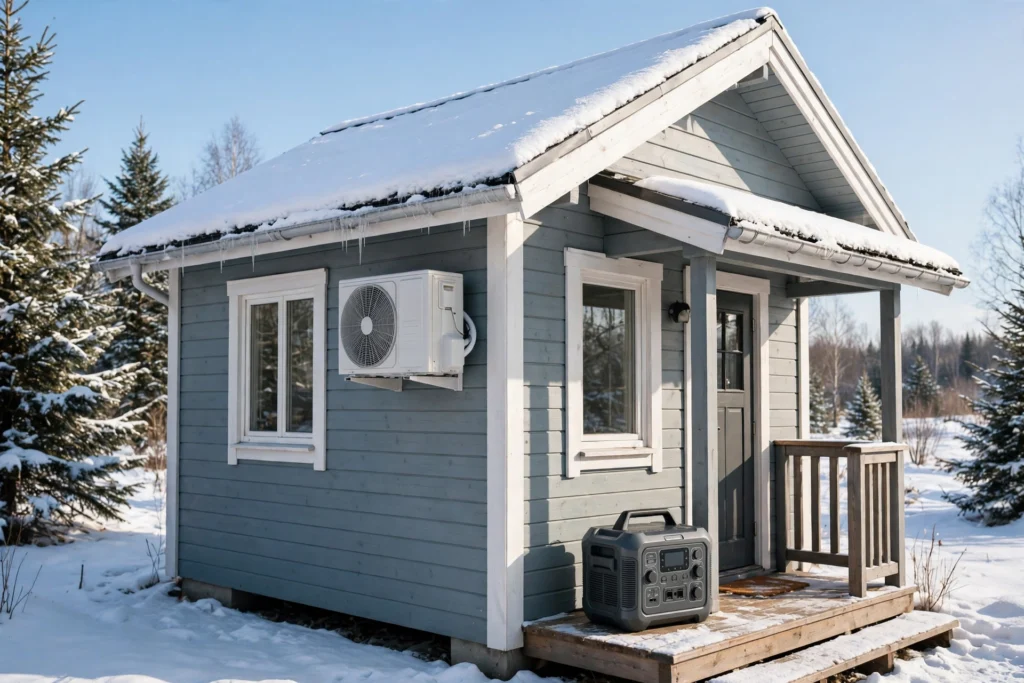
Westinghouse iGen4500
4,500 starting / 3,700 running watts of clean inverter power, quiet enough for a small lot. What it runs: one mini-split at full effort plus fridge and lights, or both mini-splits loafing on a mild day — the multi-day backbone.
Bluetti Elite 200 V2
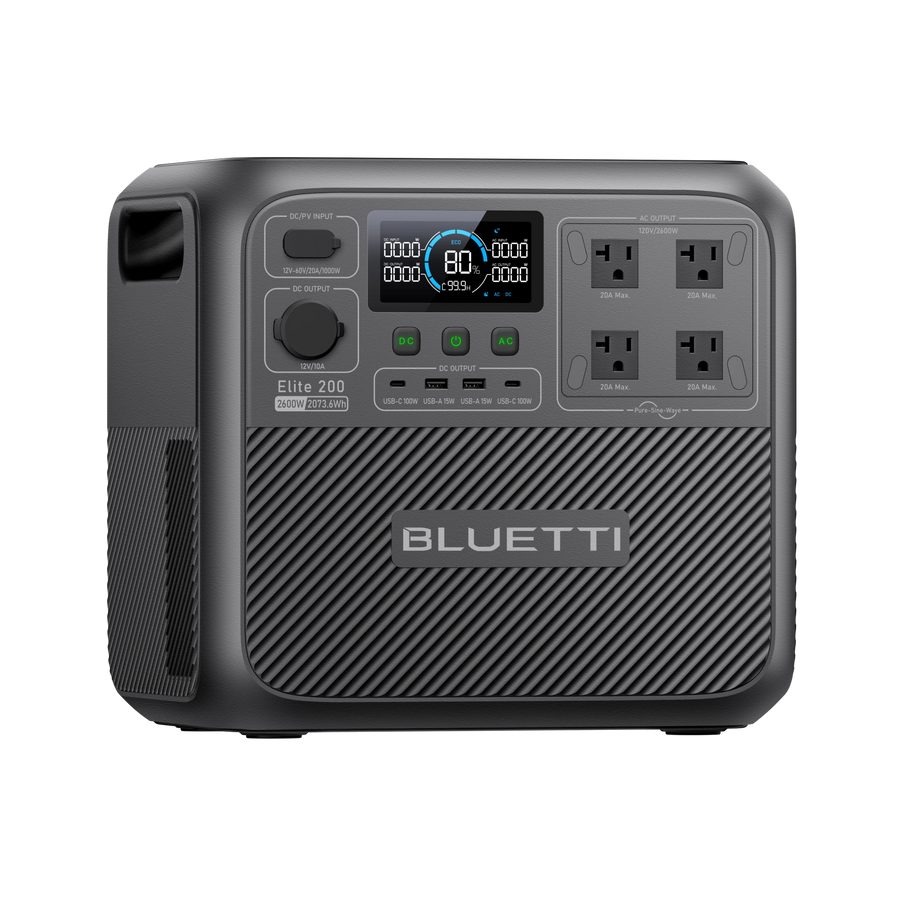
Photo: Bluetti
2,073.6Wh, about 1,740 usable. What it runs: one mini-split at low stage (~500W) for about 3.5 hours, or the fridge and lights through the night while the house coasts on stored warmth.
The generator half: Westinghouse iGen4500, 86/100: 4,500 starting / 3,700 running watts of clean inverter power. One mini-split at full effort plus fridge and lights, or both mini-splits loafing on a mild day — the multi-day backbone.
The silent-hours half: Bluetti Elite 200 V2, 86/100: 2,073.6 Wh, about 1,740 usable. One mini-split at low stage (about 500 W) for about 3.5 hours, or the fridge and lights through the night.
The rule: Anyone who sells you a battery-only answer for days of winter heat is selling, not answering.
What two mini-splits actually draw
A mini-split is not one load; it is a dial. Inverter compressors ramp, so the same unit that sips 350 watts holding a room on a 30°F afternoon will pull 1,200–1,500 watts fighting a 5°F morning — and its heat output falls as the temperature does, the double squeeze our heat-pump page works through in detail. For a small house with two single-zone units (typically 9,000–12,000 BTU each):
| Conditions | One unit draws | Both units draw | A 2kWh station lasts (one unit) |
|---|---|---|---|
| Mild, ~35°F, holding temp | ~300–500W | ~600–1,000W | ~3.5–5.5 hours |
| Cold, ~20°F, working | ~700–1,000W | ~1,400–2,000W | ~1.7–2.5 hours |
| Deep cold, ~5°F, full effort | ~1,200–1,500W | ~2,400–3,000W | ~1.2–1.4 hours |
Read the last column as the strategy, not a failure: on battery, you heat one room — the one with the pipes and the people — in stretches, and let insulation and bedding do the rest. A small house helps here more than square footage suggests: 650 square feet loses heat slowly when doors are closed and one room is kept at temperature.
How long a 2 kWh station lasts, one unit (hours on about 1,740 usable watt-hours, by outside temperature): mild, about 35°F, holding — ~3.5–5.5 hours · cold, about 20°F, working — ~1.7–2.5 hours · deep cold, about 5°F, full effort — ~1.2–1.4 hours.
The draws behind it: One unit draws about 300–500 W mild, 700–1,000 W cold, and 1,200–1,500 W at full effort. Both units draw roughly double.
Westinghouse iGen4500
Why this one: 4,500 starting / 3,700 running watts of clean inverter power, quiet enough for a small lot. What it runs: one mini-split at full effort plus fridge and lights, or both mini-splits loafing on a mild day — the multi-day backbone.
The beginner questions, answered in order
The asker behind this page said they knew nothing about generators, so — plainly. A generator lives outdoors, always, at least 20 feet from the house with its exhaust pointed away; generator carbon monoxide is the outage killer that needs no storm damage to help it. An inverter generator is the kind to buy for a house: cleaner power for electronics, quieter, and it sips fuel at partial load. Sizing is by watts, and your watts are in the table above plus about 150 for the fridge and 100 for lights and phones. And the connection for a mini-split is not an extension cord through a window in January: mini-splits are hardwired, so the real setup is the interlock or transfer switch from our hookup page — an electrician’s visit that turns outage night into flipping two switches.
The plan, by outage length
Overnight outage: the station alone. One mini-split in the bedroom, fridge on rotation, done. Two to three days: station plus generator in blocks — generator runs 3–4 hours morning and evening (heat both rooms hard, recharge the station, catch the fridge up), station carries the in-between silently. Fuel for that rhythm: roughly 2–3 gallons a day, not the 8–10 of round-the-clock running. A week of deep cold: the honest options narrow — the generator becomes a near-full-time appliance with the fuel storage that implies, or the house becomes a one-room camp with the water shut off and pipes drained as insurance. Knowing which winter you are planning for is the actual decision; the hardware follows.
Relevant pickBluetti Elite 200 V2
The silent-hours half of the system: one mini-split at low stage (~500W) for about 3.5 hours, or the fridge and lights through the night while the house coasts on stored warmth.
2,073.6 Wh · About 1,740 usable
The non-electric backstop worth naming
Every all-electric house should hear this once: a single non-electric heat source changes the whole risk picture — a vented propane or kerosene heater used strictly by its maker’s rules with a battery CO alarm in the room is the common version, and it converts “the battery died at 4 a.m.” from a pipe emergency into a cold morning. It is not a recommendation to improvise heat; it is a recommendation that a house with exactly one way to be warm has a fragile plan, and the second way need not be electric.
Follow-up questions
Will a mini-split even start on a power station?
Yes — this is the mini-split’s party trick. Inverter compressors soft-start by design, so there is no locked-rotor wall of the kind that defeats stations with conventional heat pumps. If the station’s inverter covers the running watts, it covers the start.
Do mini-splits work at all in deep cold?
Cold-climate models hold most of their capacity to about 5°F and keep working below it; standard models fade earlier and lean on any auxiliary heat fitted. At −16°F — the morning in a companion question in this harvest — owners report houses held “mostly warm,” which matches the physics: diminished, not defeated. Your model’s low-temperature rating is on its spec sheet and is worth knowing before the outage, not during it.
Should I oversize the station instead of buying a generator?
Doubling the battery doubles a few hours into a few more hours; it does not reach days of heat. Past one night, watt-hours stop being the constraint and energy supply becomes it — which is a fuel tank’s job. Buy the pairing, not the bigger box.
Frequently asked questions
What does the electrician’s part cost?
An interlock or a small transfer switch typically lands in the $400–$1,500 installed range depending on the route — real money, and still the cheapest part of the system per decade of use. The hookup page in this series breaks the options down.
Can I run a space heater off the station as a supplement?
A 1,500W space heater drains a 2kWh station in a little over an hour — the worst watt in the house. The mini-split moves two to three times the heat per watt; if electricity is the budget, the heat pump is where it gets spent.
Where do the pipes fit in this plan?
At the centre of it. Heat the room the plumbing runs through, keep cabinet doors open on exterior walls, and drip the furthest faucet on the coldest nights — and if the house will sit cold for days, draining the system is the definitive move, covered in our freeze-protection work.
The bottom line
Small house, electric heat, real winters: a 2kWh station for the silent hours, a 4,500W-class inverter generator for the long ones, one heated room as the plan, and a non-electric backstop if you can manage it. That is the smallest system we can describe to you with a straight face.
The full set is at What People Are Asking About Outage Living, and the heat-pump math lives at Can a Generator Run My Heat Pump?
Talk it over with other homeowners
The Ordinary Prepper Community on Facebook is where readers compare outage plans, show their setups, and help decide what we test next.