
As an Amazon Associate, Ordinary Prepper earns from qualifying purchases. Prices last checked October 28, 2026.
Home Readiness — Guide
Standby Generator Bids: Placement, Load Managers, and How to Check What You're Paying For
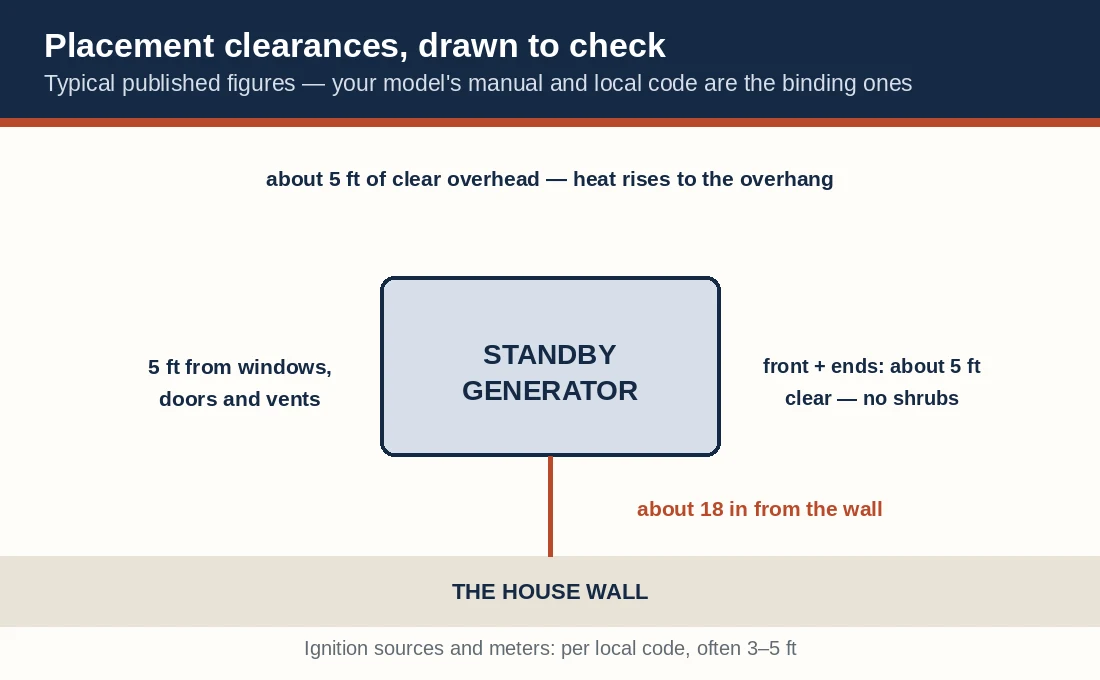
Short answer: If three installers bid $16,000–$19,000 for a 20–26 kW standby and disagree about placement, load managers, and code, the disagreement itself is the information: at least one bid is selling you capacity or convenience you may not need. Check placement against the manufacturer’s clearance numbers first — a standby generator typically needs about 18 inches from the house, 5 feet from windows, doors, and vents, and 5 feet of clear space in front and at the ends (your model’s manual and your local code are the authority, and carbon monoxide is the reason the window number is not negotiable). Then read the bids line by line: the generator, the automatic transfer switch, the pad, the gas work, the electrical work, permits — and ask what the load managers are for. Load managers exist to let a smaller, cheaper generator carry a big house by shedding loads in order; a bid with a 26 kW machine and a stack of load managers deserves the hardest questions of all.
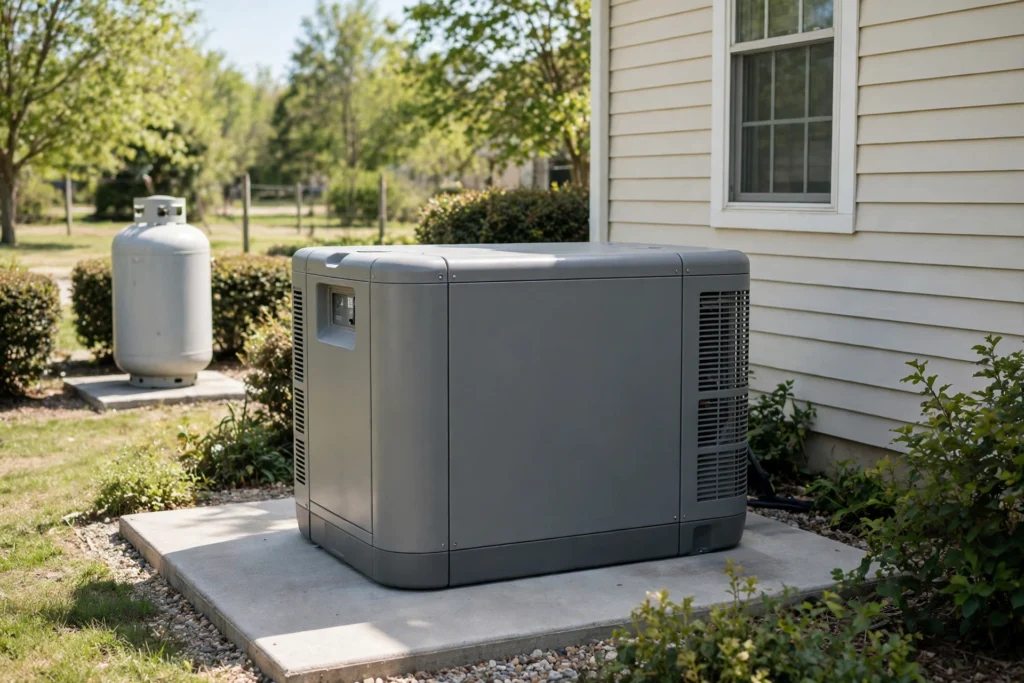
The clearance numbers, because placement fights start here
| Clearance | Typical requirement | Why |
|---|---|---|
| From the house wall | ~18 in (per manual) | Heat and service access |
| From windows, doors, vents | 5 ft | Exhaust/CO must not enter |
| Front and ends | ~5 ft clear, no shrubs | Airflow and service access |
| From ignition sources / meters | Per local code (often 3–5 ft) | Gas safety |
| Overhead | ~5 ft from overhangs/structures | Heat rise |
These are the commonly published figures for the major residential brands, offered as a reading lens for your bids — the binding numbers are your specific model’s installation manual plus your jurisdiction’s code, and an installer who waves at either is telling you something. Placement also has a money dimension: every extra foot of gas line and electrical run from the panel costs, which is why two honest bids can still differ by thousands on siting alone. A bid that puts the unit far away should say what the distance buys — usually noise and the window rule — in writing.
Westinghouse iGen4500
Why this one: A portable inverter generator, an inlet box and an interlock covers the same fridge, furnace blower, sump and lights for a small fraction of the money — it is the comparison every standby bid should have to survive.
How to read a standby bid, line by line
The generator itself should be a named model with a stated fuel rating — a 22 kW unit’s output differs on natural gas versus propane, sometimes by 2–3 kW, and bids that quote the propane number for a natural-gas house are inflating quietly. The ATS (automatic transfer switch) should state its amp rating — 200-amp service-rated is the whole-house standard — and whether it is included or a line item still to come. The pad (concrete or composite), the battery (frequently a surprise extra), gas plumbing and who pulls the gas permit, electrical labour, and the cold-weather kit where winters demand it: a complete bid prices all of them. The bids in this question ranged across $3,000, which is roughly the price of exactly these lines being present in one bid and “to be determined” in another.
Load managers: the concept every bidder should explain the same way
A load manager (or load-shed module) watches the generator’s output and temporarily disconnects chosen big loads — the AC compressor, the electric range, the dryer — when the total threatens the generator’s limit, reconnecting them in priority order. It is good technology with one honest purpose: letting a smaller generator serve a bigger house.
How a load manager earns its place: Generator (the limit it watches) → load manager (sheds in priority order) → the big loads (AC · range · dryer). Loads are disconnected as the total nears the limit — and reconnected in priority order. Good technology, one honest purpose: a smaller generator serving a bigger house.
The bid test: A 24–26 kW bid that still needs one? Make the bidder explain it in loads, not adjectives.
So the questions write themselves. If the bid includes a 24–26 kW generator, why does it need load management for this house? (Sometimes the answer is legitimate — a 5-ton AC’s starting surge against everything else — and should be explained in loads, not adjectives.) Which loads are managed, and in what order? Could a 18–20 kW unit with managers do the same job for less? An installer who answers these crisply is selling engineering; one who answers with “we always include them” is selling a package.
What the right size usually looks like
Most houses bidding 20–26 kW land there because nobody did the load math, and our sizing pages exist to do it: a typical house’s outage essentials run 1,500–2,500 watts, a comfortable whole-house selection runs 5,000–9,000, and the loads that push a home to standby-class capacity are central AC starting surges, electric ranges, dryers, and well pumps — most of which can be managed, sequenced, or simply not run simultaneously. A standby in the 14–20 kW class with load management covers the great majority of houses that get quoted 26. The premium bid is not automatically the dishonest one — whole-house, everything-at-once, both ACs is a real product — but it should be bought as a choice, with the cheaper engineered option priced beside it.
Before you sign: price the portable alternative once
A standby bid only makes sense against the other way of doing the same job. A portable inverter generator, an inlet box and an interlock or transfer switch will not start itself at 2 a.m. — that convenience is exactly what the $16,000–$19,000 buys — but it covers the same fridge, furnace blower, sump and lights for a small fraction of the money, and it is the comparison every bidder should have to survive. The portables we have already scored for house duty are the Westinghouse iGen4500 and the Champion 4,500W Dual Fuel Inverter for the basics, and the DuroMax XP12000HX when the load list grows toward whole-house. No prices are printed here because they move; the links show today’s figure.
The standby: Starts itself at 2 a.m. — $16,000–$19,000.
The portable route: You start it — a fraction of the money: inverter generator · inlet · interlock.
The same loads either way: The fridge, the furnace blower, the sump and the lights.
The portables scored for house duty: iGen4500 + Champion 4,500W for the basics · DuroMax XP12000HX as loads grow.
Relevant pickChampion 4,500W Dual Fuel Inverter
The other portable we have scored for the basics — dual fuel, so propane becomes the storage answer instead of a gasoline clock.
Dual fuel · Scored for house duty
Your next step: size the portable route for your own load list with our generator sizing page, then read transfer switch, interlock, or extension cords for what the hookup half of that route actually costs and involves.
Follow-up questions
Why do bids cluster at $16,000–$19,000?
Because the hardware is only part of the job: generator and ATS often run $6,000–$9,000 of it, and gas work, electrical, pad, permits, and labour in a tight trades market carry the rest. That is also why the portable-generator alternative — a few thousand dollars all-in with an interlock — belongs in the same conversation before anyone signs.
What warranty and service questions matter?
Who services it, from how far away, with what response time in a regional outage (when every customer calls at once), and what the weekly exercise cycle and annual maintenance cost. A standby is a 15-year appliance with a small engine; the dealer relationship outlasts the install day by a decade.
Natural gas or propane for a standby?
Natural gas never runs out and derates the unit a little; propane restores full rating and depends on a tank — a 250-gallon tank at typical standby burn gives days, not weeks, of continuous running, which matters for the outage length you are actually insuring against.
Why bids cluster: The hardware is only part of the job: gas work, electrical, the pad, permits and labour in a tight trades market carry the rest.
Warranty and service: Who services it, from how far away, with what response time in a regional outage — and what the weekly exercise cycle and annual maintenance involve.
Natural gas: Never runs out, and derates the unit a little.
Propane: Restores the full rating and depends on a tank: days, not weeks, of continuous running from a typical tank — which matters for the outage length you are actually insuring against.
Frequently asked questions
Can I get a fourth bid without offending anyone?
Yes, and tell all of them the same spec: your load list, your placement constraints, the line items you want priced. Bids written to the same spec become comparable; bids written to each salesman’s imagination never do.
Is the cheapest bid the risky one?
Not by price alone — by omissions. The risky bid is the one missing the permit, the gas work, or the battery, because those costs return as change orders. Read for what is absent, not for what is present.
Should the generator sit where I want it, or where they want it?
Within the clearances, your preference rules — you will hear it exercise weekly for 15 years, which argues for distance from bedrooms; they will argue for distance from your wallet, which is distance from the panel and the gas meter. The right spot is the one that satisfies the CO clearances and both arguments at once, and it exists on most lots.
The bottom line
Get the bids onto one spec, check placement against the manual’s clearances, make every load manager justify itself, and price the managed 18–20 kW option beside the flagship. The installer who welcomes that process is the one to hire — the generator is the easy part of this purchase.
One spec for everyone: Tell every bidder the same load list, placement constraints, and line items to price — bids to one spec become comparable.
Check placement: Against the manual’s clearances first: the disagreement between bids is itself information.
Price the portable once: An inlet box and interlock or transfer switch covers the same fridge, blower, sump and lights — it just will not start itself at 2 a.m.
Hire the welcome: The installer who welcomes the questions is the one to hire: the service relationship outlasts the install day by a decade.
The full set is at What People Are Asking About Home Generators, and the sizing math starts at What Size Generator Do I Need for My House? (1,000–3,000 Sq Ft, Worked Out)
Talk it over with other homeowners
The Ordinary Prepper Community on Facebook is where readers compare outage plans, show their setups, and help decide what we test next.