As an Amazon Associate, Ordinary Prepper earns from qualifying purchases.
Home Readiness — Guide
What Happens If Card Payments Go Down? Paying When ATMs and Card Machines Stop Working
Short answer: When card payments go down, the money in your bank account is still yours — you just cannot reach it or spend it until something comes back. Card machines need power and a network, ATMs need both too, and a phone wallet rides the same rails as the card behind it. The households that keep shopping are the ones holding cash they already had: about $300 in small bills covers roughly three days of essentials for most homes, and it only works if it was in the house before the failure, because the ATM is part of the failure.
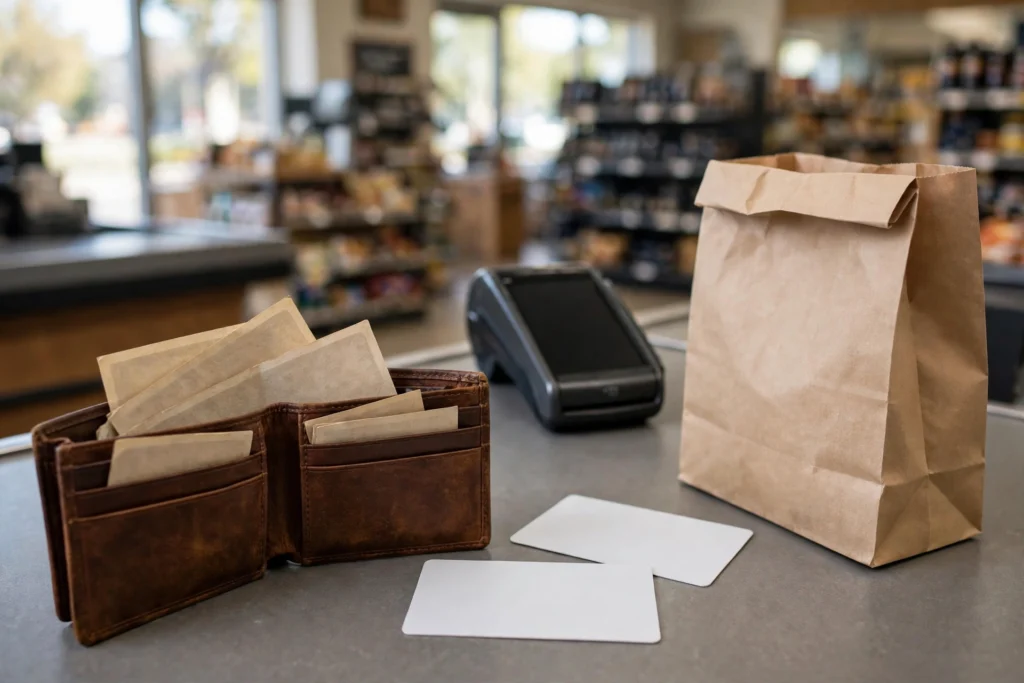
Three ways the same failure starts
Payment failures look identical at the register — a declined card, a dark terminal, a line that stops moving — but they start in three different places, and which one you are in decides what still works.
Power down: Iberia, Apr 2025 — terminals + ATMs dark. What still works: cash already in hand.
Software down: CrowdStrike, Jul 2024 — card systems crashed. What still works: cash, and unaffected stores.
One network down: One card network or one bank. What still works: a card on another network.
At the register, all three look the same: a declined card and a line that stops moving.
The power version is the Iberian blackout of April 28, 2025. The grid failed across Spain and Portugal — about 55 million people — and card terminals went dark with everything else. The Bank of Spain later pointed out that the national payments system itself kept working, on backup power. It did not matter. The machines in the shops had no power, and neither did the ATMs, so the only money that spent that day was cash already in people’s wallets.
The software version needs no blackout at all. On July 19, 2024, a faulty update from the security firm CrowdStrike crashed Windows computers worldwide — Microsoft put the count at about 8.5 million machines — and stores that could not run their card systems went cash-only with the lights on and the shelves full. Shoppers were sent out to find cash, and the cash points near affected stores in Britain emptied under the rush, which is the part worth remembering: even a working ATM stops being a plan when everyone in town has the same plan at the same hour.
The third version is the smallest and the most fixable. Sometimes only one card network, or one bank, is down. Your card declines, the person behind you pays without trouble, and nothing else in the store is wrong. That failure is the reason Sweden’s central bank tells households to hold cards from two different networks — a Visa and a Mastercard, say — because a single-network outage cannot take both at once.
| Event | What failed | What still worked |
|---|---|---|
| Iberia blackout, Apr 2025 | Power to terminals and ATMs | Cash already in hand |
| CrowdStrike outage, Jul 2024 | Card systems at many stores | Cash; unaffected stores |
| Single-network outage | One card network or bank | A card on another network |
SentrySafe SFW123GDC
Why this one: The home base for the whole stash and the documents: the stash has to survive the week it is needed in, including the ordinary disasters — and a drawer does not do that.
Why the ATM is not the backup plan
The instinct in every one of these stories is the same: walk to a cash machine. It fails for a plain mechanical reason. An ATM is a card machine with a safe attached — it needs power to run and a network connection to check your balance and record the withdrawal. In the Iberian blackout both were gone, so the machines stood dark in powered-down streets while the banking system behind them was, technically, fine. In the CrowdStrike outage the machines mostly worked, and a different limit showed up instead: a Friday’s worth of a whole town withdrawing at once drains the machines that are working, and a cash point holds far less than a day of panic.
Power: To run the machine at all.
Network: To check the balance + record the withdrawal.
Cash stock: A day of panic drains a working machine.
Cash at home: No dependencies at all — it works first, and is gone fastest. The supply you can count on is the supply already at home — the ECB’s spare-tire point.
So the sequence in a real payment failure runs backwards from the instinct. Cash works first and is gone fastest. The supply you can actually count on is the supply that was already at home, which is why every official version of this advice — the European Central Bank’s included — is about keeping cash, not about finding it on the day. The ECB’s study of these crises, published in September 2025 and titled “Keep calm and carry cash,” calls physical money a spare tire for the payment system: not the thing you drive on every day, and the only thing that works when the regular wheel comes off.
The layered way to pay, in the order it fails
Sweden’s Riksbank publishes the clearest version of the household setup, and it is layered precisely because each layer fails differently. Translated for an American house, it looks like this:
Layer 1 — Cash: No power · no network · no battery · no account check.
Layer 2 — Two physical cards: Different networks · PIN you remember · offline approval fallback.
Layer 3 — Phone payment service: Different rails from card payments — may stand when cards fall.
Note: A phone wallet is a copy of layer 2 — it dies with the phone’s battery.
Cash is layer one because it is the only layer with no dependencies at all — no power, no network, no battery, no account check. Our companion page worked out the amount from the same official figures: how much cash to keep at home lands at about $300 in small bills for three days of essentials for most households, and about $500 for a full week. The Riksbank’s own benchmark is SEK 1,000 per adult — about $101 — for roughly a week of essential purchases, and the ECB’s range is €70 to €100 (about $78 to $111) per person for about 72 hours. Different currencies, same order of magnitude, same three-to-seven-day window.
Two physical cards on different networks are layer two. Physical matters: a card in a phone wallet is a fine everyday tool, but it dies with the phone’s battery and leans on the same networks, while a plastic card with a PIN you actually remember can still pay in situations where the connection is down and the terminal falls back to an offline approval. If every card in your wallet turns out to be on the same network — worth checking tonight, it surprises people — that is a one-phone-call fix at your bank, not a purchase.
A phone payment service is layer three, not layer one, for the opposite reason people expect: the Riksbank includes it because it runs on different rails from card payments, so in a card-network failure it may be the thing still standing. Layers are not ranked by convenience. They are ranked by how little they share with the layer that just failed.
Which bills, and where they live
Small bills, because a cash-only store making change for a hundred is a store running out of change by the second customer. The mix our denominations page works out for a $300 stash is twenty $1 bills, twenty-two $5s, eight $10s, four $20s and a $10 roll of quarters — nothing larger than a twenty, weighted toward fives. The full reasoning, and the mixes for $150 and $500, are on the companion page: what denominations emergency cash should be in.
Where the $300 goes, by denomination
The mix the denominations page works out — nothing larger than a twenty, weighted toward fives.
Where it lives matters for the same reason the ATM fails: the stash has to survive the week it is needed in, including the ordinary disasters. The three options our cash page carries, linked there and here rather than replaced with a competing set, are the SentrySafe SFW123GDC fire safe as the home base for the whole stash and the documents, the SentrySafe 1200 Fire Chest as the smaller first step, and the ROLOWAY fireproof document bag as the grab-and-go layer that keeps one day of spending reachable without opening the whole reserve. Split it the way the cash page recommends: the bulk in the safe or chest, about one day of spending — roughly $75 — in the bag.
Relevant pickROLOWAY Fireproof Document Bag
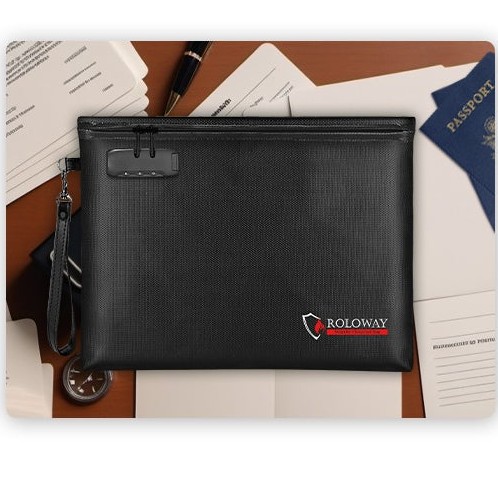
Photo: ROLOWAY
The grab-and-go layer that keeps one day of spending reachable without opening the whole reserve.
Grab-and-go layer · One day of spending, reachable
Prices last checked: October 31, 2026.
Follow-up questions
Will my phone wallet still work when cards are down?
A phone wallet is the card behind it, plus a battery. If the failure is your card’s network, the wallet fails with the card; if the failure is power, the wallet works only until the phone dies and only at a terminal that still has power of its own. Treat it as a copy of layer two, never as a layer of its own — which is why the Riksbank’s list asks for the physical cards and their PINs alongside any phone service.
Can a store take my card offline?
Sometimes. A physical card’s chip can approve a small payment offline, up to a limit the bank sets in advance, and the charge settles when the connection returns — that is the mechanism behind the Riksbank’s advice to keep physical cards and PINs ready. It is the store’s and the bank’s choice, not yours, and it disappears entirely when the terminal itself has no power. Offline card payment is a pleasant surprise in a network outage, not a plan for a blackout.
How much cash should I carry day to day, not just keep at home?
Enough for the small version of the same problem: a tank of fuel or a grocery run on the day a network hiccups, in the small bills a cash-only line can actually use. For most people that is $40 to $60 folded behind the cards, refreshed when it gets spent — the home stash is the three-day reserve, the wallet amount is the same idea at one-purchase size. The habit matters as much as the amount: Sweden’s advice includes using cash now and then in normal life, because a cash system nobody uses is a cash system that is not there in a crisis.
Frequently asked questions
How long do payment outages usually last?
Hours, in the recorded cases — about ten hours for the Iberian blackout’s worst stretch, and most CrowdStrike-affected stores trading normally again within a day or so. The stash is sized at three days anyway, because the tail is uneven: your store may be back while your bank, your pharmacy or your town’s cash points are not, and a three-day reserve costs little more shelf space than a one-day one.
If I have two cards, do I still need cash?
Yes, for the power version. Two cards on two networks cover a network failure between them, but both cards are equally plastic when the terminal has no electricity and the ATM is dark. Cards are the answer to the smallest failure on this page; cash is the answer to the largest, and the largest is the one with a recent, dated example.
Will a check work instead?
Rarely, and slower. A shop that cannot verify anything electronically is being asked to take your word in writing, and most will simply say no; a check also does nothing at a fuel pump or a pharmacy counter at midnight. Keep the checkbook for bills to people who know you. For strangers in a failure, it is cash, then a second network, then a phone route.
The bottom line
A payment failure is not a bank failure — your money is fine, and unreachable, at the same time. The fix is boring and cheap: about $300 in small bills at home, split between a fire-safe place and a grab-and-go layer; physical cards on two different networks, with the PINs known; and a phone payment route as the third way through. Built on an ordinary weekend, it turns the next CrowdStrike headline or local blackout from a story about your household into a story you read about other people’s.
The full set is at What People Are Asking About Outage Living, and the companion pages work out how much cash to keep at home and which denominations it should be in.
Talk it over with other homeowners
The Ordinary Prepper Community on Facebook is where readers compare outage plans, show their setups, and help decide what we test next.