
As an Amazon Associate, Ordinary Prepper earns from qualifying purchases. Prices last checked October 25, 2026.
Home Readiness — Guide
How to Keep Pipes and Stored Water Safe in a Cold Snap
Short answer: pipes in unheated spaces can start freezing when it is 20°F outside — long before most people worry — and the fix is a sequence, not a product: drain the outdoor faucets, insulate every exposed run, put heat cable on the one pipe that still freezes, and keep the house at 55°F or warmer on the coldest nights. That is how to keep pipes from freezing in a cold snap, and the stakes are in one more number: a crack just 1/8 of an inch long can leak up to 250 gallons of water a day, which is why a burst pipe is a flood, not a drip. The same cold snap threatens the other water in the house — the stored kind. Water expands about 9% as it turns to ice, so a storage container filled to the brim in a cold garage can split at the seam. This page scores the four tools that cover the four jobs, then walks the stored-water rules. Everything here is sized for an ordinary house: a crawl space, a garage wall, one stubborn kitchen run.
How we researched this comparison
We scored 4 products for this comparison — the four separate jobs in freeze protection: two heat cables, a faucet cover, and a leak alarm that warns when protection fails. The scores rest on the manufacturers’ specifications and certifications, on prices checked on October 25, 2026, and on verified-owner feedback named per product below. One honest limit: the premium cable’s owner sample is only a handful of reviews, which its section flags — its score leans on its self-regulating certification instead of owner volume. We never claim hands-on testing, and affiliate commissions are checked only after scores are set — the full method, with the scoring weights, is on our how we research and score page.
Raychem FrostGuard 6-Foot Cable
A self-regulating cable that cannot overheat, even where it overlaps — the forgiving choice for plastic pipe and runs with valves. It has no thermostat, so it draws power whenever it is plugged in.
Frost King HC6A Heat Cable, 6-Foot
The classic hardware-store cable: 7 watts per foot with a built-in thermostat that switches on below 38°F. Cheap and proven — with the strictest install rules on this page.
Frost King FC2 Faucet Cover
A hard plastic shell with a foam core that seals over an outdoor faucet in about a minute. It only works as the last step of draining the faucet down — the cover alone saves nothing.
Govee WiFi Water Sensor, 2-Pack
A leak alarm with a 100 dB siren plus phone and email alerts, for the floor under the pipes you protected. It warns — it does not prevent — and this model has no freeze-temperature alert.
If you buy through a link in this section, we may earn a commission from the seller. It never costs you extra, and it never changes a score.
What does each tool actually protect?
Four different jobs, which is why this comparison scores tools against their own job instead of pretending a faucet cover competes with a heat cable. Grading signals, stated plainly: the specifications are each maker’s own published figures, checked against the makers’ instruction sheets this week. The prices and rating counts were verified on Keepa and camelcamelcamel on October 25, 2026, and two findings are stated rather than smoothed over: the FrostGuard’s $113.88 is a marketplace-seller price (Amazon direct was out of stock on both trackers), and the Govee 2-pack had no current offer of any kind on either tracker — its card says so instead of printing a stale price.
Four tools, four zones of one house — each tool is scored against its own job
Inside (warm side) — the sink run
Crawl space — heat cable on the riser and the exposed run; a leak sensor on the floor below the pipes
Outside — the faucet cover
| Product | Its job | Key figure | Price |
|---|---|---|---|
| Raychem FrostGuard 6 ft | Active heat, any pipe | Self-regulating, ~6 W/ft | $113.88 (marketplace) |
| Frost King HC6A 6 ft | Active heat, short runs | 7 W/ft, thermostat at 38°F | $25.99 |
| Frost King FC2 Cover | Outdoor faucet seal | Hard shell, foam core | $6.79 |
| Govee Water Sensor 2-Pack | Leak warning | 100 dB + app alerts | Out of stock |
Prices last checked: October 25, 2026, on Keepa and camelcamelcamel. The FrostGuard price is a marketplace seller’s (Amazon direct was out of stock), and the Govee 2-pack had no current offer on either tracker.
Raychem FrostGuard 6-Foot Cable
Why this one: A self-regulating cable that cannot overheat, even where it overlaps — the forgiving choice for plastic pipe and runs with valves. It has no thermostat, so it draws power whenever it is plugged in.
Which heat cable is hardest to install wrong?
The Raychem FrostGuard is the hardest cable here to install wrong, because of how it makes heat. It is self-regulating: each inch of cable adjusts its own output to the temperature at that spot — about 6 watts per foot on a 40°F pipe, less as the pipe warms — and the maker rates it as unable to overheat, even where it crosses or overlaps itself. That one property removes the classic heat-tape mistake, the overlapped wrap around a valve that cooks itself. Raychem rates it for metal or plastic water pipes up to 2-1/2 inches, it is CSA certified, and it can be installed down to 5°F, the coldest working limit here. The 6-foot kit linked here is the short end of a line that runs to 100 feet, with a 6-foot cord and a lighted, grounded plug; buy the length the maker’s chart gives for your pipe, and add a foot for each valve.
Self-regulating cable: output follows the pipe
Self-regulating — each inch adjusts to the temperature at that spot: full output at a cold spot (the Raychem FrostGuard runs about 6 W/ft on a 40°F pipe), less as the pipe warms
Constant-wattage — one steady output along the whole run, the same at every spot
The evidence file for the FrostGuard is documentation, not a star count: it is the only cable here whose maker publishes a length chart for both metal and plastic pipe, the only one that can be installed at 5°F, and the top pick in the most detailed independent heat-tape guide we found, which worked from all three makers’ full instruction sheets. That guide’s verdict matches the spec sheet: this is the cable for plastic pipe, for runs with valves and fittings, and for anyone who wants the most forgiving install — and its named costs are the ones already stated, the missing thermostat and the premium price — $113.88 from marketplace sellers today, with Amazon direct out of stock. The rating record is printed as found, and it is thin: 5.0 stars across just 2 reviews on Keepa — a sample too small to lean on, which is why this pick’s score rests on the documentation above rather than owner volume.
The trade-offs are real. FrostGuard has no thermostat, so it is drawing power the whole time it is plugged in — the discipline is to unplug it in spring, or put it on a routine. Raychem requires a ground-fault (GFCI) protected outlet, forbids extension cords outright, and requires insulation over the installed cable: at least 1/2 inch of fire-resistant, waterproof insulation, and a full inch where temperatures reach -20°F. Fasten it with fiberglass tape or nylon ties, not electrical tape. One naming wrinkle: the Raychem brand now belongs to Chemelex, so newer boxes may not carry the nVent name the listing uses — same product line, new owner. Buy it if your problem pipe is plastic, bends around valves, or you want the cable that forgives a first-time install. Skip it if the run is short, straight, metal, and budget decides — that is the next pick’s home ground.
When is the Frost King HC6A the right buy instead?
The Frost King HC6A is the right buy when the run is short, straight, and metal — a crawl-space riser, a garage wall line, the pipe feeding a hose bib. It is a constant-wattage cable, a steady 7 watts per foot, with a built-in thermostat that turns it on when the pipe drops below about 38°F and off again around 45°F, so unlike the FrostGuard it costs nothing on mild days. It is $25.99 on Amazon today. Kits run from 3 to 30 feet (the HC6A linked here is the 6-foot), it covers water-filled supply pipe up to 1-1/2 inches, and the plug has a power light you can check at a glance. The owner record here is the deepest on this page: 4.6 stars across 6,448 reviews on Keepa, checked today. What can be documented is the cable’s footing: it is the standard budget heat cable in hardware stores nationally, sold in 3-foot steps from 3 to 30 feet, and the detailed independent guide that worked from the makers’ instruction sheets names the HC line its best budget pick for short runs — while flagging the same two weaknesses named here, the overlap ban and the mixed plastic guidance.
Constant wattage is exactly why its rules are the strictest on this page, and they are the maker’s, not ours: run it straight along the bottom of the pipe, never spiral, cross, overlap, or cut it, tape it every 6 inches, seat the thermostat tight against the pipe at its coldest end, and cover it with no more than 1/2 inch of non-flammable insulation plus a waterproof wrap. Install it above 15°F — wrestling a stiff cable in deep cold is how installs go wrong. Two honest flags. Frost King’s own guidance on plastic pipe contradicts itself: the instructions allow water-filled plastic supply pipe including PEX, while its FAQ limits plastic to Schedule 40 and rules out PVC and flexible lines — on plastic, buy the FrostGuard and skip the argument. And where the CPSC says to use a GFCI-protected outlet every time, Frost King only strongly recommends one. Follow the CPSC. The warranty is 12 months, the shortest commitment here. Buy it if a short metal run freezes every winter and the budget is the deciding vote. Skip it if the pipe is PVC, the run bends around fittings, or nobody in the house will inspect it each fall — an uninspected heat cable is the risk, not the solution.
Heat cable rules depend on the cable type — the makers’ own rules. Both types: plug into a GFCI-protected outlet; no extension cords on the FrostGuard
Self-regulating (FrostGuard) — overlap allowed, it cannot overheat even where it crosses itself; no thermostat, it draws power whenever it is plugged in; insulation over the cable at least 1/2 in. (a full inch at -20°F); fasten with fiberglass tape or nylon ties, not electrical tape
Constant wattage (Frost King HC6A) — never spiral, cross, overlap, or cut the cable; run it straight along the bottom of the pipe, tape every 6 inches; built-in thermostat switches on below about 38°F, seat it tight at the coldest end; no more than 1/2 in. of non-flammable insulation, plus a waterproof wrap; install the HC6A above 15°F
Relevant pickFrost King HC6A Heat Cable, 6-Foot
The classic hardware-store cable: 7 watts per foot with a built-in thermostat that switches on below 38°F. Cheap and proven — with the strictest install rules on this page.
7 W per foot · Thermostat on below 38°F
Why does the outdoor faucet get a cover of its own?
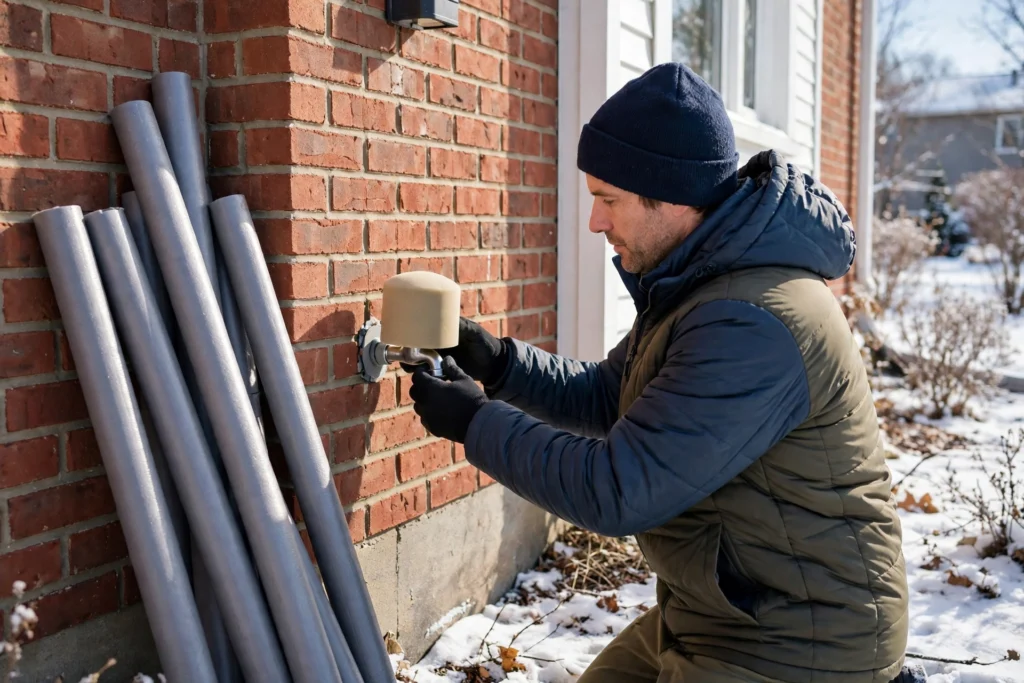
The outdoor faucet gets its own cover because it is the most exposed piece of plumbing on the house and, by the Red Cross’s list, one of the pipes that freezes most often. The Frost King FC2 is a hard plastic shell lined with poly foam: you loop its cord over the faucet handle, pull it snug, and it traps a pocket of still air against the wall, out of the wind. It takes about a minute, needs no tools, and survives winters a fabric sock cover does not. The listing’s record is strong on both signals we can verify: 4.6 stars across 4,862 reviews on Keepa, checked today, and Amazon flags the FC2 as kept by customers at a better-than-average rate for its category — fewer returns than similar products. It is $6.79 on Amazon today. For a cover whose whole job is to fit, seal, and survive being knocked around a garage shelf for ten winters, a low return rate is the owner verdict that matters, and it matches the design: there is almost nothing on it to break.
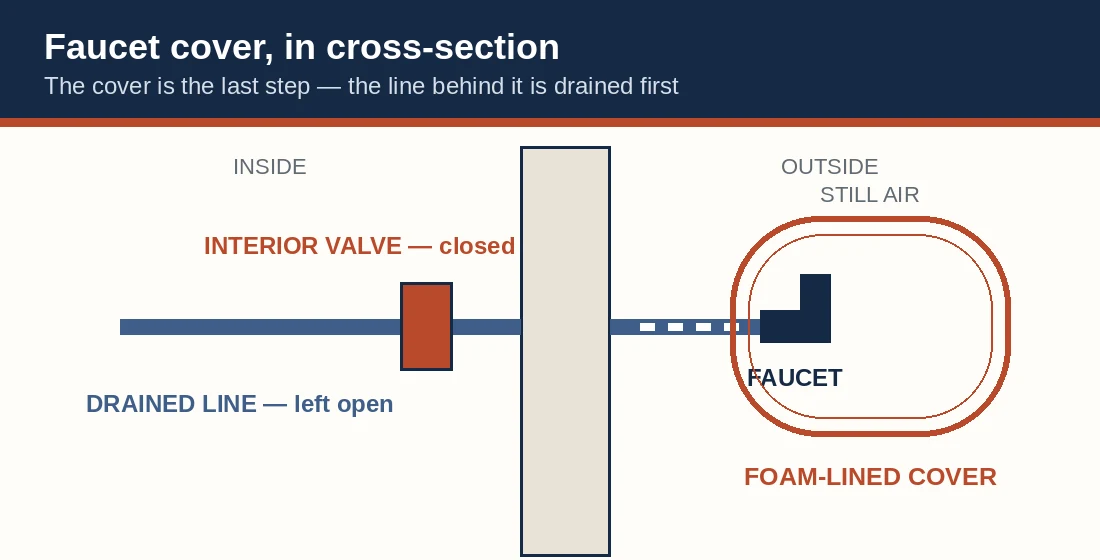
Now the part the packaging underplays: the cover is the last step, not the fix. The sequence that protects the faucet is disconnecting the hose (a connected hose traps water in the faucet body — the single most common cause of a split faucet), closing the interior valve that feeds it, opening the outdoor faucet so the line drains, and leaving it open so any leftover water has room to expand. Then the cover goes on. A cover over a faucet still full of water, hose attached, is a hat on a problem. Buy it if your house has standard outdoor faucets and cold winters — at this price it is the cheapest insurance on the page. Skip it if your faucets are frost-free sillcocks installed correctly (they drain back into the warm wall by design) — still disconnect the hose, which ruins that design too.
What warns you when the protection fails?
A leak sensor warns you, and the Govee WiFi Water Sensor is the warning layer we would put under the pipes this page just protected. Each sensor sits on the floor where a leak would pool; on contact with water it sounds a 100 dB alarm — loud enough to hear a floor away — and sends a phone app and email alert over your home Wi-Fi, which is what makes it useful when the house is empty, the exact situation where a burst pipe does its worst damage. The 2-pack covers the water heater pan and the crawl-space low point, or under the kitchen sink. The owner pattern on Govee’s water sensors, across the packs in this line, is consistent: setup is quick, the alerts arrive fast, and the argument is about upkeep — owners of the simpler non-connected alarms complain they never know when a battery has died, which is the specific failure the Wi-Fi version answers by reporting to the app. The verified record: 4.2 stars across 1,531 reviews on Keepa, checked today — and one gap stated plainly: neither tracker shows a current offer for this 2-pack right now, Amazon or marketplace, so the listing may show unavailable until stock returns. The pick stands on the product; the stock note gets refreshed with the prices.
Leak sensors: where water lands first — at floor level, where a leak would pool
• Under the kitchen sink
• In the water heater pan
• At the crawl-space low point
The Govee sensor sounds a 100 dB siren at the sensor and sends a phone and email alert over Wi-Fi.
Score it for what it is, though. This sensor detects water that has already escaped; it prevents nothing. This model reports leaks only — it has no temperature or freeze alert, so it cannot warn you the night before, only minutes into the event. Its alerts need 2.4 GHz Wi-Fi, power, and internet all alive, and a long outage can take the router down with the heat — the siren still sounds for anyone home, but the phone alert is only as reliable as the network it rides on. Put the sensors where water would land first, test them with a wet finger at install and each fall, and treat them as the smoke-alarm layer of the water system: cheap, loud, and only useful maintained. Buy it if a slow, unseen leak is your realistic fear — a water heater, a crawl-space run, a house that sits empty on winter weekends. Skip it if you need freeze warning before the burst; look for a temperature-alert sensor instead, and fix the pipe first either way.
Insulation or heat cable: which comes first?
Insulation comes first, on every pipe you can reach — but understand what it does. A foam sleeve only slows heat loss; it adds no heat at all. In a long enough deep freeze, an insulated pipe in an unheated space still reaches the temperature of that space. What insulation buys is time and margin: hours of delay on a cold night, and protection through the short snaps that make up most winters in most of the country. It is also the cheapest step here by far — pre-slit foam tubes, sized to the pipe, pressed shut, joints taped, a few dollars per six-foot length at any hardware store. Do the whole crawl space, the garage wall, the attic runs, hot and cold lines both. Then be honest about the one or two runs that have frozen before, or that sit in moving cold air no sleeve can fix. Those get heat cable, installed on the bare pipe and insulated over it exactly as the cable’s maker directs — the cable and the sleeve are partners, not rivals. The Red Cross order of operations agrees: insulation and sleeves first, UL-listed heat tape or cable for the pipes that need more.
Insulation first — cover on the faucet outside
Pre-slit foam sleeves with taped joints go on every run. Where a run still freezes, the heat cable goes on the bare pipe and the insulation goes over it
The faucet cover seals to the wall outside; hose off, line drained
Insulation adds no heat — it buys time. The runs that still freeze get cable, not more foam.
What should you do on the coldest nights?
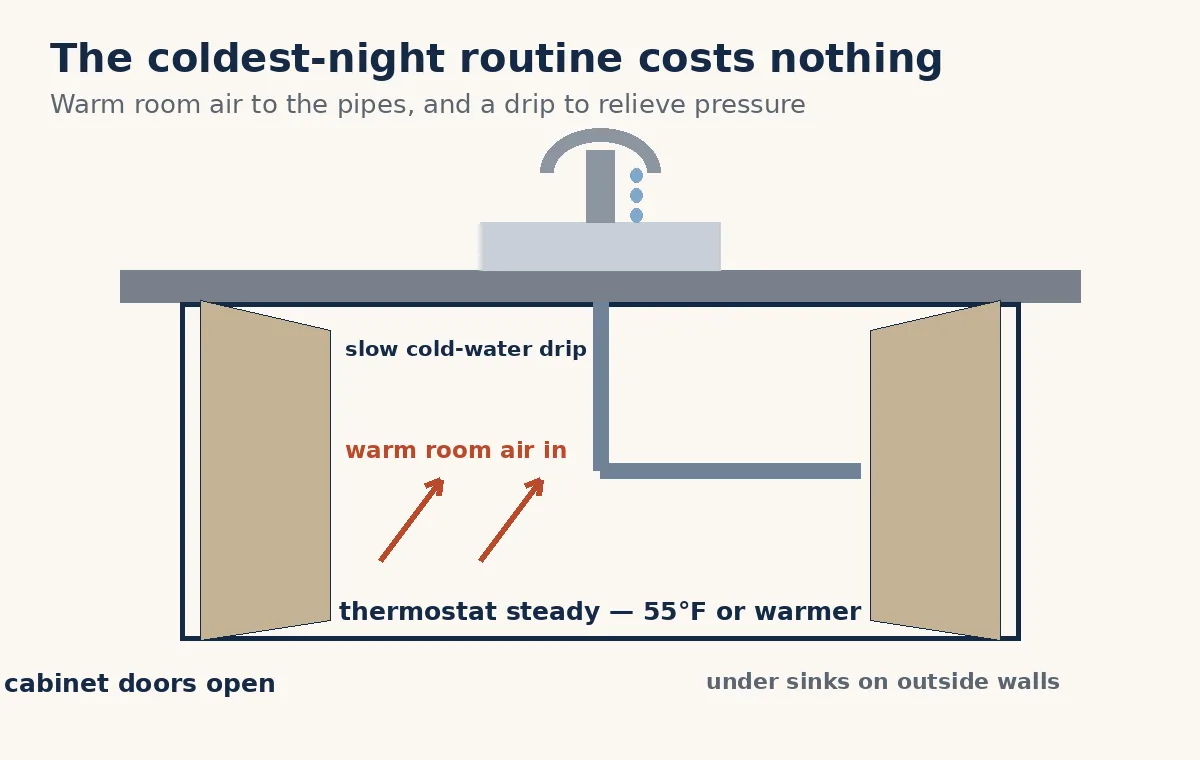
On the coldest nights — forecast anywhere near 20°F, the temperature where research finds pipes in unheated spaces start freezing — run the Red Cross routine, because it costs nothing and it is aimed at exactly these nights. Keep the thermostat at the same temperature day and night; the overnight setback is not worth it this week. Open the cabinet doors under kitchen and bathroom sinks, especially on outside walls, so warm room air reaches the pipes — and move the cleaners and chemicals up out of reach of children and pets first. Let cold water drip from the faucets those exposed pipes serve; moving water is much harder to freeze, and a drip also relieves the pressure buildup that is what actually bursts the pipe. Keep the garage door closed if water lines run through the garage. Away from home: leave the heat on, set no lower than 55°F, and for a long winter absence have a plumber walk you through shutting off the main and draining the lines once, properly — water heaters and sprinklers each have their own steps. These habits are the difference between the houses that freeze at 20°F and the houses that freeze at 5°F: the products above widen the margin, and the routine uses it.
How do you keep stored water from splitting its container?
You keep stored water safe with headspace, placement, and the right container — in that order. Water expands about 9% when it freezes, and a rigid container filled to the brim has nowhere to put that growth, so it splits at a seam or pops a cap. If a container lives anywhere that can freeze — a garage, a shed, an unheated basement corner — leave about 10% of its volume empty, an inch or two below the top. Placement beats headspace, though: inside the heated part of the house, a closet or a basement that stays above freezing, water needs no expansion room and stays usable instead of becoming a block of ice you cannot pour during the outage you stored it for. Keep containers off bare concrete where you can (a board or shelf evens out the temperature swings and is kinder to the plastic), out of sunlight, and dated, so rotation stays honest. Size the supply with the water storage calculator — one gallon per person per day — and pick containers from our water storage comparison that match where they will actually live. One weight warning: a full 5-gallon container is about 40 pounds and a 55-gallon drum is over 450 — fill them where they will sit.
Stored water needs room to become ice
Water expands about 9% as it freezes — leave about 10% of the container empty, an inch or two below the top. The ice pushes up into that headspace instead of splitting the container
Best: inside the heated part of the house, where it stays liquid
Store it on a board or shelf — off bare concrete, out of sunlight — and date it for rotation.
What if a pipe freezes anyway?
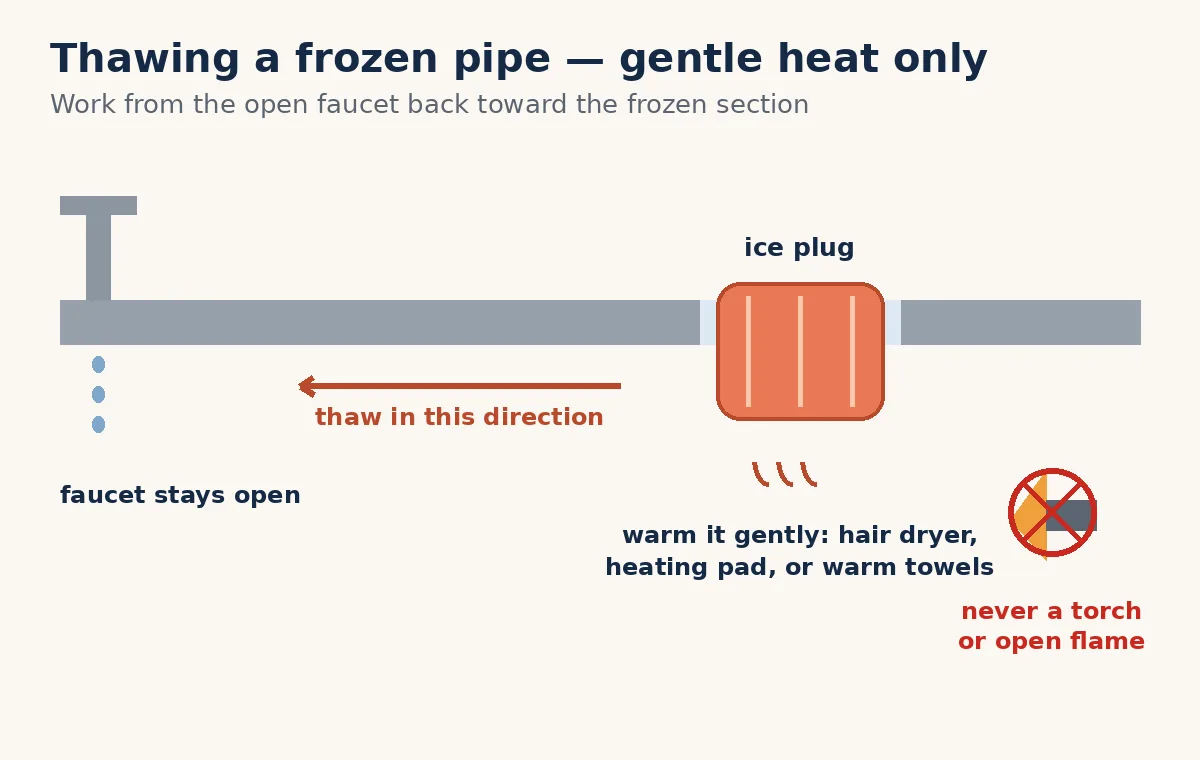
If a pipe freezes anyway, the next hour decides whether it is a story or an insurance claim. The sign is a faucet that slows to a trickle. Keep that faucet open — running water helps melt the plug and relieves pressure. Find the frozen stretch (the coldest exposed section serving that faucet is the usual suspect) and warm it gently: a hair dryer, a heating pad, towels soaked in warm water, working from the faucet back toward the frozen part. Never use a torch or any open flame — that is both a fire risk and a way to burst the pipe you are saving. If you cannot find the frozen section, cannot reach it, or the pipe has already split: shut the water off at the main — every adult in the house should know where that valve is before winter, which is why it is a scored line in our room-by-room readiness audit — and call a plumber. When a pipe thaws, watch it: a split often announces itself only when the ice plug melts.
What are the honest caveats?
Five, and the first one matters most. Heat cable has a fire record. The U.S. Consumer Product Safety Commission has warned about heat tapes since at least 1989, and in 1996 estimated that faulty heat tapes caused about 1,500 fires, 10 deaths, and 100 injuries a year — with old, worn, and badly installed tapes singled out. That is why this page repeats the rules instead of softening them: buy only UL- or CSA-listed cable, replace uncertified cable older than three years, inspect every fall and replace at the first sign of cracking, charring, or damage (never repair it), use a GFCI outlet, and never install cable in walls, floors, or ceilings. Second, no product on this page protects a house with the heat off — below a whole-house 55°F, you are relying on luck and pipe location. Third, insulation has a floor: in a multi-day freeze in a vented crawl space, sleeves alone lose. Fourth, prices and availability move with the season — heat cable sells out in the first cold snap, which is the commercial argument for doing this in October instead of January. Fifth, none of this substitutes for a plumber on the runs that freeze every year; a pipe that freezes annually is telling you it is routed wrong, and rerouting it once can retire the whole problem.
Three more worth a look
Not reviewed or scored — listed because readers cross-shop them, with the same disclosure as everything here.
EasyHeat AHB Pipe Heating Cable
The same thermostat-cable class as the Frost King, from Emerson’s EasyHeat line — sold in lengths up to 80 feet, for the long crawl-space runs the 30-foot Frost King kits cannot reach.
Reliance Aqua-Tainer 7-Gallon
The stored-water container from our water comparison — rigid, stackable, with a spigot; store it inside the heated space and it skips the freeze problem entirely.
Everbilt Foam Pipe Insulation, 6-Foot
The insulation-first step as a single pre-slit tube for 1/2-inch pipe — buy a bundle of lengths for the whole crawl space, not one tube at a time, and tape the joints.
As an Amazon Associate, Ordinary Prepper earns from qualifying purchases. The three products above have not been reviewed or scored.
Frequently asked questions
At what temperature do pipes freeze?
Water freezes at 32°F, but the outside temperature that puts pipes at risk is about 20°F: research on pipes in unheated spaces finds freezing starting around 20°F outdoors, and colder, draftier spots freeze sooner. Treat a forecast near 20°F as the night to run the full routine.
Can pipes freeze in one night?
Yes. An exposed pipe in a crawl space or garage wall can freeze in a few hours of deep cold, especially with wind driving cold air through gaps. One hard night is the normal case, not the exception — which is why the faucet covers and cabinet doors matter before it arrives.
Does letting a faucet drip really prevent freezing?
It helps two ways: moving water is harder to freeze, and an open faucet relieves the pressure that builds between an ice plug and the closed tap — and pressure, not ice itself, is what bursts the pipe. A slow cold-water drip from the faucet farthest along an exposed run is the standard advice.
Will foam pipe insulation alone keep pipes from freezing?
Not through a long, deep freeze. Insulation adds no heat; it only slows the pipe’s cooling, buying hours and covering short cold snaps. Pipes that still freeze under insulation — or sit in unheated, drafty spaces — need heat cable under the insulation, installed to the cable maker’s directions.
How much empty space should stored water have in winter?
About 10% of the container — an inch or two below the top — anywhere the container can freeze, because water expands roughly 9% as it turns to ice. Better still, store drinking water inside the heated part of the house, where it stays liquid and the headspace does not matter.
How long does heat cable last?
Plan on inspecting it every fall and treating age with suspicion: the CPSC advises replacing uncertified heat tapes more than three years old with listed ones, and any cable — at any age — with cracked, charred, cut, or discolored sections gets replaced, never repaired. A listed cable, installed right and checked yearly, is a multi-year tool.
Which protection should you buy first?
Buy in the order the cold attacks. First, the free and nearly free layer: drain the outdoor faucets, fit foam sleeves on every exposed run, and put an FC2 cover on each faucet — a whole house’s worth is a small hardware-store trip. Second, heat cable for the one run that has frozen before or faces the coldest air: the FrostGuard if it is plastic, bent, or your first install, the Frost King HC6A if it is short, straight, metal, and watched. Third, the warning layer: a Govee sensor pair under the water heater and the lowest plumbing, so the failure you did not prevent at least phones you. Then check the rest of the house the way this page checked the pipes — our room-by-room readiness audit scores 34 checks in about 45 minutes, the household emergency checklist lists the supplies, and the whole water picture lives on the Water hub and the Home Readiness hub.
Talk it over with other homeowners. If your house has one pipe that freezes every single winter, bring its story — where it runs and what you have tried is exactly the kind of problem other crawl-space veterans have already solved once. The Ordinary Prepper Community on Facebook is where readers compare outage plans, show their setups, and help decide what we research next. Join the group →