
As an Amazon Associate, Ordinary Prepper earns from qualifying purchases. Prices last checked October 26, 2026.
Home Readiness — Guide
10 Things Most Emergency Kits Forget
Short answer: the kits that fail are rarely missing food or water. They are missing the small things around the food and water — a way to move water out of a heavy container, an alarm for the gas you cannot smell, a way to open the cans, a spare pair of glasses, and a written plan somebody else in the house has actually read. None of the ten items below is expensive. Most cost less than one freeze-dried bucket, and every one of them is the kind of thing you only notice at the worst moment: in the dark, with the power out, when the store run is not happening. Work down the list, check what your house already has, and fix the gaps in the order they are written — the first five bite within a day.
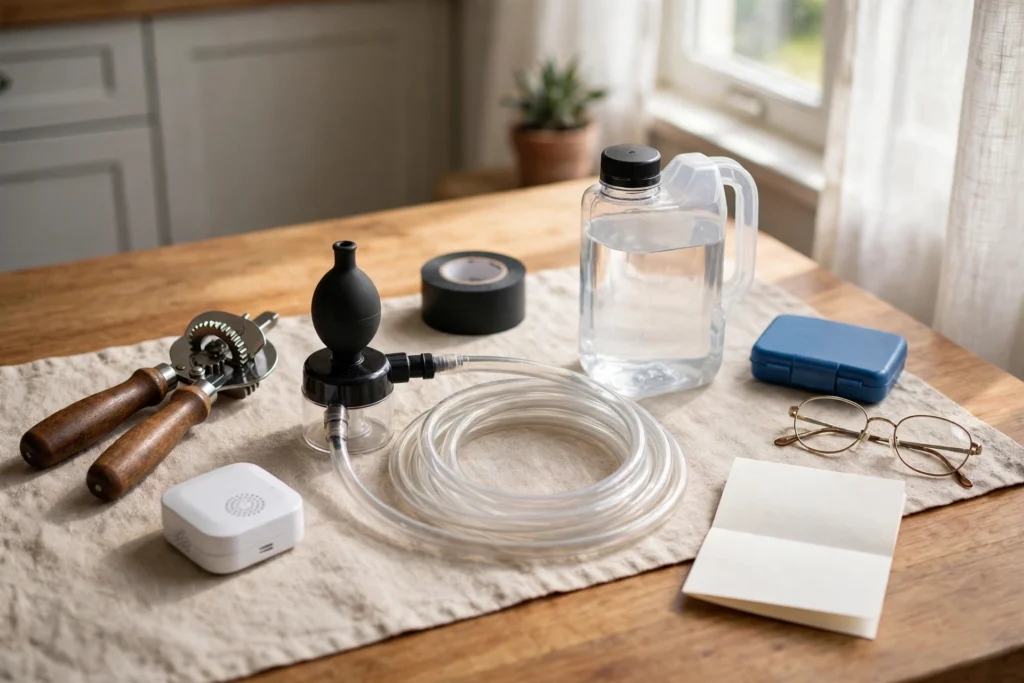
| Forgotten item | When you miss it | The small fix |
|---|---|---|
| Water transport | Day one | A hand siphon pump |
| CO alarm | The first cold night | One battery alarm per level |
| Manual overrides | The first outage | Know the hand way for each system |
| Spare parts | When one small part fails | Cords, filters, fuses, tape |
| Home repair basics | After the storm, not during | Tarp, tape, patch kit |
| Dental fix | Any weekend night | Temporary filling kit + a guide book |
| Spare glasses | The moment yours break | One backup pair in the kit |
| Medication buffer | When refills are delayed | A list, a buffer, an organizer |
| Written family plan | When phones are dead | Contacts and meeting points on paper |
| Your wild card | Only your house knows | Walk your own rooms and look |
Prices last checked: October 26, 2026. This is a guide, not a scored comparison — nothing below carries a score, and the links are to the gap item itself or to a review we have already published.
How do you move stored water without lifting the container?
Water transport is the gap almost every stored-water plan has. A full 7-gallon container weighs about 58 pounds, and a 55-gallon drum weighs more than 450 — neither one pours into a cooking pot at a kitchen sink. Owners of the big containers in our water container comparison solve it the same way: a cheap hand siphon. The Original Safety Siphon moves up to 3.5 gallons a minute through a 6-foot food-grade hose with a self-priming copper valve — a few shakes start it, no mouth-siphoning, no power. Keep one with the containers, not in a toolbox across the house, and label a second short hose for drinking water only, so the same hose never moves fuel one month and water the next.
Pounds you would be lifting
Neither pours into a cooking pot at a kitchen sink — the hand siphon in this section moves up to 3.5 gallons a minute instead.
The Original Safety Siphon
Why this one: A full 7-gallon container weighs about 58 pounds, and a 55-gallon drum more than 450 — neither one pours into a cooking pot at a kitchen sink. A cheap hand siphon is how owners of the big containers solve it: a few shakes start it, no mouth-siphoning, no power.
Where is your carbon monoxide alarm — and does it run on batteries?
A carbon monoxide alarm is the forgotten item with the worst downside. CO has no smell, and the moments a house produces it are exactly the emergency moments: a generator running too close, a stove used for heat, a fireplace with a closed flue. In the CPSC survey behind our home readiness audit, only about 55 percent of tested households had a CO alarm at all. The fix is a battery alarm, because a plug-in alarm with no battery backup goes dark in the outage when you need it most. The First Alert CO710 runs on a sealed 10-year lithium battery, shows the current and peak CO reading on a backlit display, and sounds at 85 decibels — put one on every level and near the sleeping areas, and write the install date on the case.
Where the battery CO alarms go: On every level, basement to top floor · near sleeping areas, outside the bedrooms. CO has no smell — the alarm is the only nose the house has.
The alarm itself: Sealed 10-year battery · 85 dB. Write the date — the install date, on the case.
Why battery: A plug-in alarm with no battery backup goes dark in the outage — when it is needed most. Only about 55% of tested households had a CO alarm at all (CPSC survey).
Relevant pickFirst Alert CO710
The fix is a battery alarm, because a plug-in alarm with no battery backup goes dark in the outage when you need it most. This one runs on a sealed 10-year lithium battery and shows the current and peak CO reading on a backlit display.
Sealed 10-year battery · Backlit display · 85 dB alarm
What in your house only works with electricity — and what is the hand way?
Manual overrides are knowledge, not gear, which is why kits forget them. Walk the house once and answer, out loud, for each system: the garage door (find the red release cord and try it), the gas and water shutoffs (find them, tag them, keep the wrench with them), the can opener (electric-only kitchens are common — see item five of the audit), and the locks (a keyed spare somewhere a family member can reach if the smart lock dies). If you run a power station, the override question doubles: which loads move to the battery, in what order, is written down in our solar generator comparison and the runtime guide — fridge first, medical devices second, lights and phones riding along.
Which small parts would stop a working system cold?
Spare parts are the dullest item on this list and the one that ends the most plans. A power station with no spare charging cable is a paperweight in a week. A water filter with no spare cartridge is a one-week filter. The short list that covers most houses: one spare charging cord for your power station, one spare filter element for whatever filters your drinking water, the odd-size batteries your alarms and lanterns take (not just AA), a handful of the fuses your house or car actually uses, and a roll of heavy repair tape. Gorilla Tape Tough and Wide is the tape we would stock — double-thick adhesive, weather-resistant backing, 2.88 inches wide so one strip patches a torn tarp or a cracked container lid.
What fixes a roof, a window, or a pipe in the first hour?
Home repairs after a storm are mostly about keeping water out and heat in for the next 48 hours, not about rebuilding. The kit is three things: a medium tarp with rope or bungees, the repair tape from the section above, and a basic patch kit — plastic sheeting, a staple gun if you own one, and work gloves. Houses that have these three handle the common first-hour jobs: a tarp over a damaged roof section, plastic over a broken window, tape and a bucket under a dripping joint until a plumber is a realistic idea again. The Home Readiness hub collects the rest of this shelf, including the freeze-protection sequence for the pipe itself.
What do you do when a filling falls out on a Saturday night?
Dental emergencies are the forgotten item people laugh about until it happens to them. A lost filling or a loose crown on a weekend night, in a storm week, is pain with no appointment at the end of it. The honest fix is temporary and says so on the box: DenTek Temparin Max is the temporary filling material dentists themselves stock — it seals a lost filling or secures a loose cap for up to 48 hours while you get to a dentist, and the kit is rated for 13 or more repairs. Pair it with the book written for exactly this gap, Murray Dickson’s Where There Is No Dentist (Hesperian, updated 2021 printing) — plain-language guidance on examining teeth and handling common dental problems when a dentist is not reachable, rated 4.7 stars across more than 1,000 reader reviews. Neither replaces a dentist. Both turn a miserable night into a manageable one.
A lost filling — the 48-hour bridge: Seal it (temporary filling material) → up to 48 hours (a manageable night) → the dentist (the real fix). Temporary on purpose — it buys time; it does not replace the dentist.
The kit: Rated for 13 or more repairs — lost fillings and loose caps. Where There Is No Dentist rides alongside, for when no dentist is reachable.
See the filling kit on Amazon See the book on Amazon
What happens if your glasses break in week one?
Vision and hearing get one short section because the fix is short. If you wear prescription glasses, a spare pair — even last year’s prescription — belongs in the kit, not in a drawer you will forget. If you wear readers, a spare pair in your strength costs very little and weighs nothing; buy your own strength rather than an assorted bundle. Hearing-aid wearers: a card of the right battery size, stored with the medicines, rotated when you rotate the medicines. These are the items nobody photographs for a kit layout photo, and the ones that decide whether you can read a medicine label, a map, or a shutoff tag in the dark.
There is no single right product to link here, because the strength has to be yours — any large retailer multipack in your own strength does the job, and an assorted-strength bundle does not.
How do you handle medicines when refills are delayed?
Backup medication is information only on this page, on purpose. We give no medical advice and link no medicines. The readiness version is paperwork and timing: a written list of each household member’s prescriptions, doses, and pharmacy; a buffer built by refilling as early as your insurer and doctor allow, discussed with both of them; and storage that keeps medicines dry, dated, and together — a simple organizer or a labeled box is the only product this section needs. Ready.gov’s guidance is the same shape: keep an extra supply where you can, and talk to your doctor and pharmacist about how. If a medicine needs refrigeration, that fact belongs in your power plan — it changes what the battery runs first.
Does anyone else in the house know the plan?
A family emergency plan is the item that costs nothing and is missing most often. Paper, not an app: out-of-area contact, two meeting points (near the house, and away from the street), the shutoff locations from section three, and who collects the pets and the medicine box. Every adult and older child should be able to find it in the dark and have read it once while the lights were on. Our first-month guide builds this in week one, and the household emergency checklist carries the tick-off version sized to your household.
What is your house’s wild card?
The wild card is the item only your household needs: the sump pump that must never stop, the baby supplies, the pet medication, the well pump, the CPAP, the wheelchair battery, the insulin. No listicle knows it. Walk your own rooms with the other nine items in mind and ask, room by room, what would stop working here that nobody else would think of — that answer is item ten, and for most houses it outranks half this list. Write it on the plan from section nine so it is not only in one person’s head.
What should you be honest about before you buy anything?
Three caveats. First, most of this list is probably already in your house somewhere — the work is gathering and dating it, not buying it; go and look before you order. Second, temporary fixes are temporary: the filling kit buys 48 hours, the tape buys a dry night, and neither one closes the job. Third, a kit nobody has walked through is a pile of gear — the audit habit matters more than any single item here, which is why this page keeps sending you back to it.
Three more worth a look
Not reviewed or scored — listed because readers cross-shop them, with the same disclosure as everything here.
Midland WR120B Weather Radio
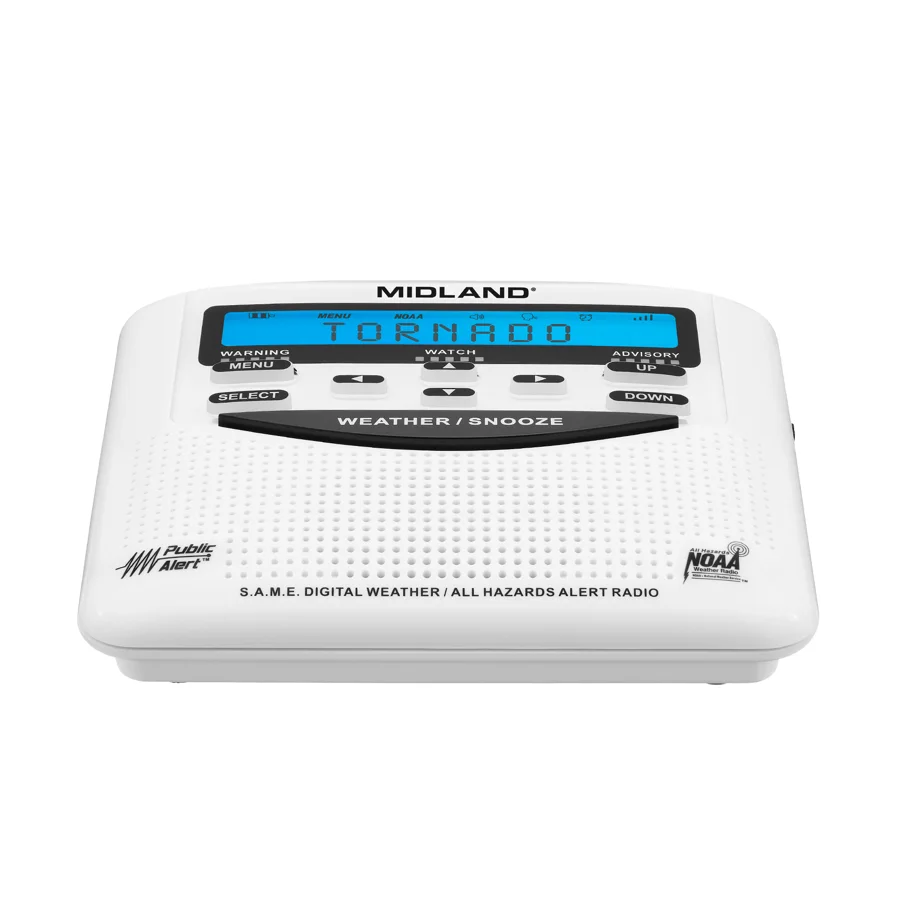
The NOAA alert radio that wakes the house for warnings you would otherwise sleep through.
Anker PowerCore Essential 20000 PD
A 20,000 mAh phone bank — several full phone charges in a drawer, for the outage before the big battery comes out.
Swing-A-Way Easy Crank Can Opener
The manual opener with the long crank handle — the audit’s most-missed kitchen item, answered properly.
As an Amazon Associate, Ordinary Prepper earns from qualifying purchases. The three products above have not been reviewed or scored.
Frequently asked questions
What do people forget most in an emergency kit?
A manual can opener, a battery carbon monoxide alarm, and a way to move stored water — in roughly that order. After those come spare glasses, a medication list with a small buffer, and a written family plan. None of the top six is expensive; all six are easy to walk past in the store.
How often should you check an emergency kit?
Twice a year, on the weekends the clocks change. Check alarm test buttons and dates, rotate medicines and water, recharge the phone bank, and re-read the family plan with the household. A kit check takes about 20 minutes once the kit exists.
Where should a carbon monoxide alarm go?
On every level of the home and near the sleeping areas, following the alarm maker’s placement instructions. Battery models keep working in an outage, which is when generators, stoves, and fireplaces make CO most likely. Replace the whole alarm at its end-of-life date — 10 years for a sealed-battery model.
How much water should a household store?
One gallon per person per day for drinking and sanitation. Three days is the floor Ready.gov points to and two weeks is the comfortable target — a family of four at three days is 12 gallons, plus extra for pets. Our water storage calculator does the math for your household size.
Can a temporary dental filling replace a dentist visit?
No. A temporary filling kit is rated to protect a lost filling or loose crown for up to about 48 hours while you arrange care. It is a bridge through a weekend or a storm week, not a repair — the dentist visit still has to happen.
What should a renter’s version of this list look like?
Almost identical. Renters skip permanent changes and lean on the landlord for fixed alarms and shutoffs — but learn where the shutoffs are anyway. The siphon, the dental kit, spare glasses, the plan on paper, and the repair tape are fully in a renter’s control.
Where do you start?
Start with the three that protect people rather than property: the CO alarm, the medication list and buffer conversation, and the written plan. Then the three that make stored supplies usable — siphon, can opener, spare parts — and finish with repairs, dental, and glasses the next time you are already ordering household basics. Run the room-by-room audit when you are done and score the house again; keep the ongoing list beside it in the household emergency checklist, and see the rest of the shelf on the Home Readiness hub.
Talk it over with other homeowners. If you walked your own rooms and found a wild-card item no list had ever named for your house, tell the group what it was — those answers are how this list gets better. The Ordinary Prepper Community on Facebook is where readers compare outage plans, show their setups, and help decide what we research next. Join the group →