
As an Amazon Associate, Ordinary Prepper earns from qualifying purchases. Prices last checked October 27, 2026.
Home Readiness — Guide
How Long Will a Power Station Run an Oxygen Concentrator?
Short answer: a 2 kWh power station runs a typical home oxygen concentrator for about 5 hours — not all night. Philips lists its EverFlo at 350 watts average, and a station hands over only about 85% of its rated watt-hours once the inverter takes its cut — so a 2,074 Wh station delivers roughly 1,763 usable watt-hours, and 1,763 ÷ 350 is about 5 hours; a 1 kWh station lasts about 2½. Treat the station as a bridge: hours to arrange tanks, a generator recharge, or a utility priority call — with the decisions about those hours left to your oxygen supplier and home-health provider. This page just does the power math.
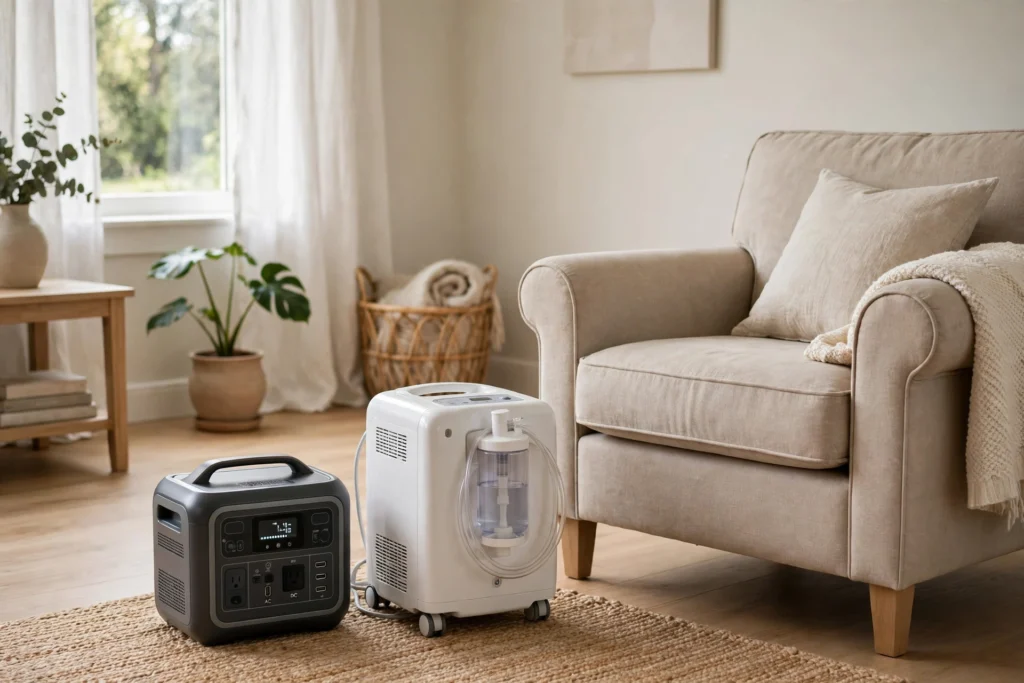
Rated is not usable — the 85% rule: A station hands over about 85% of its rated watt-hours. Bluetti Elite 200 V2: 2,074 Wh rated — about 1,763 Wh usable. EcoFlow DELTA 2 Max: 2,048 Wh rated — about 1,741 Wh usable. Anker SOLIX C1000: 1,056 Wh rated — about 898 Wh usable.
Why: The inverter takes its cut on the way out, so plan on 85% of the nameplate. That one rule sits behind every runtime figure on this page.
Bluetti Elite 200 V2
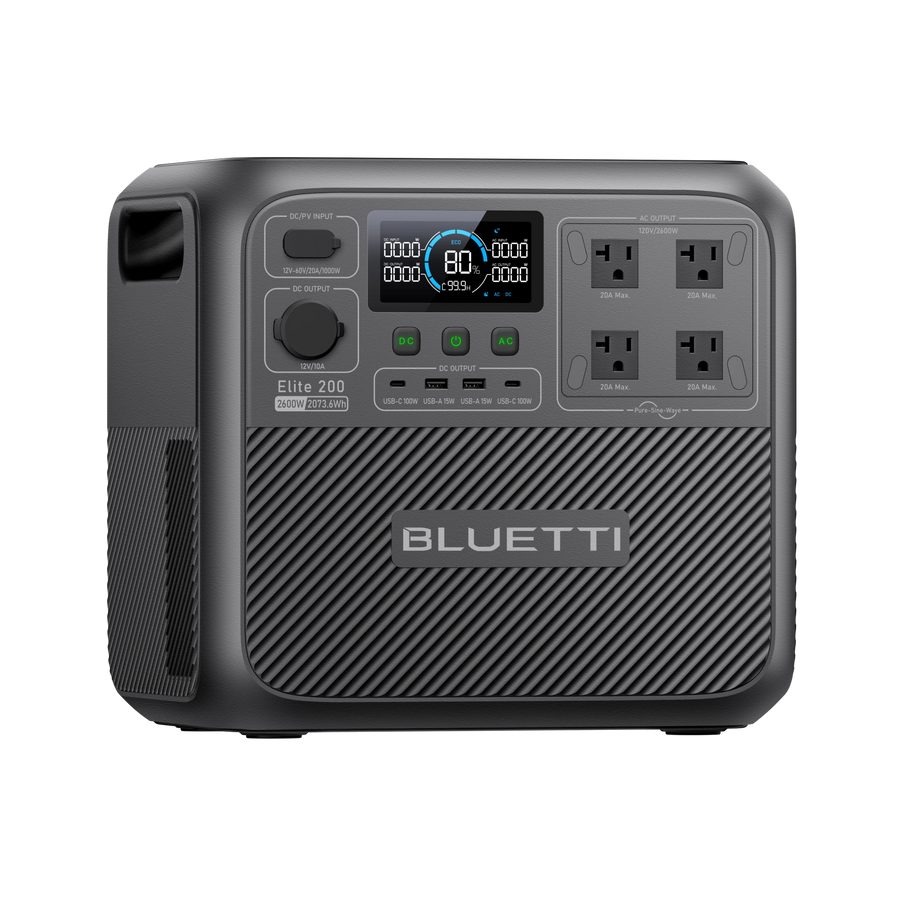
Photo: Bluetti
2,074 Wh — about 1,763 usable — and a 2,600 W inverter. About 5.9 hours at ~300 W, or 3.2 hours at ~550 W.
EcoFlow DELTA 2 Max
2,048 Wh — about 1,741 usable. About 5.8 hours at ~300 W or 3.2 hours at ~550 W. The only pick here that takes expansion batteries later, up to 6,144 Wh.
Anker SOLIX C1000
1,056 Wh — about 898 usable — at 28.4 pounds, light enough to carry to the bedroom. About 3.0 hours at ~300 W or 1.6 hours at ~550 W; doubles to 2,112 Wh with its expansion battery.
What a concentrator actually draws
There is no single concentrator wattage. Philips lists the EverFlo at 350 watts average. Drive DeVilbiss lists its 525DS at 310 watts average — 275 watts at flow settings of 2.5 liters per minute or below, so draw follows the flow setting. Inogen lists the At Home at about 110 watts at setting 2 (275-watt maximum): same 5-liter class, a third of the EverFlo’s draw at a low setting. Invacare lists its 10-liter Platinum 10 at 585 watts.
| Machine | Type | Draw | Source |
|---|---|---|---|
| Philips Respironics EverFlo | Stationary, 5 L | 350 W average | Philips specs |
| Drive DeVilbiss 525DS | Stationary, 5 L | 310 W avg; 275 W low flow | Drive DeVilbiss specs |
| Inogen At Home | Stationary, 5 L | ~110 W at setting 2; 275 W max | Inogen specs |
| Invacare Platinum 10 | Stationary, 10 L | 585 W average | Invacare specs |
| Inogen One G4 | Portable, pulse | ~40 W at setting 2 | Inogen specs |
Portables are the contrast, not a shortcut. An Inogen One-class portable draws around 40 watts because it delivers oxygen in pulses, not a continuous stream — a different kind of therapy, and whether one fits a prescription is for the supplier and provider, not a battery decision. Portables can also run or charge from a 12V car adapter. For a stationary machine, plan on the two levels below — about 300 watts for an efficient 5-liter machine, about 550 for a larger or high-flow one — and measure your own; your number is the only one that counts.
What a concentrator actually draws: Maker-listed draw (the Inogen rows at setting 2): Inogen One G4 portable ~40 W · Inogen At Home ~110 W · Drive DeVilbiss 525DS 310 W · Philips EverFlo 350 W · Invacare Platinum 10 585 W.
Draw follows the flow setting: The 525DS drops to 275 W at 2.5 litres per minute or below, and the At Home’s maximum is 275 W. The portable delivers pulses, not a continuous stream — a different kind of therapy. Measure your own machine: your number is the only one that counts.
Bluetti Elite 200 V2
Why this one: About 1,763 usable watt-hours: roughly 5.9 hours at ~300W, or 3.2 hours at ~550W. The longest bridge here — and still not all night, which is why the plan around the battery matters.
The runtime table
| Station | Usable Wh | At ~300 W | At ~550 W |
|---|---|---|---|
| Bluetti Elite 200 V2 | ~1,763 Wh | About 5.9 hours | About 3.2 hours |
| EcoFlow DELTA 2 Max | ~1,741 Wh | About 5.8 hours | About 3.2 hours |
| Anker SOLIX C1000 | ~898 Wh | About 3.0 hours | About 1.6 hours |
At the EverFlo’s 350 watts, the two big stations land at about 5 hours and the C1000 at about 2½. The overnight math, plainly: eight hours at 350 watts needs 2,800 usable watt-hours, and the biggest single station here holds about 1,763 — short by more than 1,000 watt-hours. A single 2 kWh station does not cover a full night at that draw, and at 550 watts it covers barely a third of one. Two routes change that: expansion batteries (one extra battery takes the DELTA 2 Max to 4,096 Wh, about 9.9 hours at 350 watts) and generator recharging by day. The third exception is an efficient low-setting machine: at ~110 watts, even the C1000 runs about 8 hours.
Runtime at about 300 watts (an efficient 5-litre machine): Bluetti Elite 200 V2 about 5.9 hours · EcoFlow DELTA 2 Max about 5.8 hours · Anker SOLIX C1000 about 3.0 hours.
At about 550 W — a larger or high-flow machine — the same stations run about 3.2, 3.2 and 1.6 hours. At the EverFlo’s 350 W, the two big stations land at about 5 hours and the C1000 at about two and a half.
The plan around the battery
The station is one piece. These are the others — set up before an outage, and confirmed with your oxygen supplier and home-health provider, who own the therapy and backup decisions:
- Get on your utility’s medical-priority list now. The FDA advises telling your electric company in advance that life-sustaining equipment is in the home; utilities say the list brings advance notice and priority restoration attempts, not guaranteed power.
- Ask your supplier about backup tanks. FDA disaster guidance points to nonelectric alternatives — for oxygen, tanks. How many and when to switch are the supplier’s call, made with your provider.
- Measure your own machine’s draw. A plug-in watt meter, read at the prescribed flow setting on an ordinary day, replaces every estimate here with your number — and never change a prescribed setting to save battery.
- Test the setup while the grid is up. An hour on a normal afternoon, with someone awake, watching the station’s percentage fall against the table above. The first full run should not be at 2 a.m.
- Pair a generator as the recharger, not the bedside power. It stays outdoors — carbon monoxide, not negotiable — and refills the station, which runs the concentrator indoors after the generator shuts down.
- Put it in writing. Supplier and provider numbers, tank locations, utility-list status, and measured watts, on one sheet near the concentrator.
Why is the Bluetti Elite 200 V2 the longest bridge here?
It starts with the most: 2,074 watt-hours, about 1,763 usable — about 5 hours at 350 watts — and Bluetti rates its battery at 6,000+ cycles to 80%, the longest-lived pack here. It holds 4.7 stars across 947 Amazon ratings in our October checks. Complaints repeat: 53.4 pounds, an app that drops its connection, and no expansion battery, ever.
When does the EcoFlow DELTA 2 Max make more sense?
When the plan needs to grow. Alone it matches the Bluetti within minutes — 2,048 watt-hours, about 1,741 usable, about 5 hours at 350 watts — and refills fast. Its argument is expansion: one extra battery clears a full night at 350 watts; two make 6,144 Wh. It holds 4.7 stars across 1,358 Amazon ratings in our October checks; complaints repeat on fan noise and extra-battery cost.
Relevant pickEcoFlow DELTA 2 Max
About the same bridge — 5.8 hours at ~300W or 3.2 at ~550W — and the only pick here that takes expansion batteries later, up to 6,144 Wh: the one that can grow to a full night.
2,048 Wh · Expands to 6,144 Wh
What can the Anker SOLIX C1000 honestly cover?
About 2½ hours at 350 watts — a short bridge to tanks, a generator start, or a restoration call. Its place is the efficient end: on a machine drawing ~110 watts, its 898 usable watt-hours run about 8 hours. It holds 4.7 stars across 2,166 Amazon ratings in our October checks; the recurring owner lesson is capacity — a 1 kWh box cannot carry two big loads around the clock. One BP1000 expansion battery doubles it to 2,112 Wh.
The three stations, side by side
| Station | Capacity | Hours at ~350 W | Price |
|---|---|---|---|
| Bluetti Elite 200 V2 | 2,074 Wh | About 5.0 | $899 |
| EcoFlow DELTA 2 Max | 2,048 Wh | About 5.0 | $1,029 |
| Anker SOLIX C1000 | 1,056 Wh | About 2.6 | $499.99 |
Prices last checked October 27, 2026.
Three more worth a look
Not reviewed or scored — each answers a question this page raises.
P3 Kill A Watt P4400
The plug-in watt meter this page keeps pointing at — it turns “about 300 watts” into your machine’s number.
Jackery Explorer 2000 v2
Another 2,042 Wh station, and at about 39.5 pounds the lightest 2 kWh box we track — the bridge one person can move between houses.
Anker SOLIX BP1000 Expansion Battery
The add-on that doubles the SOLIX C1000 to 2,112 Wh — about 5 hours at 350 watts instead of 2½. C1000 only; not a station on its own.
As an Amazon Associate, Ordinary Prepper earns from qualifying purchases. The three products above have not been reviewed or scored.
The questions that come next
Can one station run a CPAP and a concentrator on the same night?
Not for a whole night, on any single station here. Add the loads: 350 watts plus a CPAP at about 55 watts with its humidifier (worked out on our CPAP runtime page) is roughly 405 watts — about 4.3 hours on a 2 kWh station, against the roughly 3,240 watt-hours the pair would need for a full night. The workable split is two batteries, one per machine.
How long will a portable concentrator run on its own battery?
Hours, not a night, at most settings: Inogen’s specs for the One G4 class put the standard battery at up to about 3 hours and the double at up to about 6, at low settings. On a station, at roughly 40 watts, the same portable runs about 22 hours on 1 kWh or 44 on 2 kWh — but portables and home machines are prescribed differently, so treat that as arithmetic, not a suggestion.
What size station do I need for a full night?
Plan on the 4–5 kWh class. The bare math at 350 watts is 2,800 usable watt-hours — about 3,300 rated, with nothing left over — and a medical load should never be planned to zero. With a sensible reserve: 4–5 kWh rated, plus tanks and the utility list regardless. At 550 watts it grows to about 5,200 rated watt-hours before reserve.
Frequently asked questions
Will a 1,000 Wh power station run an oxygen concentrator overnight?
For a typical home machine, no — about 2½ hours at 350 watts. The exception is an efficient machine at a low setting: at roughly 110 watts, a 1 kWh station runs about 8 hours. A watt meter tells you which side of that line your household is on.
Can a generator run an oxygen concentrator?
Generators are a standard part of outage plans for powered medical equipment — FDA disaster guidance says to ask your supplier or manufacturer about generator use for your specific machine. The pattern here is indirect: generator outdoors, recharging the station; station indoors, running the concentrator. Direct connection is the supplier’s call.
What happens when the station runs empty in the middle of the night?
The concentrator stops and its power-failure alarm sounds — Drive DeVilbiss lists one among the 525DS’s alerts, and most home machines have one. That alarm is a warning, not a backup — why every station here pairs with tanks, a utility listing, and a tested switch-over, arranged with your supplier beforehand.
Which size fits the plan?
Size the battery to the job. A bridge — a few hours while tanks are swapped in, a generator started, or a flagged medical-priority home restored — is a 2 kWh job: the Bluetti for the longest single charge, the EcoFlow if the battery may need to grow later. The whole night, every night of an outage, is a 4–5 kWh job, or a 2 kWh station with expansion batteries and a recharge plan. And an efficient low-draw machine can make the small Anker the right size after all. Measure first, then buy the size your own number asks for.
This page is one spoke of What People Are Asking About Medical Backup Power, where outage questions from households running powered medical equipment are gathered with their short answers. The 85% usable rule behind every number here is the same method used on this cluster’s founding page, how long a power station runs a CPAP, fridge, or freezer.
Talk it over with other homeowners
The Ordinary Prepper Community on Facebook is where readers compare outage plans, show their setups, and help decide what we test next.