As an Amazon Associate, Ordinary Prepper earns from qualifying purchases. Prices last checked October 28, 2026.
Home Readiness — Guide
Freezer in an Outage: The Hour-by-Hour Truth (Refreeze Rules and the Water-Jug Trick)
Short answer: A full freezer, unopened, holds safe temperatures for about 48 hours; a half-full one, about 24 — and a chest freezer beats an upright on both numbers. The refreeze rule is simpler than the arguments about it: food that still contains ice crystals, or that a thermometer shows at 40°F or below, can be refrozen safely (quality suffers, safety does not); food that sat above 40°F for more than two hours gets thrown out. And the water-jug trick is real physics, not folklore: every frozen gallon you tuck into empty space is thermal mass that has to melt before the box can warm.
The timeline, hour by hour
These are planning figures for a freezer that starts at 0°F, stays closed, and sits in a house at normal room temperature. A hot garage shortens them; a cold one stretches them.
Hours before the food crosses 40°F
Planning figures from the table above — door closed, freezer starting at 0°F, normal room temperature. Each bar is the end of that freezer’s safe stretch.
| Hours without power | Full chest freezer | Full upright | Half-full, either |
|---|---|---|---|
| 0–4 | Still near 0°F | Still near 0°F | Barely moved |
| 4–12 | 0–10°F — frozen solid | 5–15°F — frozen solid | 10–20°F — frozen |
| 12–24 | 10–20°F — safe | 15–28°F — safe | 25–38°F — approaching the line |
| 24–36 | 20–30°F — safe | 28–40°F — decision time | Above 40°F — act or discard |
| 36–48 | 30–40°F — the last safe stretch | Above 40°F for hours — discard perishables | Discard perishables |
| 48+ | Crossing 40°F — decision time | Discard | Discard |
Two honest caveats. First, these curves assume the door stays shut — every peek costs cold air, and an upright pays more for each one. Second, a freezer thermometer you can read without opening the door (or an alarm that beeps as temperatures climb) turns this table from a guess into a measurement. The single most useful ten dollars in outage food safety is knowing the actual number.
Bluetti Elite 200 V2
Why this one: A power station sized to the freezer: it stretches a full chest freezer’s safe window to roughly three extra days — often the difference between the 24-hour half-full line and the storm actually ending.
The refreeze rules, stated once and plainly
The food-safety authorities — USDA’s guidance is the standard reference — land on three rules, and they cover nearly every argument:
The refreeze decision (USDA rules — temperature and time decide, not smell or taste): ice crystals, or 40°F or colder → REFREEZE IT (texture suffers a little — safety does not change) · above 40°F, under 2 hours → COOK IT NOW (eat it, or refreeze it cooked) · above 40°F, over 2 hours → THROW IT OUT (meat · dairy · eggs · leftovers — all of it).
The coin test — for the trip away: A coin frozen on a cup of water: coin at the bottom = it thawed and refroze.
Ice crystals present, or 40°F or colder: refreeze it. The texture of vegetables and the quality of meat will suffer a little; the safety does not change. Above 40°F for under two hours: cook it now and eat it or refreeze it cooked. Above 40°F for more than two hours: throw it out — meat, poultry, seafood, dairy, eggs, leftovers, all of it. When in doubt, throw it out is not a slogan; it is because the bacteria that matter do not reliably change smell or taste.
The coin-on-a-cup trick belongs in this section too, because it answers the vacation version of the question: freeze a cup of water, lay a coin on the ice, and if you come home to the coin at the bottom, the freezer thawed and refroze while you were gone — treat the contents by the discard rule, however cold they feel now.
The water-jug trick, with the math shown
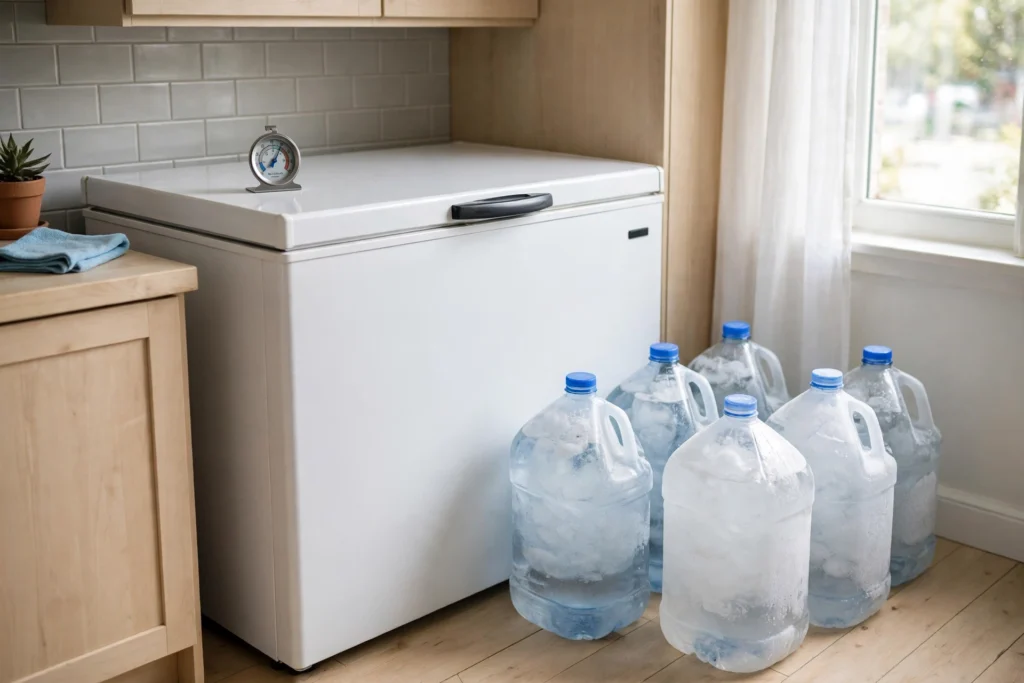
Ice is a battery for cold. Melting one pound of ice absorbs about 144 BTU without changing temperature at all — the energy goes into the phase change, not into warming. A gallon of water is 8.3 pounds, so a frozen gallon jug parked in your freezer absorbs roughly 1,200 BTU just by melting, before the box around it gains a degree that matters. Five jugs in the empty corners of a half-full freezer are 6,000 BTU of patience.
Cold absorbed just by melting
Melting ice takes in heat without warming at all — the jugs make the freezer slower, not colder.
Put plainly: the jugs do not make the freezer colder, they make it slower. They convert a half-full freezer’s 24-hour clock toward a full freezer’s 48 — not all the way, but most of it — and they cost nothing but space you were not using. Rules of the trick: fill jugs 90% full (water expands about 9% as it freezes), freeze them in place before storm season rather than during the outage, and when the outage comes, do not take them out to “check” — every opening spends what they bought.
What to do at each decision point
Hour 0: note the time, keep the door shut, move the thermometer where you can read it. Hour 12: if power is not back and the freezer is half-full, this is the moment for dry ice if you can get it — roughly 50 pounds per 18-cubic-foot freezer per two days, handled with gloves, never sealed airtight in a small room. Hour 24: chest owners relax; upright and half-full owners start the generator or station rotation — a few hours of powered cooling resets the clock substantially — or start cooking the most perishable things first. Hour 36–48: thermometer out, rules above applied item by item, no nostalgia discounts for expensive cuts.
Buying more hours, honestly
The timeline above assumes no power at all. The one purchase that rewrites it is a power station sized to the freezer: a chest freezer draws roughly 590 watt-hours a day, so the Bluetti Elite 200 V2 (2,073.6Wh) stretches a full chest freezer’s safe window to roughly three extra days, the EcoFlow DELTA 2 Max (2,048Wh) does about the same and recharges quickly from a generator, and the Anker SOLIX C1000 buys about a day and a half — often the difference between the 24-hour half-full line and the storm actually ending. No prices are printed here because they move; the links show today’s figure.
Relevant pickEcoFlow DELTA 2 Max
Does about the same as the Bluetti for the freezer — and recharges quickly from a generator when the power flickers back.
2,048 Wh · Fast generator recharge
Your next step: check the full runtime table on our power station runtime page for CPAP, fridge and freezer before you buy anything — for many houses the water jugs above plus a sealed door are the whole answer, and the station is only worth it when the outage risk is measured in days.
Buying more hours for a chest freezer (a chest freezer draws roughly 590 watt-hours a day): Bluetti Elite 200 V2 — roughly 3 extra days · EcoFlow DELTA 2 Max — about the same · Anker SOLIX C1000 — about a day and a half.
Why it matters: Station capacities as scored on this site: Bluetti 2,073.6 Wh, EcoFlow 2,048 Wh — a day and a half is often the difference between the 24-hour half-full line and the storm actually ending.
Follow-up questions
Can I store food outside in the snow instead?
Usually no, and the reasons are temperature control, not tidiness: a sunny 25°F day warms a dark box past 40°F by noon, animals are diligent, and frozen ground does not mean frozen food. A sealed cooler in deep shade in genuinely sub-freezing weather is the narrow exception — monitored with the thermometer, not assumed.
What thaws first, and what should I eat first?
Small, thin items at the door and the top thaw first; dense roasts at the centre last longest. Eat in the order the companion page on outage eating lays out: fridge perishables first, then the freezer’s thawing edge, pantry last.
Does a blanket over the freezer help?
Marginally, and only over the box — never over the vents or compressor area while it might still run, and it is no substitute for mass or a closed door. The jugs do more.
Frequently asked questions
How do I know the temperature without opening the door?
A thermometer with an external display or a wireless sensor, bought before the season. Absent that, the honest method is one quick open with a probe thermometer at the decision hours — fast, once, with a plan — rather than hourly peeking.
Is refrozen meat safe for kids and grandparents?
The ice-crystal/40°F rule is the health authorities’ rule for everyone; where it is met, refreezing is considered safe. Households that prefer a wider margin can cook the borderline items instead of refreezing them raw — cooking resets the safety question entirely.
What about ice cream? It always seems to melt first.
It does — ice cream softens well below 0°F because of its sugar and air content, and it is the household’s traditional early-warning instrument. Melted-and-refrozen ice cream is a quality write-off; treat it as the canary, not the evidence.
The bottom line
Keep it full, keep it shut, know the temperature, and let the clock — 48 hours full, 24 half-full — set your decisions instead of anxiety. Fill the empty space with frozen jugs this week, while filling them is free.
The full set is at What People Are Asking About Freezers, and the food shelves live in our Food hub.
Talk it over with other homeowners
The Ordinary Prepper Community on Facebook is where readers compare outage plans, show their setups, and help decide what we test next.