
As an Amazon Associate, Ordinary Prepper earns from qualifying purchases. Prices last checked October 28, 2026.
Home Readiness — Guide
Keeping Insulin and Fridge Medicines Safe in an Outage
Short answer: Most refrigerated medicines — insulin is the common case — are stored at 36–46°F (2–8°C), and their makers publish what happens outside that window: unopened insulin generally keeps until its expiry at fridge temperature, most in-use insulin pens and vials are rated for up to 28 days at room temperature below about 77–86°F depending on the product, and freezing is the one unforgivable event — insulin that has frozen should be discarded, per manufacturer guidance. In an outage, an unopened fridge holds safe temperatures for about 4 hours; after that, the medicine moves to a cooler with ice packs — with a barrier so nothing touches ice directly — or onto backup power, where a fridge is a surprisingly small load: about 1,200 watt-hours a day, which a 2,000Wh station covers for well over a day. Your own product’s patient leaflet and your pharmacist are the authority for your medicine; this page is the logistics, with the thresholds stated so you can plan around them.
The temperature windows, by the book
| Situation | Published guidance | Source of the rule |
|---|---|---|
| Unopened insulin, stored | 36–46°F until expiry | Manufacturer patient leaflets |
| In-use insulin (most products) | Up to 28 days below ~77–86°F | Product-specific leaflets — check yours |
| Insulin that has frozen | Discard | Manufacturer guidance |
| Fridge, power off, door closed | ~4 hours in the safe zone | USDA/FDA outage guidance |
| Other fridge medicines | Windows vary widely by product | Each product’s leaflet |
The spread in the second row is the lesson: “insulin” is a family of products with different rated room-temperature lives, and biologics, eye drops, and other refrigerated medicines each carry their own. The outage plan that works is written per product, in calm weather, from the leaflets in your own boxes — ten minutes with a pen beats any generic chart, including this one, at 2 a.m.
Bluetti Elite 200 V2
Why this one: The stations we have scored for medical loads start here: the longest bridge here — a station this size holds the medicine shelf at temperature for well over a day, and longer if it only runs the fridge.
The plan, in order
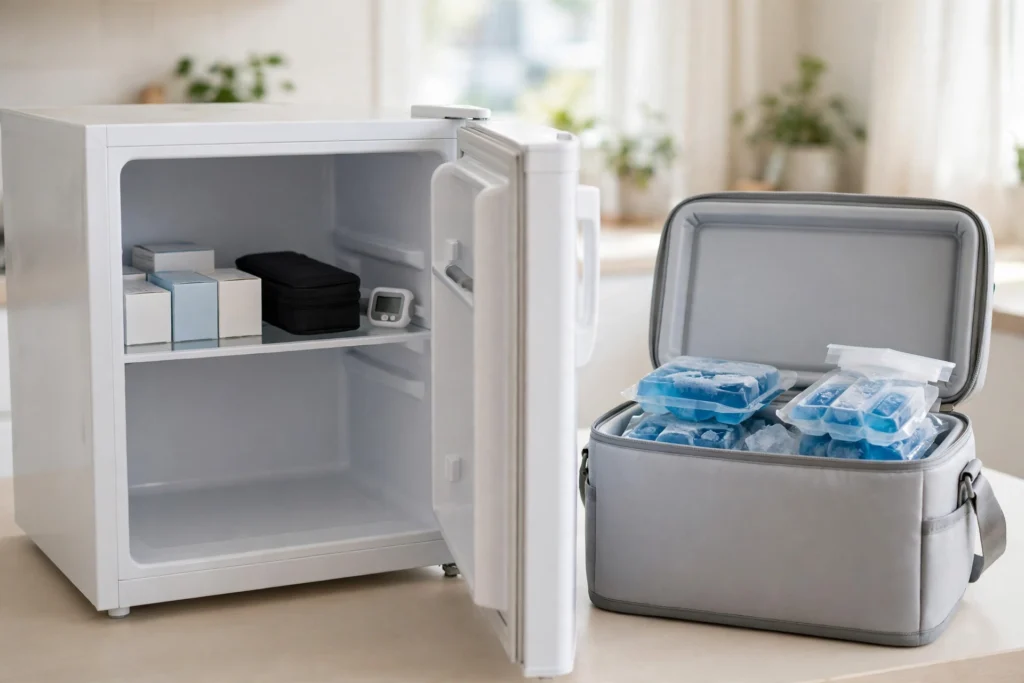
Hours 0–4: the fridge is the plan. Door shut, thermometer inside if you have one, nothing to decide yet. Hours 4–24: two routes, and most households run both. Route one is the cooler protocol: medicine in a sealed container or its case, ice packs around it with a towel or cardboard barrier — direct contact with a frozen pack can freeze the medicine against it, which converts a save into a discard — and a thermometer in the cooler so “cold” is a number, not a hope. Route two is backup power: at roughly 150 watts running and about 1,200 watt-hours a day, the fridge is among the cheapest critical loads in the house; a 2,048Wh station carries it for about a day and a half, and a station-plus-generator rotation carries it indefinitely.
Day 2 and beyond: the question shifts from the fridge to the specific products. In-use insulin inside its room-temperature window is fine on the counter, counted from when it warmed, not from when the power died — write the date on the pen. Unopened stock stays on ice or power. And a pharmacy with power, a hospital, or a neighbour two streets over whose lights are on are all legitimate parts of a real plan: medicines are small, and a fridge shelf is an easy thing to lend.
What never to do
Never freeze medicine deliberately to “keep it longer” — freezing damages insulin and many biologics irreversibly. Never store it against dry ice (far below freezing, same damage, faster). Never judge by looking: insulin that has been heat-damaged or frozen may look normal — a pen that was frozen can show clumping or frosting in the cartridge, and those are discard signs, but a clear appearance is not a safety certificate. And never stretch a doubtful supply silently: pharmacists replace outage-damaged medicine routinely, insurers and makers have replacement programmes, and the conversation is a normal one they have weekly.
The kit to assemble now
A small hard cooler that lives near the fridge. Two or four ice packs that live in the freezer, always frozen. A minimum-maximum fridge thermometer — knowing the coldest and warmest the box reached answers questions a spot reading cannot. A written card, taped inside a cupboard door, listing each refrigerated medicine in the house, its window, and its discard rule, copied from its leaflet. That card is this entire page, personalised — and making it is a fifteen-minute job on a quiet evening.
Powering the fridge shelf past hour four
The cooler-and-ice-packs route above is the no-cost plan. The powered route is smaller than most people expect: a fridge draws about 1,200 watt-hours a day, so a 2,000Wh-class station holds the medicine shelf at temperature for well over a day, and longer if it only runs the fridge. The stations we have already scored for medical loads are the Bluetti Elite 200 V2 (2,073.6Wh — the longest bridge here) and the Anker SOLIX C1000 (about a day on a fridge — a bridge to the cooler plan, not a replacement for it). No prices are printed here because they move; the links show today’s figure. A station is a temperature plan, not a medical decision — your product’s leaflet and your pharmacist still rule on the medicine itself.
Relevant pickAnker SOLIX C1000
About a day on a fridge — a bridge to the cooler plan, not a replacement for it.
Bridge to the cooler plan
Your next step: see the fridge runtime worked in full on our power station runtime page for CPAP, fridge and freezer, and if oxygen is also in the house, read how long a power station runs an oxygen concentrator — the two loads together change the size you need.
Fridge runtime on backup power (at 1,200 watt-hours a day and about 85% of rated capacity delivered): 1,056 Wh station — about 17 hours · 2,048 Wh station — about 35 hours.
The boundary: A station is a temperature plan, not a medical decision — the product leaflet and your pharmacist rule on the medicine itself.
Follow-up questions
How long will a power station run the fridge for medicine?
At 1,200 watt-hours a day and about 85% of rated capacity delivered, a 1,056Wh station covers roughly 17 hours of fridge; a 2,048Wh station, about a day and a half; either, rotated with a generator or solar by day, covers the outage. The full runtime method is in our power-station runtime page.
What about other devices — CPAP, oxygen?
Same house, different math, covered in their own pages in this cluster: CPAP runtimes in our runtime guide, and concentrator planning — watts, tanks, and utility priority-restoration lists — in the oxygen concentrator page.
Can I use the car fridge or a 12V cooler?
A powered cooler that holds a verified 36–46°F is a valid route and a gentle load; a cheap thermoelectric cooler that only promises “below ambient” is not verifiable enough for medicine unless your thermometer proves its actual temperature. Measure, then trust.
Frequently asked questions
My insulin got warm. Who decides if it is still good?
The product’s leaflet states the rated limits; your pharmacist applies them to your situation and is the right call to make — they can also contact the manufacturer, several of which will assess a specific exposure and replace product that is out of specification. Do not make the decision alone and anxious when a professional makes it daily.
Should I keep a spare supply for outages?
Many clinicians advise an emergency buffer where the prescription allows it, and disaster guidance for people with diabetes commonly recommends keeping extra supplies and a written medication list with your kit. That is a conversation for your care team — raise it at the next ordinary appointment, not during the storm.
Does the 4-hour fridge rule apply to the medicine shelf specifically?
The 4-hour figure is the food-safety guidance for a closed fridge; medicines follow their own leaflets, and many tolerate longer excursions. Plan conservatively with the 4-hour move-to-cooler trigger and let the leaflets, not hope, grant any extra time.
The bottom line
Know each product’s window, keep the door shut for the first hours, move to a barriered cooler or a station after that, never let anything freeze, and write the plan on a card before the weather writes it for you.
The full set is at What People Are Asking About Medical Backup Power, and the runtime method is at How Long Will a Power Station Run Your CPAP, Fridge, or Freezer?
Talk it over with other homeowners
The Ordinary Prepper Community on Facebook is where readers compare outage plans, show their setups, and help decide what we test next.