As an Amazon Associate, Ordinary Prepper earns from qualifying purchases.
Home Readiness — Guide
How Much Cash Should I Keep at Home for Emergencies?
Short answer: For most US households, $300 in small bills covers three days of essential spending if card payments fail, and $500 covers a full week. That is not a round-number guess: it is where you land when you convert what European governments now tell their own households — the Netherlands says €70 (about $78) per adult — and price out three days of groceries, fuel, and pharmacy runs at home. American guidance never does this math. Ready.gov tells you to keep “a small amount of cash at home” in “small bills” and leaves the amount blank. This page fills in the blank, then deals with the question the amount creates: where it should live.
How we researched this comparison
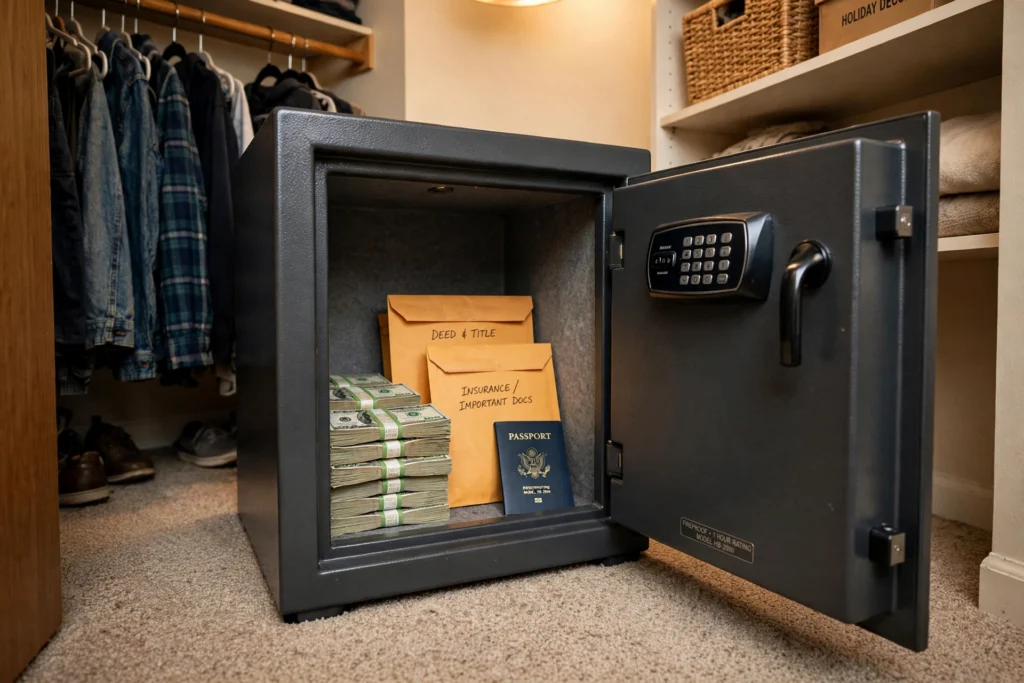
We scored 3 products for this page — the three layers a cash stash can live in: a full fire-and-water safe, a small fire chest, and a lockable document bag. The amounts themselves rest on published official guidance: the Netherlands, European Central Bank, Swedish, German, and UK figures are laid out on the page. The picks rest on their certifications — the UL and ETL ratings quoted exactly in each card — and on the owner record named there. No prices are printed on this page: we could not verify a same-day price we trusted for these picks, so the cards carry scores and links only. We never claim hands-on testing, and affiliate commissions are checked only after scores are set — the full method, with the scoring weights, is on our how we research and score page.
SentrySafe SFW123GDC
UL Classified for one hour at 1,700°F and ETL Verified for 24 hours in up to 8 inches of water — the strongest verified fire-and-water pairing in its class. At 1.23 cubic feet it takes the cash, the documents, and a backup drive, and it bolts down. The notes that repeat across its 4.4-star owner average: it weighs about 90 pounds, so plan its home before it arrives, and fire safes trap humidity, so a desiccant pack inside is standard practice.
SentrySafe 1200 Fire Chest
UL Classified for 30 minutes at 1,550°F, sized for a flat stack of bills and the passports, with a handle for a grab-and-go exit. Its 4.7-star average across more than 15,000 ratings is the deepest owner base of any pick here. Its limit is plain: it is not waterproof. Treat it as the starter layer, not the whole plan.
ROLOWAY Fireproof Document Bag with Lock
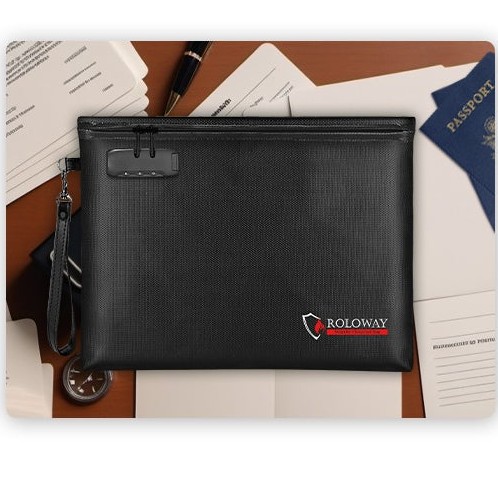
Photo: ROLOWAY.
A big flat bag: documents go in unbent, the zipper locks, and divided pockets keep denominations and papers apart. One honesty note — its 5,200°F figure is the maker’s material rating, not a UL safe certification, and no bag is a safe. As the organizing layer inside a chest or safe, or as the thing you grab, it earns its place; alone on a closet floor it is a partial answer.
If you buy through a link in this section, we may earn a commission from the seller. It never costs you extra, and it never changes a score.
What other countries actually tell their households
Since late 2024, Western governments have been putting numbers on this. The amounts differ; the reasoning does not — every one of them is planning around electronic payments failing, not around banks failing.
Official cash guidance per person, in dollars
The figures governments publish, at the conversions printed on this page. The ECB advises a €70–€100 range per person; Ready.gov gives no figure at all. Guidance amounts, not prices.
| Authority | Cash guidance | What it covers |
|---|---|---|
| Netherlands — central bank (2025) | €70 (about $78) per adult, plus €30 (about $33) per child | 72 hours of failed card payments |
| European Central Bank (2025) | €70–€100 (about $78–$111) per person | About 72 hours of essentials |
| Sweden — civil defence & Riksbank (2024–2026) | Cash for at least a week; SEK 1,000 (about $101) per adult is the benchmark | A week of essential purchases |
| Austria — central bank | About €100 (about $111) per household member, in a safe place | Payment failure, small bills |
| United States — Ready.gov | “A small amount of cash” — no figure given | Unstated |
Two follow-ups are worth knowing. The Dutch central bank surveyed households in February 2026 and found 58% actually keep the advised amount — a specific number gets acted on in a way “a small amount” never does. And in the US, a July 2025 SafeHome survey of 1,200 adults found only 30% of households have what they consider sufficient emergency cash, with cost the most-cited barrier. Both facts point the same way: the advice works when it is a number, and the number has to be buildable.
SentrySafe SFW123GDC
Why this one: The home base for the whole stash: the strongest verified fire-and-water pairing in its class — UL Classified for one hour at 1,700°F and ETL Verified for 24 hours in up to 8 inches of water. At 1.23 cubic feet it takes the cash, the documents, and a backup drive.
The math: what a cash-only day costs a household
When cards are down you are not funding your normal life. You are funding a short list: groceries for simple meals, fuel, a pharmacy run, ice, batteries. For a household of four that list runs roughly $75 a day — about $45–60 of groceries, $15–20 of fuel averaged across days, $10 of everything else. Singles and couples land lower, around $40–50.
| Household | 3 days (the Dutch window) | 1 week (the Swedish window) |
|---|---|---|
| 1 adult | ~$150 | ~$300 |
| 2 adults | ~$200 | ~$400 |
| 2 adults, 2 kids | ~$250–300 | ~$500 |
Built per person, the way the Dutch framed it, the three-day floor is about $75–100 per adult and $35–40 per child — close to their €70 (about $78) and €30 (about $33) once converted. So: $300 is the working target for most households, $500 is the comfortable one, and anything is better than the current national average of meaning to get around to it. Build it gradually, which is the Dutch advice too — $20–40 in small bills a week reaches $300 in about two months. Which bills, exactly, is its own question, and we gave it its own page: what denominations emergency cash should be in.
One week of essential cash spending
The Swedish window: a full week with cards down.
For three days — the Dutch window — the same households land at about $150, $200 and $250–300. So $300 is the working target for most households, and $500 is the comfortable one.
Where the cash should live
Ready.gov’s one specific instruction is “in a safe place,” and FEMA’s financial first-aid guidance adds the container detail: documents belong in a fireproof, waterproof container. Cash deserves the same logic, because the two events most likely to separate you from it are a house fire and the water that puts the fire out. That is the reasoning behind the picks above: verified fire ratings first (UL and ETL are independent certifications; a maker’s temperature claim is not), water protection second, and a lock third — a home safe is a fire box that also discourages a quick hand, not a bank vault.
Photo: ROLOWAY.
Two working rules. Split the stash: the bulk sits in the safe or chest; one day of spending — about $75 — rides in the bag where you can reach it without opening the whole reserve. And rotate it: spend a bill or two into normal circulation every month or two and replace them, which keeps the stash fresh and keeps you in the habit of using cash. Sweden’s Riksbank gives the same advice for the same reason — cash systems stay alive by being used.
Relevant pickROLOWAY Fireproof Document Bag
The grab-and-go layer from the picks above: a big flat bag where documents go in unbent and denominations stay apart — and the piece of the system that holds one day of spending, about $75, reachable without opening the whole reserve.
Grab-and-go layer · Locking zipper · Divided pockets
Follow-up questions
Should some of the stash be coins?
One roll of quarters — $10 — is the whole coin strategy. Quarters cover exact change, a laundromat, a vending machine, air for a tire. Dimes and nickels buy nothing quarters don’t, at several times the weight.
Does homeowners insurance cover cash stolen from a safe?
Barely. Standard policies cap the “money” category at a small sublimit — $200 is the common figure — no matter what the safe cost or how much was in it. Read your own policy’s money sublimit before the stash grows past it, and keep the framing straight: this stash is outage spending money, not savings. Savings belong in the bank.
Is this about banks failing?
No, and nothing in the official guidance behind these numbers is either. Every worked example is a payments failure: the April 2025 Iberian blackout left shops cash-only for a day, and the July 2024 CrowdStrike outage did the same to scattered US stores in an afternoon. The fragile part is the card network and the power behind it — which is also why cash sits inside our wider outage plan, the six problems every house has to solve when the power goes out.
Frequently asked questions
How much cash should a single person keep?
About $150 for the three-day window, $300 for the week, by the same math — one adult’s essentials run $40–50 a day when cards are down.
How fast do I need to build this?
Gradually is both the official Dutch advice and the realistic one. Small bills pulled from normal spending — $20–40 a week — get most households to the $300 mark in about two months without the stash ever competing with a bill.
Where shouldn’t it live?
Not all in one place, and not in the spots a thief checks in the first two minutes — the top dresser drawer, the nightstand, the desk. A heavy or bolted-down fire safe in an unremarkable spot beats a clever hiding place, because the likelier enemy is fire, not burglary, and fire checks every hiding place.
The verdict
The US is the outlier in this story: every comparable government now names an amount, and ours names none. The number the evidence supports is $300 in small bills for three days, $500 if you want Sweden’s full week — kept somewhere that survives fire and water, split between a safe place and a grab-and-go layer, and rotated often enough that it stays real money instead of a museum exhibit.
The full set is at What People Are Asking About Outage Living, and the companion page works out which denominations the stash should be in.
Talk it over with other homeowners
The Ordinary Prepper Community on Facebook is where readers compare outage plans, show their setups, and help decide what we test next.