
As an Amazon Associate, Ordinary Prepper earns from qualifying purchases. Prices last checked October 28, 2026.
Home Readiness — Guide
How to Stop a Standby Generator Running Through a Planned Outage
Short answer: On most standby generators the sequence is: find the controller (on the unit or its app), set the mode from AUTO to OFF before the planned outage begins, and — on many models — also switch the generator’s own breaker or the service disconnect so the exercise cycle does not surprise you. Leave it in OFF until the utility’s window passes, then return it to AUTO and confirm the controller shows it. What you save is real: a standby at typical house load drinks roughly 1.5–2.5 gallons of propane an hour, so sitting out an 8-hour planned outage saves 12–20 gallons — most of a standard tank’s usable margin. But sit out the right outages: if the house has a sump pump in a wet season, medical equipment, or pipes at risk in deep cold, the generator earning its propane is the correct answer, and this page is about the other nights.
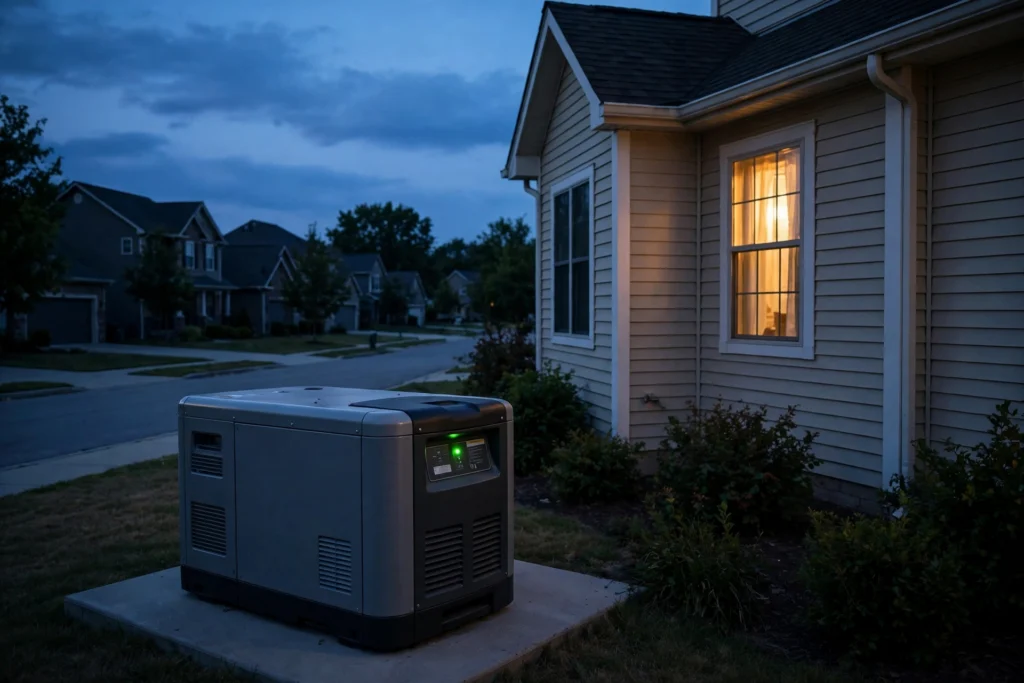
The sequence, by brand family
| Brand family | Where the control lives | The sit-out move |
|---|---|---|
| Generac (Evolution controller) | Controller on the unit; Mobile Link app | Set mode to OFF; back to AUTO after |
| Kohler | Controller on the unit; OnCue app | Set to OFF / disable auto start |
| Cummins | Controller on the unit; app on newer units | Set mode to OFF (not just stop) |
| Briggs & Stratton | Controller / transfer-switch interface | Set system to OFF per manual |
Your manual’s wording outranks this table — models differ, and the important distinction is universal: Stop halts a running engine now and usually returns to automatic behaviour; Off (or disabling auto-start) tells the system to stay out of the coming event entirely. You want the second, set before the utility’s stated start time, because a transfer switch that senses the outage before you act will simply start the machine again. Some owners also open the generator’s output breaker for belt and braces; if your manual blesses that step, fine — if it is silent, the controller’s OFF is the supported move and is enough.
1 — Find the controller: On the unit itself, or in its app — that is where the mode lives.
2 — AUTO to OFF, early: Set the mode from AUTO to OFF before the utility’s stated start time, with an hour of margin.
3 — The belt-and-braces step: Some owners also open the generator’s output breaker — only if the manual blesses that step; the controller’s OFF alone is the supported move.
4 — Return it to AUTO: After the stated end plus a margin: back to AUTO, and watch the controller acknowledge it.
5 — Set the reminder first: A phone reminder for the announced end time, set before you touch the controller.
What sitting out actually saves
Standby fuel math is the part nobody does at purchase time. A 20 kW-class standby burns roughly 2–2.5 gallons of propane per hour at half load and about 1.5 at quarter load; natural gas models burn their equivalent in cubic feet you will see on the next bill. Over an 8-hour planned overnight outage: 12–20 gallons of propane, which against a 250-gallon tank filled to its 80% working level (200 usable gallons, shared with nothing else in many homes) is a tenth of the reserve — spent on an outage the utility announced, on a mild night, for a house that would have slept through it in the dark. Sit out four announced outages a year and the arithmetic becomes a tank refill you do not buy.
What sitting out an 8-hour outage saves: At quarter load, about 12 gallons of propane not burned; at half load, about 20 gallons.
The burn rate: A 20 kW-class standby burns roughly 1.5 gallons of propane an hour at quarter load and about 2–2.5 at half load. Sit out four announced outages a year and the arithmetic becomes a tank refill you do not buy.
When sitting it out is the wrong call
Three loads veto the plan, and they outrank thrift. A sump pump in a wet week — the pit does not know the outage was announced, and a basement flood costs more than a decade of propane. Medical equipment — oxygen concentrators and their kin are why standbys exist; if the house is on the utility’s priority list, let the machine do its job. Deep cold with pipes at risk — a furnace that never fires is a burst-pipe lottery ticket, and our freeze-protection pages price that outcome at up to 250 gallons of water a day from an eighth-inch crack. Add a fourth, quietly: if nobody will be home to notice a problem, automatic is the point of the machine. The sit-out plan is for mild, announced, somebody-home nights — which happen to be a large share of planned outages.
The restart half, which people forget
The most common ending to this story is not a flooded basement; it is a generator discovered in OFF three weeks later, during the unannounced outage it was bought for. So the sequence ends with rituals: return the controller to AUTO when the utility window closes, watch it acknowledge, and put a note where future-you will see it — many owners set a phone reminder for the announced end time before they touch the controller. If your unit has an app, it will usually tell you the current mode from the couch; checking it there the next morning is the cheapest insurance in this whole series.
If you sit this one out, check these loads first
Sitting out a planned outage is only the right call for the loads this house can pause. Before the utility’s window starts, walk the three that cannot: the sump pump, if the pit is wet — our sump pump battery backup page works the duty-cycle math and the stations that carry one; the furnace blower in cold weather — a power station runs a furnace blower for hours, which is the cheap way to keep pipes safe while the standby sits silent; and any refrigerated medicine — the insulin and fridge-medicine plan has the temperature windows and the hour-four move. If any of those three has no non-generator answer tonight, the generator earning its propane is the correct answer, and this page’s sequence is for another night.
The sump pump: If the pit is wet, it needs its own answer tonight: battery backup sized by its duty cycle.
The furnace blower: In cold weather a power station runs a blower for hours — the cheap way to keep pipes safe while the standby sits silent.
Refrigerated medicine: The temperature windows and the hour-four move decide whether the fridge’s contents ride out the night.
The restart check: Back in AUTO, confirmed on the controller — and if the unit has an app, check the mode from the couch the next morning.
Follow-up questions
Will turning it off upset the weekly exercise cycle?
No — the exercise schedule resumes when the unit returns to AUTO. A missed exercise during a planned outage is a non-event for a maintained machine; the battery is the thing to keep an eye on if OFF stretches into weeks, which this plan never intends.
Can I just shut the gas valve instead?
Do not improvise with the fuel supply: a generator commanded to start without fuel cranks, faults, and logs errors, and gas valves are not mode switches. The controller’s OFF exists precisely for this; use the control the maker built.
The tank: A standard 250-gallon propane tank, filled to 80%: about 200 usable gallons, shared with nothing else in many homes.
One sit-out: 12–20 gallons not burned on an outage the utility announced, on a mild night.
The gas-valve warning: Never improvise with the fuel supply instead: a generator commanded to start without fuel cranks, faults, and logs errors.
The utility says “overnight” — when exactly do I act?
Set OFF before the stated start of the window, and set AUTO after the stated end plus a margin — utilities restore in stages and a flicker at the boundary can trigger a start-stop cycle you did not want either. An hour of margin on both ends is the calm version.
Frequently asked questions
Does sitting out an outage void anything?
No — OFF is a manufacturer-supported operating mode, documented in your manual for exactly this purpose (and for service). What voids warranties is defeating safety controls, which this is not.
Will the transfer switch do anything odd while the generator is off?
It will sense the outage and wait for a generator that never starts — which is the design intent of the OFF mode — and it will restore the house to utility power the moment it returns. No manual step at the switch is normally required.
My generator started anyway. What happened?
Usually one of two things: the mode was set to Stop rather than Off, or the outage began before the change took effect and the controller’s start delay logic completed. Set it earlier next time, in OFF, and verify the display says so — the acknowledgment is part of the sequence.
The bottom line
AUTO is the right default and OFF is the right tool for an announced, mild, occupied night: controller to OFF before the window, AUTO after it, reminder set, sump-medical-pipes vetoes checked first. The propane you do not burn is the cheapest backup power there is.
The full set is at What People Are Asking About Home Generators, and the fuel math behind this page is at Generator Fuel: Burn Per Day, How Much to Store.
Talk it over with other homeowners
The Ordinary Prepper Community on Facebook is where readers compare outage plans, show their setups, and help decide what we test next.