As an Amazon Associate, Ordinary Prepper earns from qualifying purchases.
Home Readiness — Guide
What Should Be in a 72-Hour Emergency Kit for a Family of 4?
Short answer: For a family of four, a 72-hour kit is mostly arithmetic: 12 gallons of water, about 24,000 calories of food that needs no fridge and little or no cooking — 36 simple meals — plus light for the rooms you will actually sit in, a weather radio, phone charging, a first aid kit with three days of everyone’s medicines, sanitation basics, a blanket for each person, copies of your documents, and $300 in small bills. Almost all of it fits in one or two storage bins in a closet, and most families already own half of it scattered around the house.
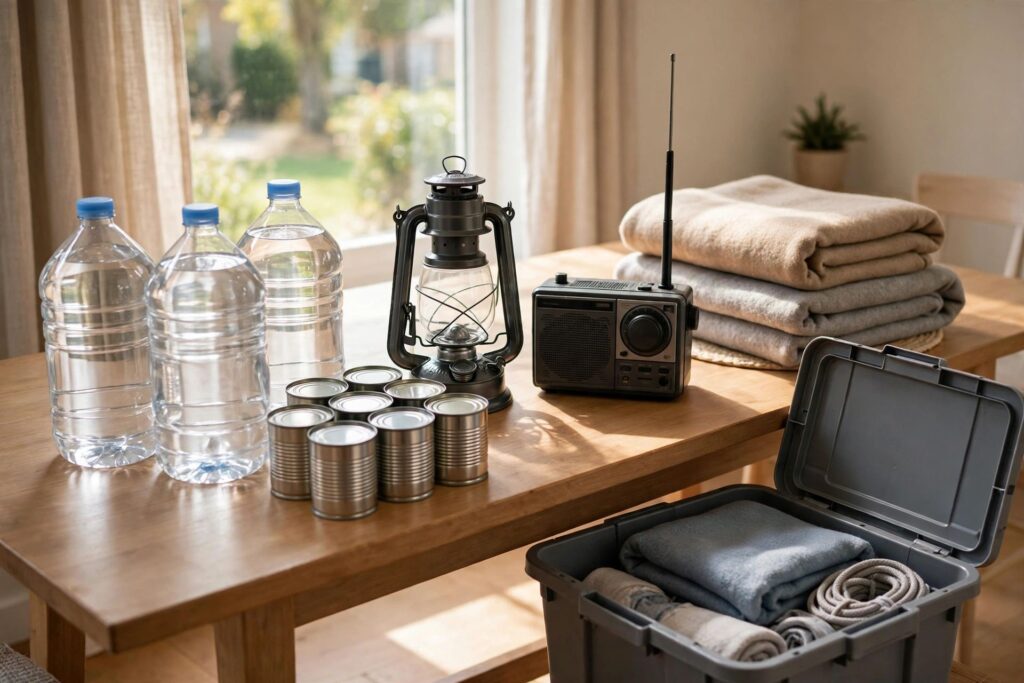
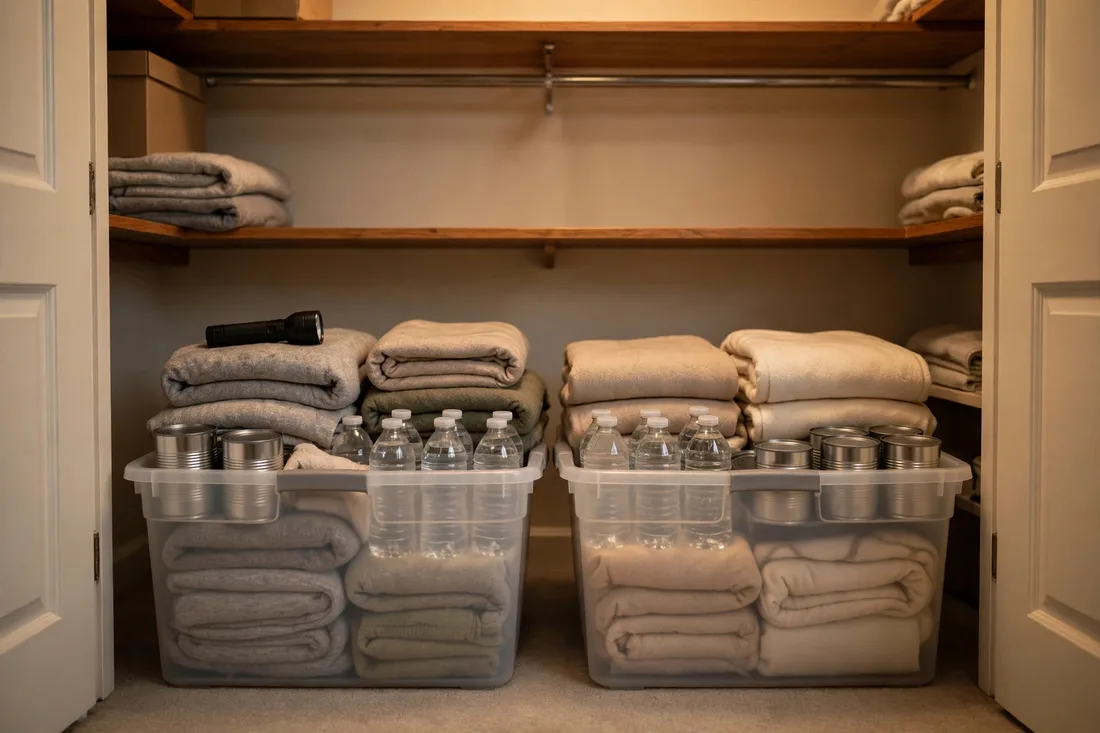
The whole kit, counted for four people and three days
Every number below comes from the same plain figures the official lists use: one gallon of water per person per day from Ready.gov, and about 2,000 calories per person per day — the planning figure our priced-out pantry page works with. Multiply by four people and three days and the kit stops being a shopping category and becomes a short list.
| Item | For 4 people, 3 days | Notes |
|---|---|---|
| Water | 12 gallons | Drinking and basic sanitation; pets are extra |
| Food | 24,000 calories — 36 meals | No fridge, little or no cooking |
| Light | 1 main lantern + 1 light per bedroom | Plus spare batteries beside each one |
| Information | 1 NOAA weather radio | Programmed for your county |
| Phone power | 1 large power bank | Several full phone charges |
| Medicines | 3+ days per person | Plus a basic first aid kit |
| Warmth | 1 blanket or sleeping bag each | 4 sets, one per person |
| Cash | $300 in small bills | See the cash pages below |
Anker PowerCore 20000 PD
Why this one: the row beside this card asks for one large bank and several full charges. This is the bank in this page’s own kit list — phone charges measured in days, not hours.
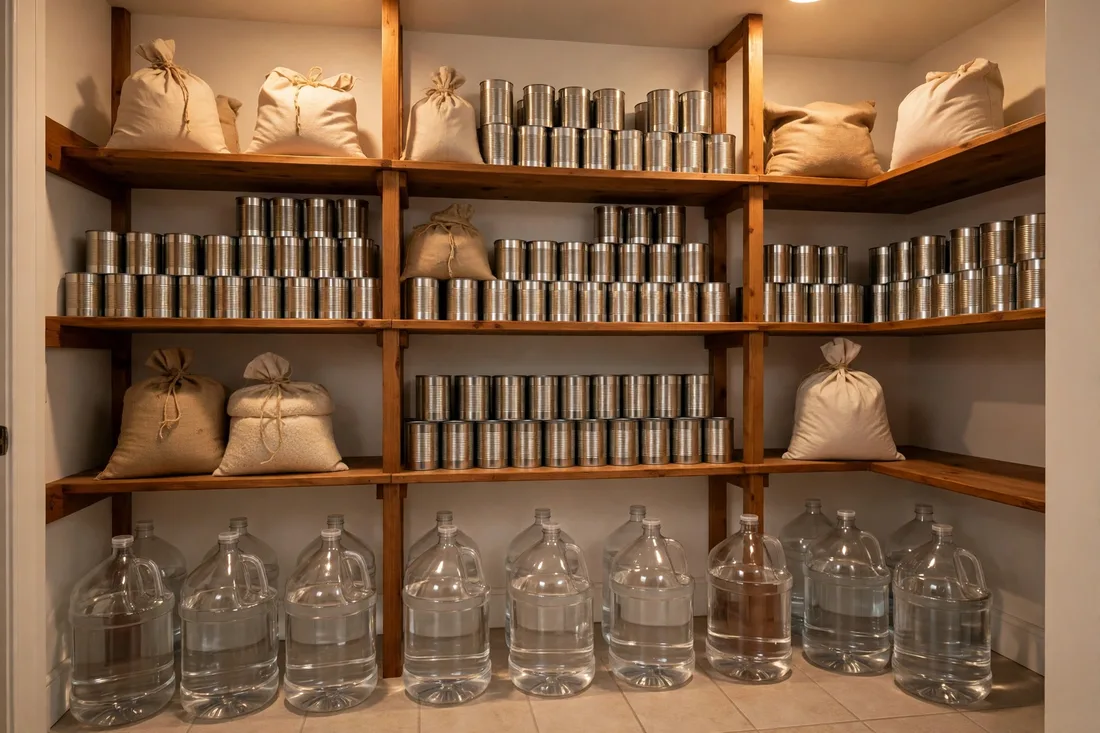
Twelve gallons sounds like a lot until it is on the floor: two cases of bottled water and a couple of jugs, or two of the stackable containers from our water storage comparison. Our water storage calculator runs the same multiplication for any household size — add a pet and it adds the pet’s share, because the one-gallon figure covers people only.
Goal Zero Lighthouse 600 Lantern
Why this one: the count above gives the kit one main lantern for the room everyone gathers in, and this is the lantern the buy list further down lands on. On low — the setting an outage actually uses — Goal Zero rates one charge at 320 hours; if it ever does run down, a minute of hand-cranking buys ten more minutes of light.
Water and food: the two lines that decide the three days
Water is the line families underbuy, because a gallon a day is more than anyone pictures drinking. It is not all drinking: it is drinking, a little cooking, brushing teeth, and the most basic washing, for four people. You cannot stretch it the way you can stretch snacks, so it goes in first and in full — 12 gallons stored, in a cool, dark place, in food-grade containers or unopened bottled water. If you fill your own containers, replace the water about every six months; write the month on tape on the lid so nobody has to guess later.
Water and food: the two deciding lines — water cannot be stretched the way snacks can; it goes in first and in full
The water math — 1 gallon per person per day × 4 people × 3 days = 12 gallons: drinking, a little cooking, brushing teeth, basic washing
Storing it — a cool, dark place, in food-grade containers or unopened bottled water; if you fill your own, replace about every six months and write the month on tape on the lid
The food math — about 2,000 calories per person per day × 4 × 3 = 24,000 calories = 36 meals
What works — food that needs no refrigeration and little or no cooking, a manual can opener, and paper plates and cups that save drinking water from washing up
Food is the easier line, because 24,000 calories is ordinary food, not special food. Three meals a day for four people for three days is 36 meals, and the meals that work need no refrigeration and little or no cooking: canned meats, beans and vegetables, peanut butter, crackers, dried fruit and nuts, cereal bars, shelf-stable milk. Add a manual can opener — an electric one is furniture in an outage — and paper plates and cups, which save drinking water that would otherwise go to washing up. Buy food your family already eats and rotate it through the kitchen; a kit nobody will eat is a donation with extra steps.
Sized for two adults and two kids
Most families of four are two adults and two children, and the sizing barely moves — which surprises people. Water stays at 12 gallons: children drink less, but the sanitation share does not shrink, and hot weather pushes everyone’s need up, not down. Food stays near 24,000 calories for the same reason; younger children eat smaller meals, older ones eat adult ones, and the planning figure absorbs both. What does change is the edges of the kit: formula and diapers if there is a baby (ready-to-feed formula, because safe water for mixing may be scarce), a comfort item and something to do for each child — books, cards, a game — and any child’s daily medicine counted first, before the general first aid kit. Put each child’s small things in their own pouch inside the main bin, so a grab-and-go moment does not become a sorting exercise.
Two adults, two kids: what actually changes — the sizing barely moves, which surprises people
The totals stay — water stays at 12 gallons; food stays near 24,000 calories
If there is a baby — ready-to-feed formula, diapers
For each child — a comfort item, something to do
Each child’s own pouch — their small things inside the main bin, daily medicine counted first
Children drink less — the sanitation share does not shrink, and heat pushes needs up.
Light, information, and phones
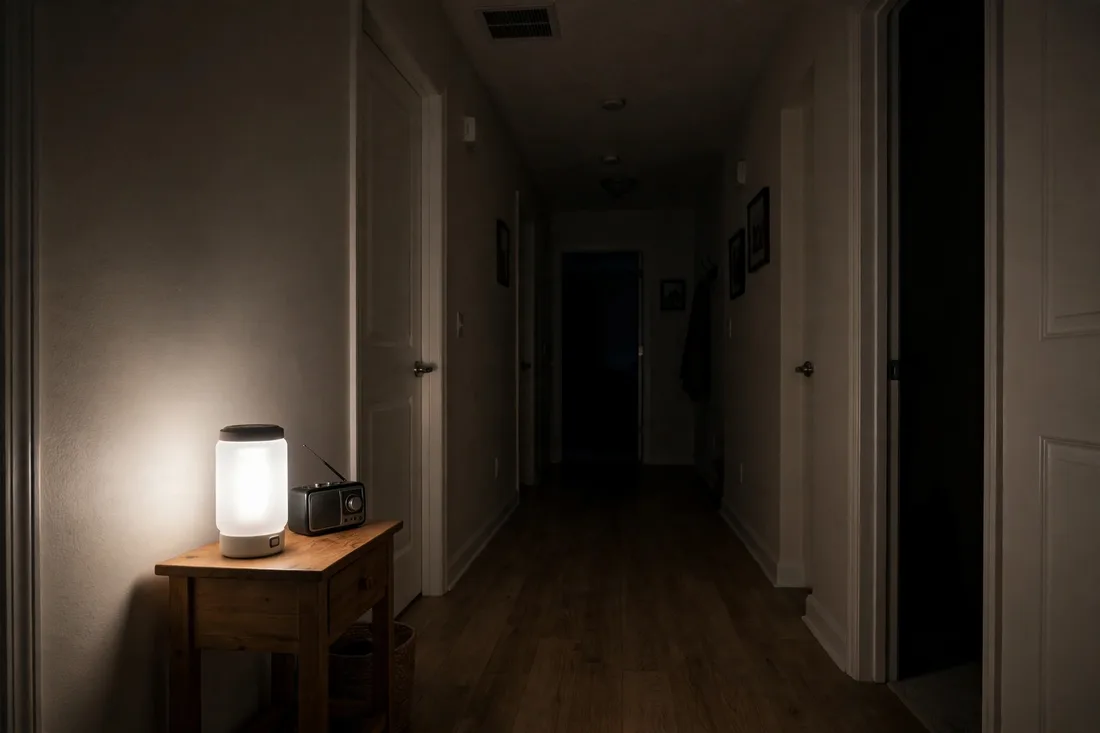
Darkness is what turns a manageable outage into a miserable one, and it is the cheapest problem in the kit to fix. The working pattern from our outage lighting comparison is layers, not one hero lantern: one real lantern for the room everyone gathers in, a plain light in each bedroom and the bathroom, and spare batteries stored beside each one. A battery or hand-crank weather radio is the information layer — it is how the house learns whether the storm has passed and whether the water is safe when phones and internet are down.
Relevant pickMidland WR120B Weather Radio
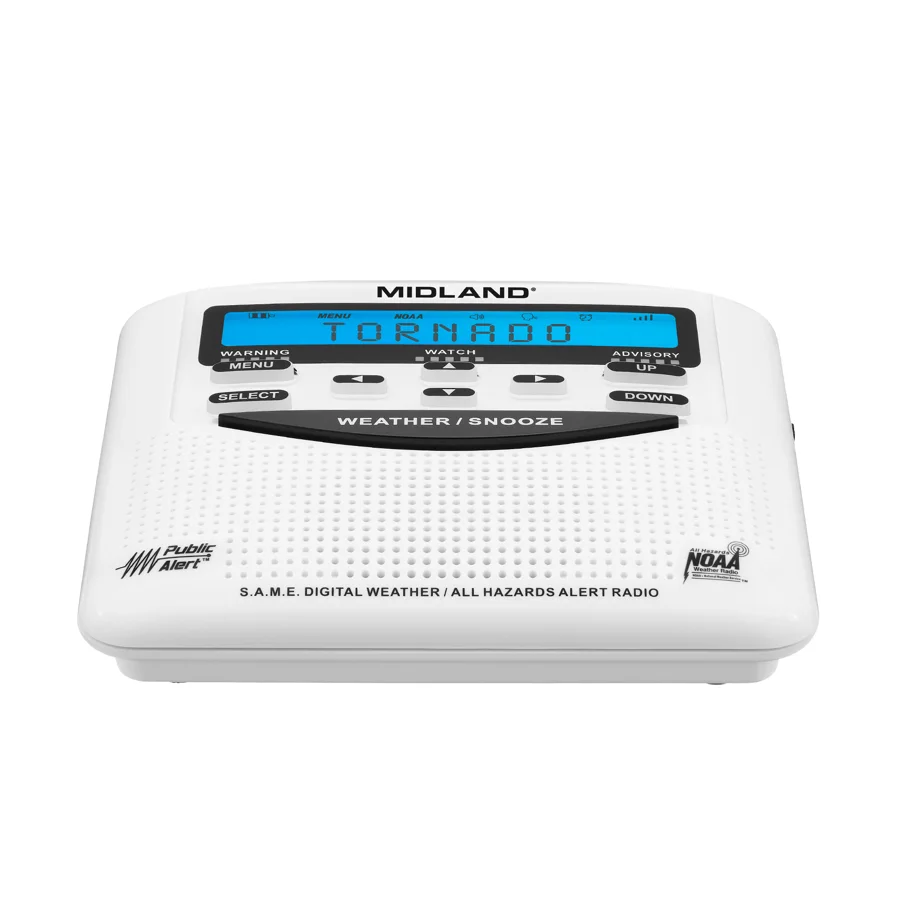
Photo: Midland
The information layer from this section, in one box: it sounds the alarm for your county’s warnings even while the house sleeps and the phones sit dark.
S.A.M.E. county alerts · 90 dB siren · 3 AA battery backup
Phones get one shared charging plan: low-power mode, one charging window a day, and texts instead of calls, because texts slip through a congested network that voice calls cannot.
Health, sanitation, warmth, and the paper layer
The unglamorous half of the kit is the half that keeps small problems small. A basic first aid kit, at least three days of each person’s prescription medicines, and an extra pair of glasses for anyone who wears them. Moist towelettes, garbage bags and plastic ties for personal sanitation — the exact items Ready.gov lists — plus soap, hand sanitizer, and toilet paper. A blanket or sleeping bag for each person and a change of clothing, because a house without heat cools faster than people expect; our freeze protection page covers what that cooling does to the pipes while you are keeping the people warm. And the paper layer: copies of insurance policies, identification, and bank details in a waterproof pouch, a written list of family contacts with one out-of-area person everyone checks in with, and cash — $300 in small bills covers three days of essential spending if card machines are down, split the way our denominations page works out, mostly fives and ones, nothing over a twenty.
The unglamorous half of the kit — the half that keeps small problems small
Health — first aid, 3+ days of medicines
Sanitation — towelettes, bags + ties, soap (the Ready.gov list: towelettes, garbage bags and plastic ties)
Warmth — a blanket or bag each, spare clothes
The paper layer — copies in a waterproof pouch: insurance, ID, bank details, the contacts list, $300 in small bills
The four bought items, if you buy anything
This kit is a gathering exercise before it is a shopping one — water, food, blankets, and documents are already in most houses. If money gets spent, four items do most of the work, and they are the same four our no-generator playbook carries, linked there and here rather than replaced with a competing set: the Goal Zero Lighthouse 600 lantern for the room everyone lives in (its low setting is rated in hundreds of hours, which is the setting an outage actually uses), the Midland WR120B weather radio for warnings and news, an Anker PowerCore 20000 power bank for phone charges measured in days, and Millennium energy bars for the no-cook shelf. No prices are printed here because they move; the links show today’s figure.
Prices last checked: October 30, 2026.
Where it lives, and keeping it honest
Store the kit in one or two easy-to-carry bins in one place everyone in the house can find in the dark — a closet, not four rooms. Then maintain it like a smoke alarm battery, on a schedule instead of a resolution: check it twice a year, swap the stored water about every six months, eat down and replace the food before its dates, test the lantern and radio, and re-count the medicines after any prescription changes. The household emergency checklist is this same kit as a tick-off list sized to your household, and the room-by-room readiness audit will tell you which line your house is shortest on. Three days covered completely is worth more than two weeks covered in theory — and once these 12 gallons and 36 meals exist, stretching toward two weeks is a pantry habit, not another project, as our duration page lays out.
Where it lives, and the upkeep rhythm — maintained like a smoke-alarm battery: on a schedule, not a resolution
One place, findable in the dark — one or two easy-to-carry bins, a closet, not four rooms
Twice a year — the full check
Every ~6 months — swap the stored water
Before the dates — eat down and replace food
Test it, re-count it — lantern and radio tested; medicines re-counted after any prescription change
Follow-up questions
Does a 72-hour kit have to be a backpack?
No. A backpack is the evacuation version — the bag you carry out the door. The family-of-four kit on this page is the stay-home version: 12 gallons of water alone weighs about 100 pounds, and it is meant to live in a bin where the house can reach it, not on anyone’s back. Keep a smaller go-bag by the door if leaving is a real scenario in your area; do not shrink the home kit to fit a bag.
How much does the water weigh, and where can it go?
Water weighs about 8.3 pounds a gallon, so 12 gallons is about 100 pounds — spread it rather than stacking it all in one spot: cases on a closet floor, jugs under a bed, containers on a garage slab. Upper-floor shelves and weak flooring are the places to avoid, and a cool, dark spot keeps it tasting like water.
How much the water weighs
Water weighs about 8.3 pounds a gallon — the full 12 gallons is about 100 pounds.
What do pets add to the kit?
Pets are extra on every line: extra water on top of the 12 gallons (the one-gallon figure is per person), three days of their food, and their medicines, leash, and carrier in the same bin logic as the children’s pouches. Count them when you size the kit, not when the storm is named.
How is this different from a deep pantry?
Depth and purpose. This kit is three days, counted exactly, stored together, and meant to be complete on its own. A deep pantry is the weeks-long layer behind it — ordinary groceries bought a little deep and rotated — and our first-30-days pantry page prices that layer out. Build the kit first; it is finished in a weekend. The pantry grows behind it at grocery speed.
Frequently asked questions
Is 72 hours really enough?
For most outages, yes — power and water restoration after US storms is usually measured in one to four days, and 72 hours is the window every major household guide plans around. It is the floor, not the ceiling: households where isolation is realistic — rural roads, island or earthquake country, a medicine that cannot miss — should build on toward two weeks once the three days are complete.
What is the single most forgotten item?
The manual can opener, closely followed by the spare batteries stored beside the lantern instead of in a different drawer. Both fail the same way: the kit is complete on paper and incomplete at 9 p.m. on the first night. Walk the kit once with the lights off and both gaps show themselves.
Can I build this kit gradually?
Yes, and most families should: one case of water per grocery trip reaches 12 gallons in a few weeks, and the food line is ordinary shopping bought slightly deep. Water first, then food, then light and the radio — in the order things run out.
The bottom line
A 72-hour kit for a family of four is 12 gallons of water, 36 meals nobody has to cook, light in the rooms that matter, a radio, charged phones, medicines, blankets, documents, and $300 in small bills — in two bins, in one closet, checked twice a year. It is not a product and it is not a hobby. It is a weekend of gathering what the house mostly owns already, counted honestly, and it is the floor every official list in the Western world now agrees on.
The full set is at What People Are Asking About Outage Living. The money half of this same kit is in how much cash to keep at home and what denominations it should be in.
Talk it over with other homeowners
The Ordinary Prepper Community on Facebook is where readers compare outage plans, show their setups, and help decide what we test next.