As an Amazon Associate, Ordinary Prepper earns from qualifying purchases. Prices last checked October 26, 2026.
Home Readiness — Guide
When the Power Goes Out: The Six Problems Every House Has to Solve
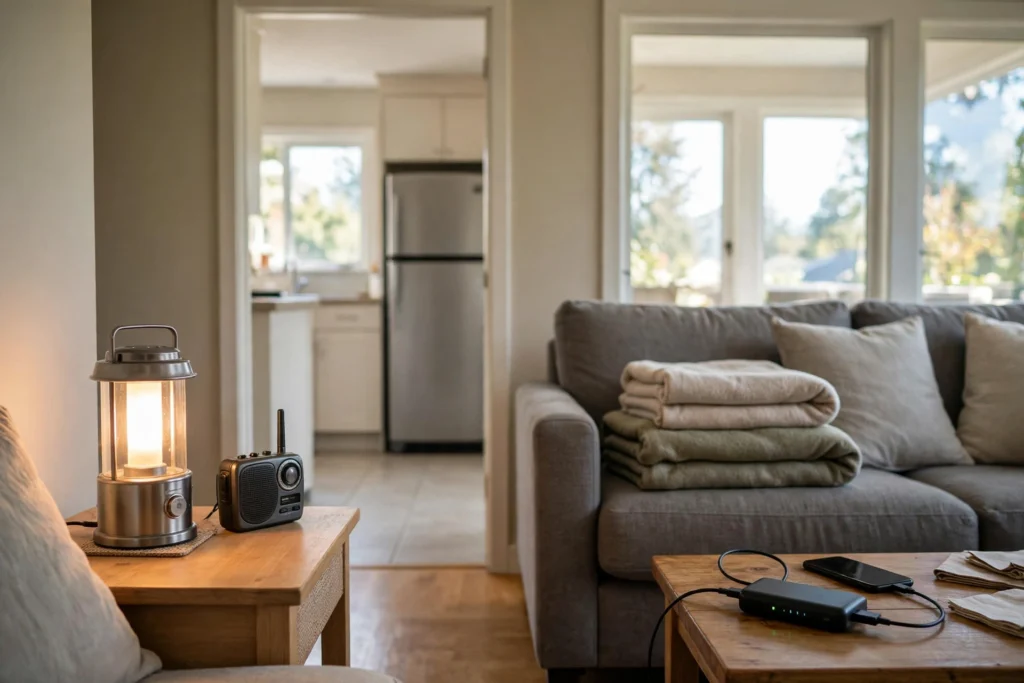
Short answer: a power outage is not one problem. It is six smaller problems arriving at the same time — food that warms up, a house that goes dark, phones that die, news that stops, small medical needs with no pharmacy run, and a toilet that will not flush. Houses that ride out an outage calmly are not the ones with the biggest battery. They are the ones that have a plain answer ready for each of the six, sized to the outage they actually get: for most homes that is hours to two days, not weeks. This page walks the six in the order they bite, with the review or the small purchase that answers each one. Nothing here needs doing today except reading it once and knowing which of the six your house fails.
| The problem | When it bites | The plain answer |
|---|---|---|
| Food and cooking | Hour 4 onward | Closed fridge, then no-cook food |
| Power | Hour 1 onward | Battery sized to fridge + medical first |
| Information | Immediately | A battery weather radio |
| Medical basics | Any time | An opened, dated first-aid kit |
| Sanitation and tools | Day one | Bucket toilet, extinguisher, bags |
| Water and staying put | Day one onward | Stored water + one warm room |
Prices last checked: October 26, 2026. This is a pillar guide, not a scored comparison — the scored reviews it points to carry their own prices and dates.
How do you keep food safe and still eat?
Food is the first problem because it runs on a clock you cannot pause. A closed refrigerator holds safe temperatures about 4 hours; a full freezer about 48 hours, a half-full one about 24. So the first answer is not cooking — it is leaving the doors shut and eating in order: fridge food that must be used first, then pantry food that needs no cooking at all. That is the layer most outage plans skip. A box of ration bars is the shelf-stable floor under the whole plan: Millennium energy bars are single 400-calorie bars in real flavors with a five-year shelf life, made to be eaten cold, standing in a dark kitchen, by people who are not enjoying themselves. Above that floor sit the real meals: the first-30-days pantry for food your household already eats, and the indoor-safe options in our backup cooking comparison when the outage stretches. And the can opener: an electric opener in a blackout is a paperweight, so the manual one — the Swing-A-Way Easy Crank, rated 4.6 stars across more than 11,000 reviews — lives in the drawer year-round.
Hours of safe cold, doors shut
A closed fridge and freezer buy time in that order — fridge food first, then pantry food that needs no cooking.
See the ration bars on Amazon See the can opener on Amazon
Millennium Energy Bars
Why this one: The shelf-stable floor under the whole food plan: single 400-calorie bars in real flavors with a five-year shelf life, made to be eaten cold, standing in a dark kitchen — the layer that is still there when the fridge food is gone.
How much power do you actually need?
Power is the problem people oversize. The honest load list for most houses is short: the fridge (about 1,200 watt-hours a day), any medical device (a CPAP runs about 320 to 440 watt-hours a night depending on heated humidity), lights, phones, and the router. A 2 kilowatt-hour power station covers that list for about a day; the math, appliance by appliance, is in our runtime guide, and the machines are compared in the solar generator comparison and the Bluetti vs EcoFlow follow-up. Below the big battery, keep the small layer charged: a 20,000 mAh phone bank like the Anker PowerCore Essential 20000 PD gives several full phone charges and costs a fraction of any station — for the many outages that end the same evening, it is the whole power plan. Size your own house with the home power sizer before buying anything with four figures on it.
What backup power can a renter use in an apartment, with no gas generator on the balcony?
A renter’s backup is battery-only, and for an apartment that is not the lesser version of a house plan — it is the correct one. A fuel generator on a balcony fails three tests at once: its exhaust drifts straight into your windows and your neighbours’, fire codes treat a fuel-burning appliance on a balcony as a hazard, and nearly every lease bans one outright. The wired options are closed to a renter too — no transfer switch, no interlock, nothing touched in the panel, because that wiring belongs to the landlord. What is left is everything that plugs into a normal outlet and unplugs again when you move, and for an apartment that turns out to be enough.
A renter’s backup, layer by layer
✓ Phone bank — 20,000 mAh: phones + a hotspot, for days
✓ Battery lights + radio: the short outage, already handled
✓ Power station — about 1 kWh (~870 usable Wh): most of a day of fridge, if the doors stay shut
✗ Fuel generator, balcony: exhaust · fire code · the lease
✗ Transfer switch · interlock: the panel is the landlord’s wiring
Keep the station indoors, in the room it serves — not on the balcony.
The layer that works starts small. A 20,000 mAh phone bank, the one linked in the power section above, covers phones and a hotspot for days. Add battery lights and the weather radio from the information section below, and the short outage — the kind most apartments actually get — is already handled. The fridge is the one load that pushes a renter toward a real station. A full-size fridge still uses about 1,200 watt-hours a day, and a 1 kilowatt-hour station delivers about 870 usable watt-hours at the honest 85% factor, so it buys most of a day of fridge cover if the doors stay shut and the cold is cycled, not the open-ended run a bigger house battery gives. That is a sensible size in an apartment: it lives in a closet, charges from any wall outlet, and leaves with you.
Two renter details are worth stating plainly. Solar is the weak leg here, whatever the product pages imply: a panel behind window glass charges slowly, and a panel on a balcony rail can breach a lease or a building’s appearance rules, so ask before you buy one and plan on wall charging before a storm as the real refill. And keep the station indoors, in the room it serves — not on the balcony, where heat, cold and weather all shorten its life. The machines themselves are the ones compared in our solar generator comparison; size yours in the home power sizer with the apartment’s shorter load list, and the number that comes out is usually a class smaller than a house needs.
How do you know what is happening outside?
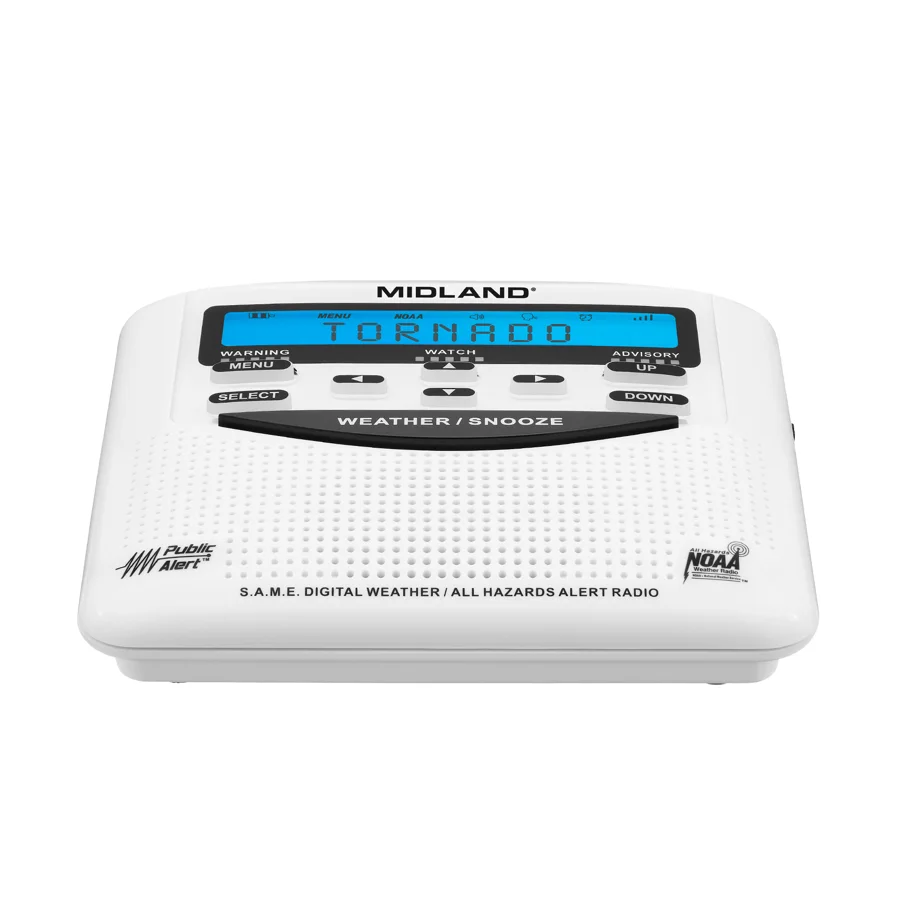
Information is the problem that feels smallest and messes up the most decisions. When the power and then the phone network go, a house guesses — about how long the outage will last, whether the storm has passed, whether the water is safe. A battery weather radio ends the guessing. The Midland WR120B receives all seven NOAA channels, uses S.A.M.E. local programming so it only alerts for your county, sounds a 90-decibel alarm for warnings, and runs on wall power with three AA batteries as the outage backup. Set it up on a calm day, program your county once, and it sits quiet until it matters. Keep the paper layer beside it: insurance and ID copies, the utility’s outage number, and the family contacts in a waterproof document pouch in the same drawer — the plan our forgotten-items list walks through item by item.
Relevant pickMidland WR120B Weather Radio
A battery weather radio ends the guessing: it receives all seven NOAA channels, sounds only for your county, and runs on wall power with three AA batteries as the outage backup.
All 7 NOAA channels · S.A.M.E. county alerts · 90 dB alarm
See the weather radio on Amazon
That radio is the top of a bigger chart. We have since worked the whole communications stack into its own pages: what to listen to in a blackout (NOAA, local AM/FM, FRS/GMRS, and ham listening, in tune-to order), how a family reaches each other when cell service is down (the out-of-area contact, texting rule, and meeting places), and satellite communicators compared for the layer that ignores the local network entirely.
What medical basics can a house honestly cover?
Medical gets a light touch on this page on purpose: a household outage plan covers small problems calmly, not serious ones bravely. The basics are a first-aid kit you have actually opened — most kits fail on never having been looked inside — plus each person’s prescription list and the buffer conversation with their doctor and pharmacist. The Be Smart Get Prepared 326-piece kit is the class of kit we mean: bandages, antiseptic, burn and blister care, a cold compress, and first-aid guides in a hard case, built to the OSHA and ANSI guidelines for workplaces and entirely at home in a hall closet. Anything beyond basics — chest pain, serious injury, a medicine emergency — is a call for help, outage or not, and no kit on this page pretends otherwise.
See the first-aid kit on Amazon
What do you do about the toilet, the trash, and the small fire?
Sanitation is the problem nobody puts on the poster, and the one that makes day two miserable when it is unplanned. If the water stops or the sewer backs up, a flushing toilet is done — the simple answer is a bucket toilet: the Reliance Luggable Loo is a 5-gallon bucket with a snap-on seat and lid, used with liners, tied off and treated like the trash it is. Beside it in the same corner of the garage: contractor trash bags (the outage makes more trash than a normal week, with no collection coming), the repair tape from the forgotten-items list, and the fire answer — because outage cooking and candles start fires. One rated extinguisher in or near the kitchen, where everyone can find it: the First Alert HOME1 is UL rated 1-A:10-B:C, rechargeable, and rated 4.8 stars across more than 46,000 reviews; the four-pack exists because the garage wants one too.
See the bucket toilet on Amazon See the extinguisher on Amazon See the repair tape on Amazon
The sanitation corner, gathered before day one
• 5-gallon bucket + seat, used with liners
• Contractor trash bags — an outage makes more trash
• One rated extinguisher, in or near the kitchen
Where does the water come from, and where do you stay warm?
The leftover problems are water and staying put. Water: one gallon per person per day, stored before the outage, because outage water advice that starts with filling containers assumes a warning you may not get. The container comparison covers the vessels and the water calculator sizes the gallons to your household; rain collection, for houses set up for it, is in our rain barrel comparison. Staying put: in a cold outage, close the house down to one warm room — doors shut, blankets out, everyone sleeping in the same room — rather than trying to heat the whole building; in a hot outage, the same room logic runs in reverse, toward the coolest room and the shade side. The freeze-protection guide covers what the cold does to the pipes while you do it. Most outages end with the household that planned these basics describing the whole thing as an inconvenience. That word is the goal.
Water stored ahead, and one room kept warm
Water: 1 gallon per person, per day — a family of four, three days: 12 gallons, stored before the outage
Cold outage: close the house down to one warm room — doors shut, blankets out, everyone sleeping in it
Hot outage: the same logic in reverse — the coolest, shade-side room instead
If your city lost power for 5 days, how would you survive without gas or a generator?
You survive five days without gas or a generator by solving the six problems on this page in order, with stores instead of power. Nothing in the first days needs electricity. It needs food that is already cold or needs no cooking, water that is already in the house, light and news that run on small batteries, and a toilet plan that does not depend on the water staying on. Five days is longer than the hours-to-two-days outage this page mostly plans for, so the honest version is stricter: ration from hour one, not from day three.
Start with the clock you cannot pause. A closed refrigerator holds safe temperatures for about 4 hours, a full freezer for about 48 hours, and a half-full freezer for about 24 — so the eating order is fridge food first, freezer food next while it is still frozen solid, and pantry food that needs no cooking last. Water is arithmetic, not a guess: one gallon per person per day means a family of four needs 20 gallons to cover five days for drinking and basic sanitation, plus extra for pets and flushing. If that water is not stored before the outage, the plan is already short, which is why the container comparison and the water calculator sit ahead of any gadget on this site.
The rest is staying put and staying informed. Close the house down to one room — the warmest in winter, the coolest and shadiest in summer — and sleep in it together rather than trying to hold the whole building. A battery weather radio covers the news problem for days on a set of AAs. Phones stay on low-power mode and get charged only if a battery bank or a car run makes that honest. The bucket toilet with liners covers sanitation when flushing stops. And the caveat from the section below still holds: a five-day citywide outage carries an evacuation decision in it, and making that decision early — while the car, the roads, and your options still work — is a plan, not a failure.
The day-by-day version of exactly this — what to do on day one, what changes by day three, and where the near-zero budget runs out — is our five days, no generator playbook. Read it on a calm day. Five days in, with cold food gone and the house dark, is the wrong time to meet it for the first time.
How do you prepare for a major outage on no budget, when the well pump needs electricity?
On no budget, you prepare for the well pump by accepting the hard part first: there is no free way to run it. Most home well pumps need a generator in the 5,000 to 7,500 watt class with a 240-volt outlet — that is a purchase, a borrow, or a neighbour, not a trick. What costs nothing is making the water you already have in the house last until one of those arrives, and that work is done before the outage, not during it. Our page on what size generator runs a well pump carries the pump numbers; this is the zero-dollar half of the same problem.
When a storm is forecast, fill everything. The bathtub, every pot and bottle, the buckets in the garage — containers you already own are the no-budget version of the water shelf. Fill freezer bottles too and tuck them around the food; they help the freezer hold while they wait to become drinking water. Then, from hour one, spend water in the right order: stored clean water for drinking and cooking first, tub and bucket water for washing and for flushing — a toilet can be flushed by pouring a bucket of water into the bowl, as the questions below note — and the small amount sitting in the pressure tank is the first to go, not a reserve to plan around.
The rest of the no-budget plan is the playbook this page is built on, with the spending stripped out. Eat in order — fridge food first inside its 4-hour window, freezer food while it is still frozen solid, pantry food that needs no cooking last. Close the house down to one room and stay put. Keep phones on low-power mode and save the charges you have. A bucket toilet with liners covers sanitation if flushing stops altogether. None of that needs a purchase; all of it needs doing on purpose from the first hour instead of the third day.
The day-by-day version, priced at near-zero, is our five days, no generator playbook — written for exactly this house. And when a little money does free up, spend it in this site’s order, not a sale page’s: containers and stored water first, with the water storage calculator sizing the gallons, the bucket and bags gathered into one corner, and the generator question last, sized to the pump you actually own.
What should you be honest about?
Three honest caveats. First, never run a generator, grill, or camp stove indoors or in a garage — carbon monoxide is the outage injury that kills, which is why the battery CO alarm sits on the forgotten-items list and why every cooking option we score is indoor-rated or labeled outdoor-only. Second, this page plans for the common outage — hours to two days. A week-long regional outage is a different plan with an evacuation decision in it, and making that decision early is a plan, not a failure. Third, food times are ceilings, not targets: when in doubt about refrigerated food after the 4-hour mark, throw it out. No saved grocery bill is worth the alternative.
Three more worth a look
Not reviewed or scored — listed because readers cross-shop them, with the same disclosure as everything here.
EcoFlow DELTA 2
The original 1 kWh EcoFlow — the step between a phone bank and the 2 kWh fridge-class stations above.
MPOWERD Luci Original Solar Lantern
A solar lantern that charges on a windowsill — light for the room everyone gathers in, with no battery drawer involved.
Goal Zero Lighthouse 600
The lantern that topped our emergency-lights comparison — the one-light answer for the kitchen table.
As an Amazon Associate, Ordinary Prepper earns from qualifying purchases. The three products above have not been reviewed or scored.
Frequently asked questions
What should you do first when the power goes out?
Check whether it is just your house (look at the neighbors, then your breaker panel), keep the fridge and freezer doors shut, and switch on one battery light. Then report the outage to your utility and put phones on low-power mode. Everything else on this page is hour two onward.
How long does food last in a fridge without power?
About 4 hours in a closed refrigerator, about 48 hours in a full closed freezer, and about 24 hours in a half-full freezer. After those windows, perishable food that has warmed up should be thrown out — when in doubt, throw it out.
When do fridge and freezer temperatures actually become a problem?
The fridge is the emergency; the freezer is not. One reader’s 12-hour blackout took a fridge from 40°F to 50°F and a full freezer from 2°F to 17°F by 6 a.m., and those two numbers are opposite stories. A closed fridge holds safe temperatures for about 4 hours, so a fridge sitting at 50°F crossed the line hours before the reading — the perishables that warmed with it are the throw-it-out kind. A freezer at 17°F is still frozen solid, and a full closed freezer holds about 48 hours: days of margin, not hours.
That gap is why staging beats buying. Before a forecast storm, freeze water bottles and tuck them around the food — a fuller freezer holds longer, where a half-full one gives you about 24 hours — and put a cheap thermometer in the fridge, so the 4-hour clock is a reading rather than a guess. Then leave both doors shut: every look inside spends the margin you just banked.
How big a power station does a house need for an outage?
For the common load — fridge, lights, phones, router, and one medical device — the 2 kilowatt-hour class covers about a day, and a 1 kilowatt-hour station covers an evening of everything except long fridge runs. Our home power sizer runs the math on your own appliance list.
Can you run a generator in the garage with the door open?
No. Generators belong outdoors, well away from windows and doors, with the exhaust pointed away from the house — garage use, even with the door open, is a leading cause of outage carbon monoxide deaths. A battery CO alarm on every level is the backstop, not the permission.
What do you do if the toilet will not flush?
If water pressure remains, a toilet can be flushed by pouring a bucket of water into the bowl. If the water or sewer is out, switch to a bucket toilet with liners — a 5-gallon bucket with a snap-on seat — and bag and bin the waste like trash until service returns.
How much water should you store for an outage?
One gallon per person per day for drinking and basic sanitation. Three days is the floor for an outage plan and two weeks is the comfortable target — 12 gallons for a family of four at three days, plus extra for pets and for flushing.
Which problem do you fix first?
The one your house fails cheapest. For most houses that is information (a weather radio and the paper plan) or sanitation (the bucket, liners, and bags already in the garage, gathered into one corner). Then food you can eat with no cooking, then the power layer sized by the sizer rather than by a sale page. Walk the whole house once with the room-by-room audit, keep the supplies honest with the household emergency checklist, and see every shelf of the system on the Home Readiness hub.
Talk it over with other homeowners. If the last outage at your house turned on one of these six problems going wrong — the toilet, the news blackout, the warm fridge — tell the group which one it was, because that is the order the next household should fix theirs in. The Ordinary Prepper Community on Facebook is where readers compare outage plans, show their setups, and help decide what we research next. Join the group →